
Reviewed · TIVOLI DAY TRIPS
Tivoli: Entrance Ticket to Villa Adriana & App Audioguide
Hadrian’s Villa is one of the most impressive Roman sites outside Rome: a sprawling country retreat where an emperor built baths, libraries, theaters, pools, gardens, and private rooms on a scale that feels closer to a small city than a villa. You walk through more than 30 ancient structures spread across roughly one square kilometer, with plenty still waiting below the ground.
I like the freedom of the self-guided format, since you can linger over mosaics or move quickly past areas that interest you less. I also like the chance to see the Maritime Theatre and Canopo, two very different spaces that show both Hadrian’s love of privacy and his taste for grand display. The main drawback is that transportation and a live guide are not included, so you must arrange your own way to Tivoli and rely on the app audioguide.
In This Review
- Key points to know before you go
- Why Hadrian built a city-sized villa in Tivoli
- Starting at the Villa Adriana ticket office
- The Maritime Theatre and Hadrian’s private side
- Canopo, statues, and the Serapeum grotto
- Mosaics, baths, and the craft behind the grandeur
- Walking the one-square-kilometer grounds
- What the digital audioguide adds
- Is $19 good value?
- Who will enjoy this visit most
- Should you book Villa Adriana?
- FAQ
- How long is the Villa Adriana ticket valid?
- Is transportation to Villa Adriana included?
- Is a guided tour included?
- Where do I start the activity?
- Can I bring a suitcase or large backpack?
- Do I need to pass through security?
- Can I cancel the booking?
Key points to know before you go

- The Maritime Theatre has a circular portico, a pool, and an artificial island once used as a private retreat within the retreat.
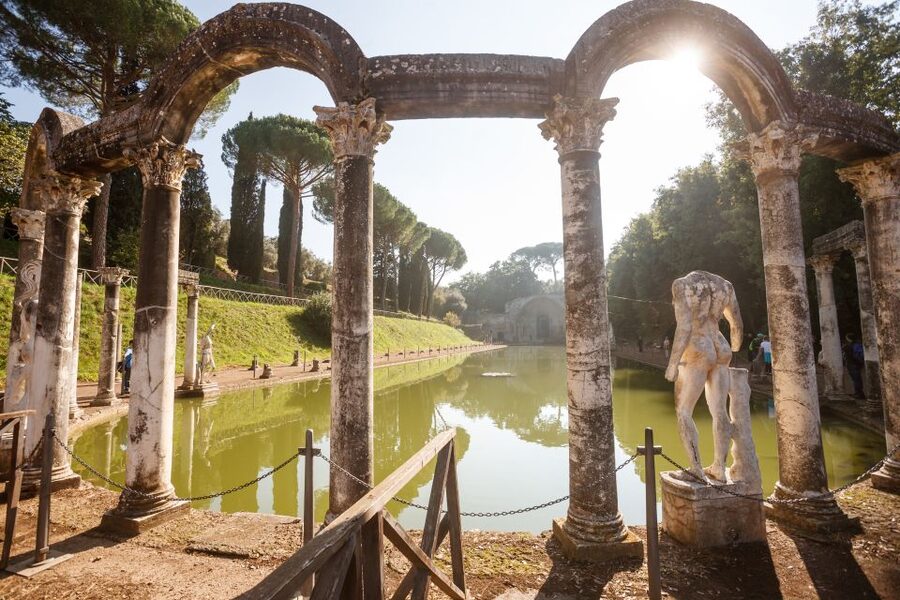
- The Canopo pool offers one of the site’s grandest views, with sculptures arranged around a huge rectangular basin.
- Roman mosaics and baths give you a closer look at the craftsmanship behind the grand ruins.
- The grounds are extensive, so comfortable shoes and at least two hours will make the visit much more pleasant.
- The ticket is valid for one day, with a digital audioguide included but no live guide or transport.
- Large bags are not allowed, and you must exchange your printed voucher at the Villa Adriana ticket office.
Why Hadrian built a city-sized villa in Tivoli
The emperor Hadrian ruled the Roman Empire from AD 117 to 138, and this estate became his country residence outside Rome. The site was not simply a large private house. It included spaces for government, ceremony, relaxation, worship, bathing, study, and entertainment.
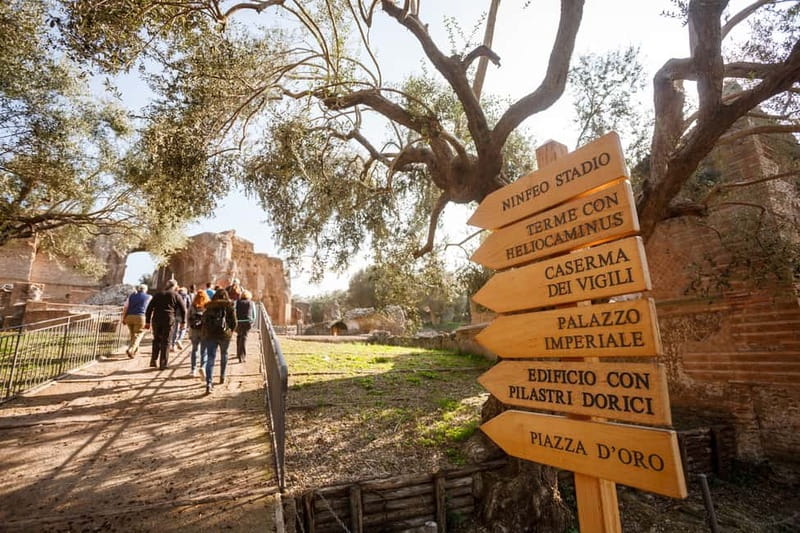
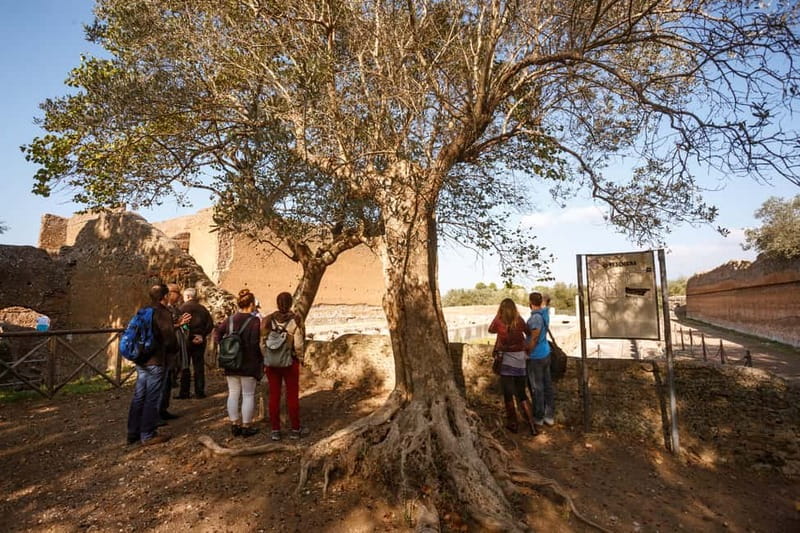
The scale is the first thing you notice. Instead of moving from room to room in a compact museum, you walk outdoors between separated buildings and ruined walls. The property covers about one square kilometer, and more than 30 structures have been identified. Much of the site has not been excavated, which gives the visit an unusual sense of possibility. The visible ruins are already vast, yet they represent only part of what once stood here.
Hadrian reportedly disliked living on Rome’s Palatine Hill, so he created a retreat where he could control the setting around him. That detail helps explain the villa’s variety. It was designed as a world apart, with long approaches, water features, formal spaces, and private corners.
I find the place most rewarding when you stop treating it as a collection of broken walls. Look at the planning. Straight walls remain remarkably precise, while curved structures and domes show how confidently Roman builders handled difficult forms. Even in a ruined state, the site makes Roman engineering feel practical rather than abstract.
More Tivoli day trips:
- From Rome: Villa D’Este and Hadrian’s Villa Tivoli Day Tour
★ 4.5 · 2,060 reviews - Tivoli Full Day Trip from Rome: Hadrian’s Villa and Villa D’Este
★ 4.5 · 1,730 reviews - Hadrian’s Villa and Villa d’Este Half-Day Trip from Rome
★ 3.5 · 808 reviews
Starting at the Villa Adriana ticket office
Your visit begins at the Villa Adriana ticket office. You need to exchange the printed voucher there before entering, so do not rely only on having the booking stored on your phone.
The ticket provides entry for one day and is intended to help you skip the ticket line. You will still pass through a security check, and the ticket office exchange remains part of the process. Keep this in mind when planning your arrival. A shorter ticket queue does not mean you can walk straight through without stopping.
Large bags, suitcases, and rucksacks are not permitted inside the attraction. Pack lightly, since a small day bag is a safer choice than arriving with luggage. The available information does not specify storage arrangements, so do not assume that a large bag can be left at the entrance.
There is no included transportation from Rome or elsewhere. You must make your own way to Tivoli and reach the entrance independently. That makes this ticket best suited to people who already have a plan for getting to the site, rather than anyone looking for a door-to-door outing.
The Maritime Theatre and Hadrian’s private side

Make the Maritime Theatre one of your first major stops. Its name can be misleading. This is not a theater in the usual sense, but a circular portico surrounding a pool with an artificial island at its center.
The round design is striking even in ruins. A barrel vault rests on pillars around the perimeter, creating a sheltered ring. Within this private complex were a lounge, a library, heated baths, three suites with heated floors, a washbasin, an art gallery, and a large fountain.
The island helped make the space feel separate from the rest of the villa. Hadrian could withdraw here without leaving his estate. It is an especially useful place to think about how Roman luxury worked. Comfort came from engineering: heated floors, controlled water, enclosed rooms, and carefully planned circulation.
You may find the Maritime Theatre more powerful than the larger ruins because its design is easy to read. The pool, ring, and island give you a clear picture of the original arrangement. Take time to look at the shape rather than rushing through for a photograph.
Canopo, statues, and the Serapeum grotto
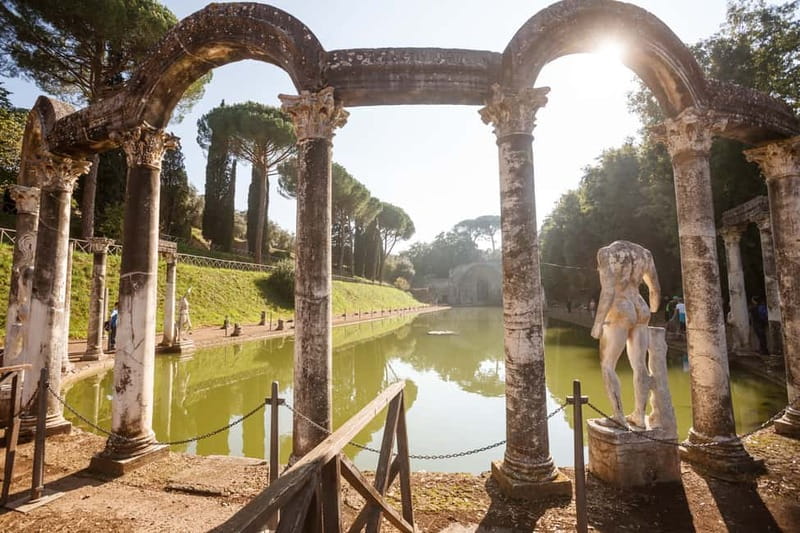
The Canopo is the villa’s grand showpiece. This huge rectangular pool was surrounded by sculptures, creating a formal water court that must have made a powerful impression in its original condition.
The sculptures connect the site to Greek and Egyptian themes. The artificial grotto of the Serapeum sits at the far end of the pool and adds a theatrical finish. Water, statues, architecture, and ceremony all come together here, making the Canopo a fine place to understand Hadrian’s taste for borrowing ideas from across the empire.
You will also see marble statues of Antinous, Hadrian’s deified lover. Their presence adds a personal note to an otherwise highly controlled imperial setting. The statues are not just decorative objects. They help you connect the monumental estate to the people and relationships around Hadrian.
The Canopo area is also one of the best places to slow down. The grounds are broad, and the scale can become tiring if you try to absorb every wall and building at the same speed. Use the audioguide to decide which areas deserve close attention, then give yourself time to look around without constantly checking the next stop.
More Rome tours worth comparing
- Rome: Colosseum & Forum with Audio Guide App -Optional Arena
★ 4.2 · 24,770 reviews - Rome: St. Peter’s Basilica & Dome Entry Ticket & Audio Tour
★ 4.2 · 7,537 reviews - Vatican & Sistine Chapel Ticket with Optional Audio Guide
★ 4.1 · 5,405 reviews - Rome: Colosseum, Forum, & Palatine Hill with Audio Guide
★ 4.3 · 4,591 reviews
Mosaics, baths, and the craft behind the grandeur
Hadrian’s Villa is famous for scale, but the smaller details often make the visit memorable. Mosaics from the theater and baths offer a closer look at the materials and decoration used inside the complex.
Mosaics can be easy to overlook when you are surrounded by enormous walls and open courtyards. I recommend making a deliberate stop whenever you see them. Their surviving patterns show the care that went into areas meant for bathing, entertainment, and daily use.
The bath areas also explain why the villa required such advanced planning. Heated floors, washbasins, fountains, and water channels were part of the experience, not rare extras. The remains help you picture the villa as a working residence rather than a set of empty ceremonial rooms.
One especially praised feature is the engineering. Walls remain strikingly straight, and curved structures retain their strength and clarity. The surviving domes and rounded rooms show how Roman builders combined mathematical control with a sense of drama.
Walking the one-square-kilometer grounds
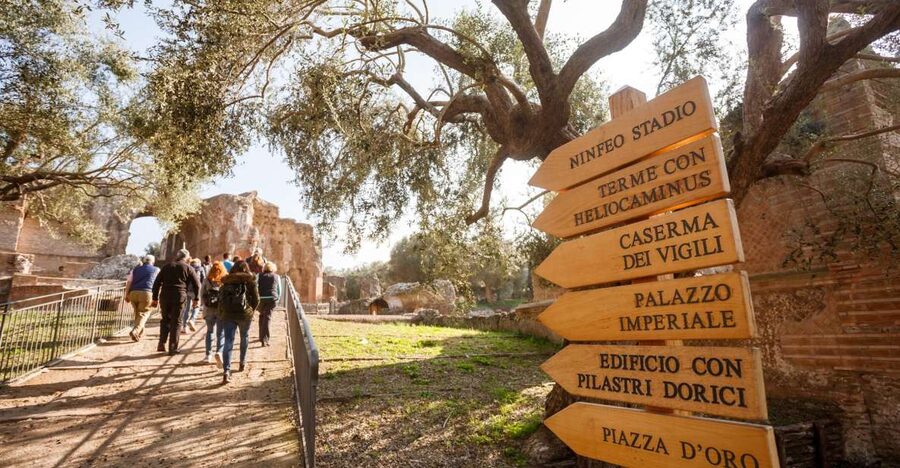
This is a walking visit, not a compact indoor attraction. You will cover open ground between ruins, courtyards, pools, and buildings, and the site can easily take at least two hours.
That minimum is useful for planning, but it is not a strict target. If Roman architecture is a major interest, you may want longer. If you are combining the visit with other stops in Tivoli, two hours gives you a reasonable first look without trying to study every ruin.
The grounds reward a steady pace. You can begin with the most recognizable monuments, then use the audioguide to add context as you go. Since the property is so large, avoid treating every remaining wall as equally important. The app can help you focus on the structures that best explain the villa’s purpose.
Wear comfortable shoes. The information provided does not describe every surface or condition, so I would plan for an outdoor archaeological site rather than a polished museum. Give yourself time between highlights, and do not schedule something immediately afterward if you dislike being rushed.
The partly unexcavated areas are worth noticing. They remind you that the villa is not a finished archaeological picture. What you see is substantial, but the ground still hides more of the original estate.
What the digital audioguide adds
The digital audioguide is included with admission, and it gives you a way to understand the ruins without joining a scheduled live tour. That suits independent visitors who want to set their own pace.
An audioguide is especially useful here because the villa’s size can make the site feel confusing at first. A wall, pool, or portico becomes more meaningful when you know whether it served a private, ceremonial, bathing, or decorative purpose.
The tradeoff is that you do not have a guide beside you to answer questions or adjust the explanation to your interests. If you want a personal discussion of Roman architecture or Hadrian’s life, this ticket will feel basic. If you prefer quiet exploration and control over your timing, it is a sensible choice.
You can also create and send a Pemcard, a digital photograph that can be delivered as a real postcard anywhere in the world. The instructions are provided separately, so follow them carefully if you want to use this feature. It is a small extra, but a fitting way to share a photograph of the Canopo or the Maritime Theatre.
Is $19 good value?
At $19 per person, this is a reasonably priced way to enter one of Lazio’s major Roman archaeological sites. The value comes from the size of the estate and the included audioguide, not from added services. You are paying for access and basic interpretation, while transport, a live guide, and other personal expenses remain your responsibility.
I consider it good value if you are comfortable arranging your own route to Tivoli and walking independently. The ticket gives you a full day of validity, so you are not forced into a short timed visit once inside. That flexibility matters at a site where you may want to pause, backtrack, or spend more time at the pools and mosaics.
The price is less attractive if you expect a complete excursion from Rome. Since no transportation is included, compare the total cost of reaching Tivoli with the price of a guided day trip before booking. The ticket itself is affordable, but it is only one part of the outing.
Free cancellation up to 24 hours before the visit and the reserve-now, pay-later option add useful flexibility. These terms can help if your plans around Rome are still changing, but check the conditions at booking.
Who will enjoy this visit most
I recommend Villa Adriana to anyone who has already seen some of Rome’s central monuments and wants a quieter setting with more room to think. It is also a strong choice for visitors who enjoy Roman engineering, ancient architecture, water systems, sculpture, and archaeology.
The site suits independent adults, history-focused families, photographers, and anyone who prefers a self-guided day. The broad grounds give you space away from Rome’s tighter streets, while the major monuments provide enough structure for a worthwhile visit.
It may be less suitable for people who dislike walking, want constant explanation, or have only a short window in Tivoli. The villa is not a quick room-by-room attraction. Its rewards build as you connect the separate areas into a picture of an imperial retreat.
The experience also works well for anyone seeking a break from Rome’s crowds. The countryside setting and open ruins create a different mood from the Colosseum or Palatine Hill, while still giving you direct contact with the Roman world.
Should you book Villa Adriana?
Book this ticket if you want a flexible, affordable visit to a large Roman estate and are happy to arrange transportation yourself. The Maritime Theatre, Canopo, Serapeum grotto, mosaics, statues, and baths give you plenty to see, while the audioguide supplies enough structure for a solo visit.
Choose a different option if you need a live guide or door-to-door transport. For everyone else, $19 is a fair price for access to a remarkable site, provided you bring the printed voucher, leave large luggage behind, and allow at least two hours for the walk.
FAQ
How long is the Villa Adriana ticket valid?
The ticket is valid for one day. Check availability for the offered starting times.
Is transportation to Villa Adriana included?
No. Transportation is not included, so you must arrange your own way to the site in Tivoli.
Is a guided tour included?
No. The package includes entry to Villa Adriana and a digital audioguide, but not a live guided tour.
Where do I start the activity?
Start at the Villa Adriana ticket office, where you must exchange your printed voucher before entering.
Can I bring a suitcase or large backpack?
No. Rucksacks, suitcases, and large bags are not permitted inside the attraction.
Do I need to pass through security?
Yes. You must pass a security check before entering Villa Adriana.
Can I cancel the booking?
Yes. You can cancel up to 24 hours in advance for a full refund. A reserve-now, pay-later option is also available.
Newest reviews from Rome
- ROME:Colosseum & Ancient Rome – private/small group TOUR★ 5.0 · 24 reviews
- Off the Beaten Track in Rome: Rione VI Parione Private Tour★ 5.0 · 24 reviews
- Cinematic Photoshoot in Rome★ 5.0 · 24 reviews
- Rome: Best of Colosseum and Roman Forum Small Group Guided Tour★ 4.5 · 24 reviews
- The Labyrinth of Rome between catacombs and ancient quarries★ 4.5 · 24 reviews
- Vatican and Trionfale Market Tour with Wine and Food Tasting★ 5.0 · 24 reviews
- private tour: Vatican Museums, Sistine Chapel, St. Peter’s Basilica★ 4.5 · 24 reviews
- Skip the Line: Vatican Wheelchair Accessible Private Tour★ 5.0 · 24 reviews
Tivoli Day Trips, compared.

Villa D’Este and Hadrian’s Villa Tivoli Day Tour
Read our review →
Tivoli Full Day Trip from Rome: Hadrian’s Villa and Villa D’Este
Read our review →
Hadrian’s Villa and Villa d’Este Half-Day Trip from Rome
Read our review →
Tivoli Villas Full Day Trip From Rome with Lunch
Read our review →
Villa d’Este and Hadrian’s Villa Tour with Lunch
Read our review →
Villa D’Este & Villa Adriana Pass & App Audioguide
Read our review →
Tivoli Day Trip with Villa d’Este and Villa Adriana
Read our review →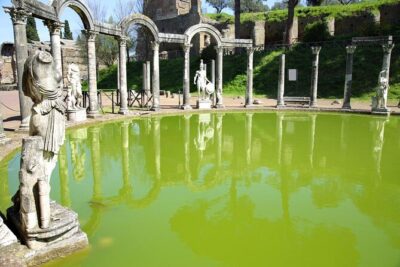
Tivoli Day Tour from Rome : Hadrian’s Villa and Villa D’Este
Read our review →Browse the lists this tour appears in