
Reviewed · WORKSHOPS
Ancient Mosaic Workshop in Rome
The best part of this Rome workshop is that you do not just look at ancient mosaics. You learn how their small marble pieces are cut, placed, and shaped, then make a personal 7-by-5-inch mosaic of your own. The studio’s connection with restoration work in Pompeii and Byzantine churches gives the lesson real weight.
I like two things here: the small group, capped at seven, and the calm, patient teaching. Instructors such as Eleonora, Renato, Giuliana, and Alex guide beginners without making the class feel childish. The main consideration is time: two and a half hours is a serious block in a busy Rome schedule, and the $107.68 price is not a bargain activity.
In This Review
- Key points to know before you book
- Why make a mosaic in Rome?
- Arriving at Studio Cassio on Via Urbana
- The opening lesson: Roman techniques before tools
- Cutting marble and building your design
- A calm break from Rome’s crowded sights
- Finishing, framing, and packing your artwork
- What the $107.68 price really covers
- Who will enjoy this workshop most?
- Smart planning for your Rome day
- Should you book the Ancient Mosaic Workshop?
- FAQ
- Where does the Ancient Mosaic Workshop take place?
- What time does the workshop start?
- How long does the experience last?
- What language is the workshop offered in?
- What will I make during the class?
- Are materials and tools included?
- Can I take my mosaic home?
- What is the minimum age?
- Is transportation included?
Key points to know before you book
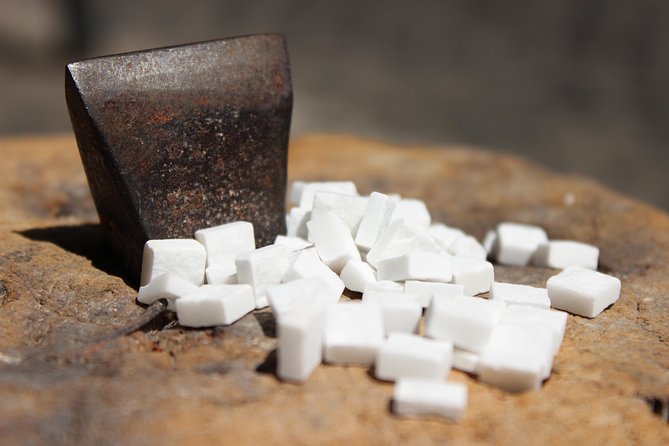
- You cut real local marble: Tools and high-quality natural stone are supplied, so this is hands-on work rather than a simple decorating class.
- You take home a finished piece: Your mosaic goes into a frame and is packed in a sturdy box for the journey home.
- The teaching connects art with Roman sites: You learn design principles and techniques that can help you notice mosaics differently in museums, churches, Pompeii, and the Vatican.
- The group stays very small: A maximum of seven people allows the instructors to give practical help while you work.
- The afternoon timing is fixed: The workshop starts at 2:00 p.m. and ends back at Studio Cassio.
- It suits beginners and older children: The minimum age is 12, and children must be accompanied by an adult.
Why make a mosaic in Rome?
Rome can fill a day with famous sights. The Colosseum, Forum, and Vatican are essential, but they place you in the role of observer. This workshop changes the pace. For a couple of hours, you sit down, handle stone, and pay close attention to how a picture is built one tiny piece at a time.
That shift matters. After working with marble, you begin to see old mosaics differently. You notice the direction of the pieces, the spacing between colors, the way an artist suggests movement, and the patience needed to create a smooth curve. The activity gives you a practical key to an art form you may otherwise rush past in a church or museum.
The workshop also gives you a souvenir with a personal story. It is not a mass-produced tile bought from a street stall. You select materials, work through a design, receive help from a trained instructor, and leave with something you made yourself. It will not replace a professional Roman mosaic, and it does not need to. Its value is in the connection to your afternoon in Rome.
More Rome tours worth comparing
- 3 in 1 Cooking Class near Navona: Fettuccine, Ravioli & Tiramisu
★ 5.0 · 7,376 reviews - Rome: Pasta & Tiramisu Class with Fine Wine by the Vatican
★ 4.9 · 4,852 reviews - Rome: Pasta Making Class with Wine, Limoncello, and Dessert
★ 4.9 · 3,177 reviews
Arriving at Studio Cassio on Via Urbana
Your meeting point is Studio Cassio, Arte del Mosaico, at Via Urbana 98 in Rome. You make your own way there, since transportation is not included. The studio is near public transportation, which makes it practical to reach, but you should still allow enough time to find the address and arrive ready for the 2:00 p.m. start.
Via Urbana gives the afternoon a neighborhood feel rather than a grand museum entrance. One useful advantage is that the activity ends at the same place where it begins. You do not need to work out a second meeting point or arrange a ride across town when the class is finished.
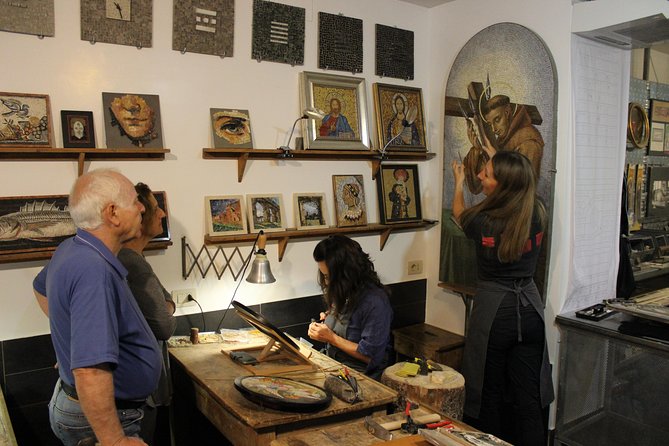
The studio itself adds to the lesson. There are works on display, including pieces connected with the artists’ restoration work. You might find yourself looking at those examples before you start, trying to understand how a professional handles a face, border, or curved line. That visual context helps explain why the basic exercises matter.
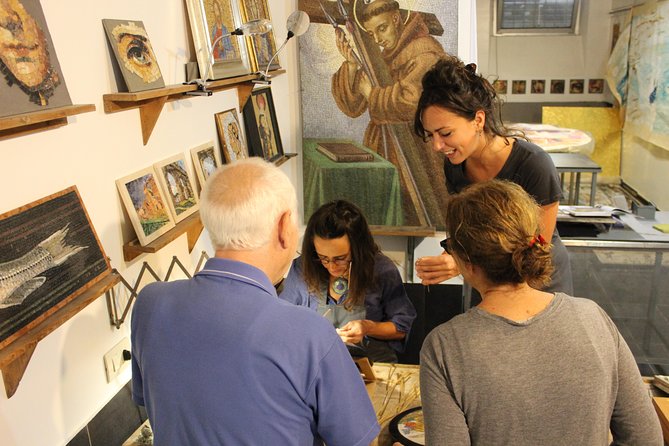
The maximum group size is seven. That number is small enough for direct assistance, especially when you are learning to handle unfamiliar tools. It also means the workshop may feel more like a class in an artist’s studio than a large sightseeing activity.
The opening lesson: Roman techniques before tools
The class begins with an introduction to mosaic history and technique. This is not just background padding before the craft starts. The instructors explain how Roman mosaics are designed and why the placement of pieces matters.
You learn the principles behind a traditional composition, including the use of texture and direction. The goal is not simply to fill a shape with colored squares. You are shown how the arrangement of pieces can help form an image and create a more convincing surface.
The instructors’ professional work adds useful context. They have experience with mosaic restoration, including work associated with Pompeii and Byzantine churches. That connection helps place the small project within a much larger tradition. You are learning a compact version of a craft that has been used for public buildings, religious spaces, and decorative floors for centuries.
The lesson is presented in English. The tone appears suited to people with no art background, but it can still hold the attention of experienced artists. You are not expected to arrive with special skills. Patience and a willingness to work carefully matter more than drawing ability.
I especially like that the class does not treat art as a talent test. You are guided through the decisions, and the instructors help you improve the result as you go. That makes it a good choice for someone who says I am not artistic but still wants to try something with their hands.
Cutting marble and building your design
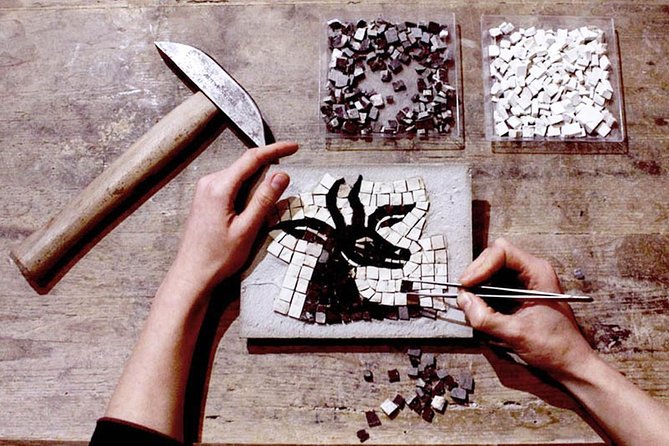
After the introduction, you choose or work from a traditional pattern. The available designs are based on ancient mosaics, including examples connected with Pompeii. You then select from different colors of marble and begin planning the textures and direction of your composition.
The practical work starts with cutting the marble tiles. All necessary tools are supplied, along with high-quality natural local marble. This is the part that separates the workshop from a simple tile-pasting activity. You are handling actual stone and learning how small pieces can be shaped to fit a design.
Do not expect to finish instantly. Cutting and placing mosaic pieces takes concentration. The work can feel slow at first because your eye must judge size, angle, color, and spacing at the same time. That slowness is part of the point. Rome often asks you to hurry from one major sight to the next, while this class rewards careful attention.
Your instructor remains available as you work. The help is practical: choosing a color, improving a line, adjusting a piece, or making the overall design look more balanced. You still create the piece yourself, but you do not have to struggle alone with every decision.
The class uses the indirect mosaic method for the project. That gives you a chance to see how a traditional composition is planned and assembled before it becomes a finished framed artwork. The result is intended to follow Roman design principles, not simply your first instinct with the materials.
A completely different way to spend the day in Rome:
- Vatican: Museums & Sistine Chapel Entrance Ticket
★ 4.5 · 144,003 reviews - Vatican Museums & Sistine Chapel Tour with Optional Basilica
★ 4.3 · 67,413 reviews - Vatican Museums, Sistine Chapel & St Peter’s Basilica Guided Tour
★ 4.5 · 39,149 reviews - Rome: Colosseum, Palatine Hill and Roman Forum Guided Tour
★ 4.8 · 32,814 reviews
A calm break from Rome’s crowded sights
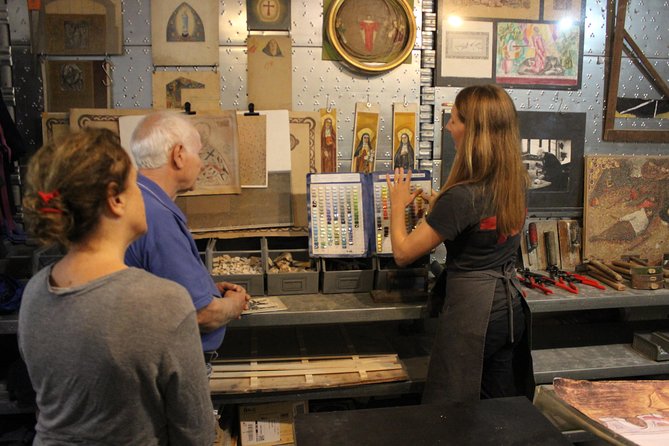
The workshop lasts about two hours and 30 minutes, beginning at 2:00 p.m. That makes it a useful afternoon pause after a morning of monuments, churches, and long walks. Some people may appreciate the chance to sit in an air-conditioned studio and concentrate on a quiet task.
Coffee, tea, and bottled water are included. These are modest additions, but they make the long seated session more comfortable. Do not treat the workshop as a meal, though. If you need lunch or a substantial snack, plan that separately.
One appealing detail is the studio’s relaxed atmosphere. You can work while talking with the instructor and other members of your small group, or focus quietly on your own piece. The activity works for solo visitors, couples, families, and friends because the project is individual even when the lesson is shared.
A nearby lunch option has also been useful for people planning the afternoon, but the workshop itself does not include food beyond coffee, tea, and water. Since the start time is fixed, I would eat beforehand or plan a meal for after the class rather than count on refreshments to carry you through the day.
Finishing, framing, and packing your artwork
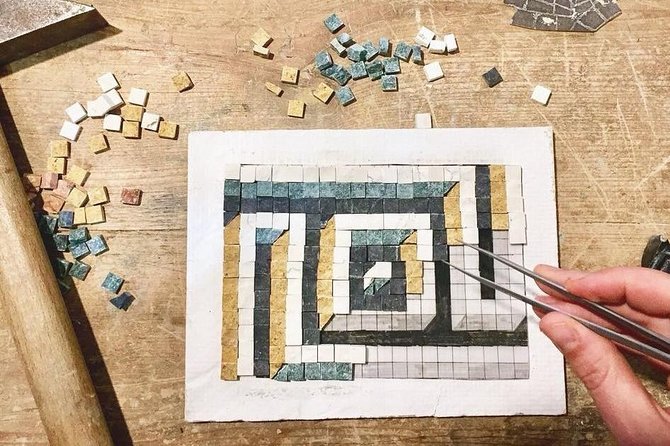
By the end, you have your own mosaic creation. The artwork is made in a frame, giving it a ready-to-display format rather than leaving you with a loose collection of tiles. It is then placed in a sturdy box to protect it during your trip home.
That packaging is important. A fragile souvenir can become a nuisance when you still have trains, flights, or several hotel changes ahead. The box does not make the piece indestructible, so you should still pack it with care, but it is a sensible inclusion.
The finished work will reflect your experience level. A professional studio piece may have finer detail and more exact lines. Your own mosaic is better understood as a handmade record of your time in Rome. The instructors’ guidance helps you produce something attractive, but they do not erase the personal character of the work.
Many people find the activity surprisingly absorbing. Once the design takes shape, you can lose track of time while fitting the pieces together. That focus is one reason this class appeals even to people who do not normally choose art activities. You leave with a physical object and a clearer sense of the labor behind the mosaics you have seen around Italy.
What the $107.68 price really covers
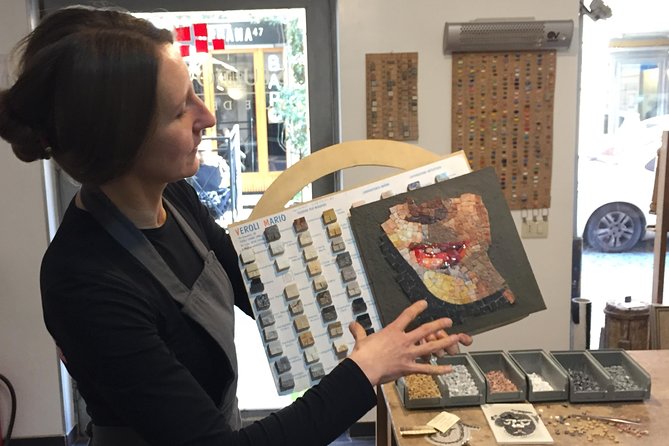
At $107.68 per person, this is a premium small-group activity. The price is not simply paying for entry to a studio. It includes the instruction, use of tools, local marble, a frame, protective packaging, refreshments, and your finished artwork.
The value depends on what you want from Rome. If you are looking for the least expensive way to fill two hours, this will not be the right pick. You can visit many churches and see mosaics without paying for a class. If you want a guided craft lesson and a personal souvenir, the package makes more sense.
The small group also matters. With no more than seven people, the instructors can watch how you work and offer specific advice. A cheaper class with a large group might provide materials but less individual attention. Here, the guidance is a central part of what you are buying.
I would think of the cost as a combined museum lesson, craft session, and souvenir. That does not make it inexpensive, but it makes the comparison fairer. The experience is strongest for someone who values personal instruction and wants to understand the technique, not just collect another object.
The 5 out of 5 rating from 160 reviews and the 99 percent recommendation rate suggest a very consistent response. The praise centers on the instructors’ patience, warmth, and ability to explain the craft clearly. Those qualities are especially important here because the tools and materials may be unfamiliar.
Who will enjoy this workshop most?
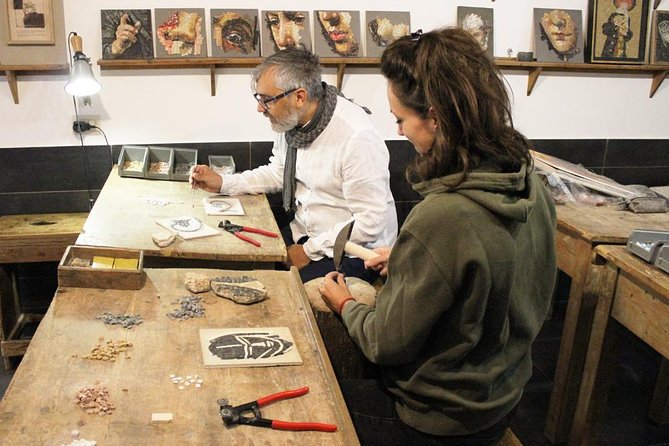
This is a good match for adults, teenagers aged 12 or older, couples, families, solo visitors, and anyone curious about historic crafts. Children must be accompanied by an adult, so a parent can take part alongside a 13-year-old or older child.
It works particularly well for:
- Art lovers who want to understand how mosaics are made
- History-minded visitors who want more context for Roman and Byzantine decoration
- Families seeking an activity beyond monuments and museums
- Solo visitors who prefer a guided project to a sightseeing group
- People who want a useful, packable souvenir
- Beginners who feel uncertain about taking an art class
You do not need previous mosaic experience. The instruction is designed for novices, while the choice of patterns and materials gives more experienced artists something to think about.
This may be less suitable if your Rome schedule is tightly packed or if you dislike seated, detailed work. The project asks for patience. It is also not a quick drop-in activity, since the fixed 2:00 p.m. start and 2.5-hour duration shape the rest of your day.
Service animals are allowed, and most participants can take part. The supplied information does not give further accessibility details, so if you have specific mobility or workspace needs, contact the provider before booking.
Smart planning for your Rome day
I would place this workshop early in your Rome stay if you can. Once you have learned how pieces are cut and arranged, mosaics in churches and museums become more interesting. You begin to look for the design choices rather than seeing only a colorful surface.
The activity ends at the starting point, so it is easy to pair with nearby plans. You could schedule it as a slower afternoon after morning sightseeing, but avoid placing a major timed attraction immediately afterward. The class is listed as approximately two hours and 30 minutes, and careful work can make the end of an artistic session feel less rigid than a museum visit.
Book ahead if this is important to your schedule. It is booked an average of 37 days in advance, and the seven-person limit keeps capacity low. Confirmation arrives when you book, and the mobile ticket is convenient for getting to the studio without printing paperwork.
Cancellation is flexible up to 24 hours before the local start time, with a full refund. Changes or cancellations made within 24 hours are not accepted for a refund, so check your Rome plans before that deadline.
Should you book the Ancient Mosaic Workshop?
I would book it if you want Rome to be more than a list of famous buildings. The strongest reasons are the small group, the patient instruction, the connection to restoration work, and the fact that you leave with a framed piece made from natural local marble.
I would skip it if you are watching every euro, dislike crafts, or have only a short time in Rome. At $107.68, this is not a casual filler activity. But for a family, couple, solo visitor, or older child who enjoys making things, it offers a rare chance to understand an ancient art by practicing it.
Book it near the start of your trip if possible. Then, when you spot mosaics in the Vatican, Roman churches, museums, or archaeological sites, you will have a better eye for the work behind them. That lasting change in how you see Rome is the real payoff.
FAQ
Where does the Ancient Mosaic Workshop take place?
It takes place at Studio Cassio, Arte del Mosaico, at Via Urbana 98, 00184 Rome, Italy.
What time does the workshop start?
The workshop starts at 2:00 p.m.
How long does the experience last?
The activity lasts approximately two hours and 30 minutes.
What language is the workshop offered in?
The workshop is offered in English.
What will I make during the class?
You will create a personalized 7-by-5-inch mosaic using traditional Roman mosaic principles.
Are materials and tools included?
Yes. High-quality natural local marble and all necessary tools are included.
Can I take my mosaic home?
Yes. Your artwork is framed and placed in a sturdy box for protection.
What is the minimum age?
The minimum age is 12. Children must be accompanied by an adult.
Is transportation included?
No. Transportation to and from attractions is not included. The activity begins and ends at Studio Cassio, which is near public transportation.
Newest reviews from Rome
- Rome: Vatican Museums & Sistine Chapel Skip-the-Line Ticket★ 4.4 · 148 reviews
- Shared Shuttle Transfer from Rome to Civitavecchia Port★ 5.0 · 148 reviews
- Rome: Crypts & Catacombs After Hours Tour with Bone Chapel★ 4.6 · 149 reviews
- Ghosts Legends and Mysteries of Rome Walking Tour★ 5.0 · 149 reviews
- Skip the Line: Vatican and Sistine Chapel with Guided Tour★ 4.0 · 149 reviews
- Tivoli: Villa Gregoriana Entrance Ticket★ 4.7 · 150 reviews
- Pizza and Tiramisu Cooking Class in Rome, Piazza Navona★ 5.0 · 150 reviews
- Appian Way E-bike Tour with Gourmet Picnic and Catacombs★ 4.5 · 150 reviews
Workshops, compared.
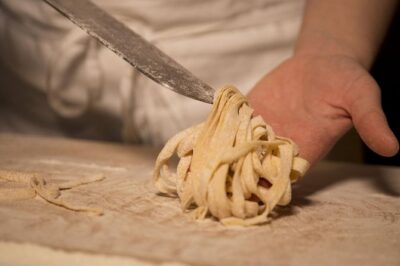
3 in 1 Cooking Class near Navona: Fettuccine, Ravioli & Tiramisu
Read our review →
Pasta & Tiramisu Class with Fine Wine by the Vatican
Read our review →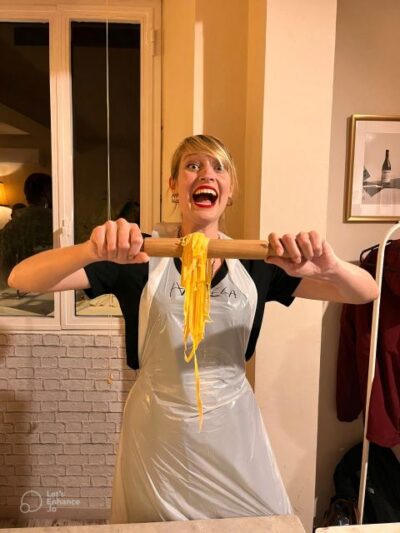
Pasta Making Class with Wine, Limoncello, and Dessert
Read our review →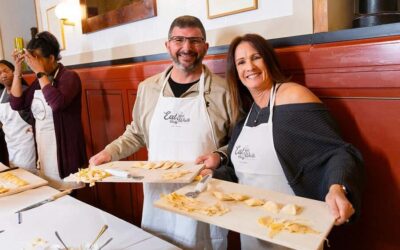
3-in-1 Fettuccine, Ravioli, and Tiramisu Cooking Class
Read our review →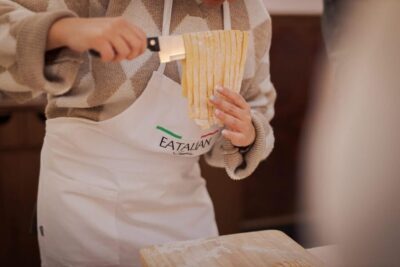
Fettuccine Pasta Cooking Class in Rome’s City Center
Read our review →
Traditional Pasta with Cocktails Cooking Class
Read our review →
Become a Masterchef in Rome: Pasta, Ravioli and Tiramisù Class
Read our review →
Fettuccine and Tiramisu Cooking Class with Wine
Read our review →Browse the lists this tour appears in