
Reviewed · ROME GHOST & LEGEND TOURS
Haunted Rome Ghost Night Walking Tour
Rome’s most unsettling stories are often found beside its prettiest squares. On this two-hour night walk, you follow a trail from the former execution ground at Campo de’ Fiori to Castel Sant’Angelo, hearing about poisoned cosmetics, grim prisons, suspicious deaths, and bodies displayed as warnings.
I like the route’s unusual sights, especially the little street Madonnas and the church decorated with human remains. I also like the tone: guides such as Ana, Youssef, Dominica, and Domenica are praised for warm, funny storytelling rather than cheap theatrics. The main drawback is practical: a group of up to 20 can be hard to hear beside Rome’s evening traffic, so a larger group may lessen the spell.
In This Review
- Key points about the Haunted Rome night walk
- Why Rome works so well after dark
- Campo de’ Fiori and Piazza Farnese: a sinister opening
- Little Madonnas on Via del Mascherone
- Ponte Sisto and the warning at Fontana del Mascherone
- Santa Maria dell’Orazione e Morte
- Prison, scandal, and a Spanish church on Via di Monserrato
- Via Giulia and cosmetics that could kill
- Mastro Titta and the final approach to Castel Sant’Angelo
- Guides, storytelling, and group size
- Is $35.07 a fair price?
- Practical advice before you go
- Who should book this Rome ghost tour?
- Should you book the Haunted Rome Ghost Night Walking Tour?
- FAQ
- Where does the Haunted Rome Ghost Night Walking Tour begin?
- Where does the tour end?
- How long is the tour?
- What language is the tour offered in?
- How much does the tour cost?
- How many people can join the standard tour?
- Is there a private tour option?
- Does the tour enter paid attractions?
- Is the tour suitable for children?
- Can I cancel for a full refund?
Key points about the Haunted Rome night walk
- Start at a former execution site: Campo de’ Fiori gives the tour an immediate, grim sense of place.
- Follow an unusual central-Rome route: The walk links Campo de’ Fiori, Ponte Sisto, Via Giulia, and Castel Sant’Angelo.
- Look for the little Madonnas: Street shrines become part of a story about crime, protection, and daily Roman life.
- Expect dark history more than paranormal theater: The stories focus on executions, prisons, violence, scandal, and suspicious deaths.
- Finish near Castel Sant’Angelo: You can continue your evening in the area after the tour ends.
- Allow for a group of up to 20: The size is manageable, but street noise can make it hard to hear a soft-spoken guide.
Why Rome works so well after dark
This is not mainly a tour of haunted rooms or staged ghost effects. It is a walk through Rome’s darker past, using ordinary streets and monuments as the setting.
That distinction matters. If you want actors, costumes, jump scares, or a guide pretending to summon spirits, this may feel too calm. If you like historical crimes, old scandals, and stories that make familiar landmarks look different, the approach works very well.
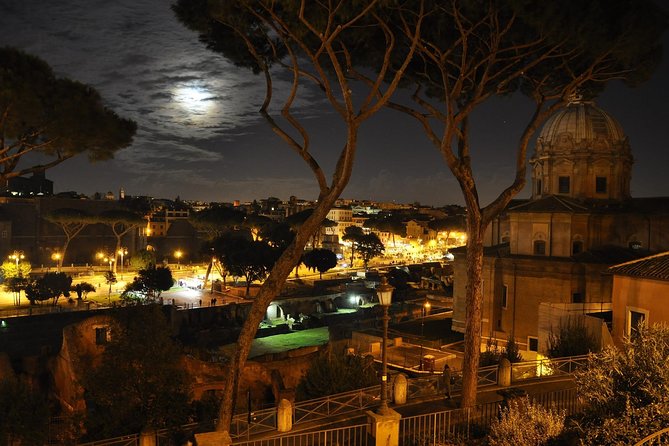
Night also suits the subject. Campo de’ Fiori, Via Giulia, Ponte Sisto, and the lanes around the old center take on a different mood after sunset. You avoid the worst daytime heat and spend two hours seeing a side of Rome that a standard ancient-history tour rarely covers.
The route is also useful for orientation. It begins in the historic center and moves toward the Tiber, ending at Castel Sant’Angelo. You are not simply circling one piazza. You are walking through several connected parts of central Rome, with a clear finish point for the rest of your evening.
More Rome legends after dark:
- Rome by Night Walking Tour – Legends & Criminal Stories
★ 4.5 · 1,003 reviews - Haunted Rome Ghost Tour – The Original
★ 4.5 · 668 reviews - Rome: Angels and Demons Guided Tour
★ 4.7 · 610 reviews
Campo de’ Fiori and Piazza Farnese: a sinister opening
The tour begins at Campo de’ Fiori, one of Rome’s best-known squares. Today, it is lined with bars and restaurants and often feels social and noisy. Its earlier role as an execution site gives the opening a sharp contrast.
That contrast is one of the tour’s strengths. You stand in a place that looks made for an evening drink while hearing about public death and punishment. The square is not treated as a spooky movie set. Its ordinary modern life is part of the point.
After roughly ten minutes, the route moves to Piazza Farnese. The square is handsome and spacious, but the story here turns to a former party center, a secret passageway, and two popes. It is the sort of tale that connects power, private behavior, and the city’s religious past without requiring a long museum visit.
You should expect several stops of about ten minutes each. That rhythm keeps the walk moving, though it also means the guide must tell each story clearly and efficiently.
Little Madonnas on Via del Mascherone
On Via del Mascherone and Vicolo dei Venti, look closely at the walls. The guide points out several madonelles, or little images of the Virgin Mary.
These shrines are easy to miss when you walk through Rome on your own. Here, they become part of a wider story about how religious images were believed to help control crime. That is a useful change of focus. Instead of only looking up at grand churches, you begin noticing small signs built into the streets.
This is one of the more authentic parts of the experience. The Madonnas are not an attraction with an entrance gate or a ticket desk. They are part of the city’s fabric, and you can keep spotting them after the tour ends.
The route’s free admission at every stop also keeps the price reasonable. You are paying for the guide’s storytelling and route planning, not for a series of costly admissions.
Ponte Sisto and the warning at Fontana del Mascherone
Ponte Sisto is presented as Rome’s oldest bridge, with a past involving accidents, power struggles, theft, and suspicious deaths. Bridges are natural places for stories about danger and escape, and this stop makes good use of that setting.
The bridge also adds a change of pace. After the enclosed streets and squares, you get a more open crossing with views along the Tiber. At night, that shift can be especially effective, though the atmosphere depends on the weather and the amount of activity around the river.
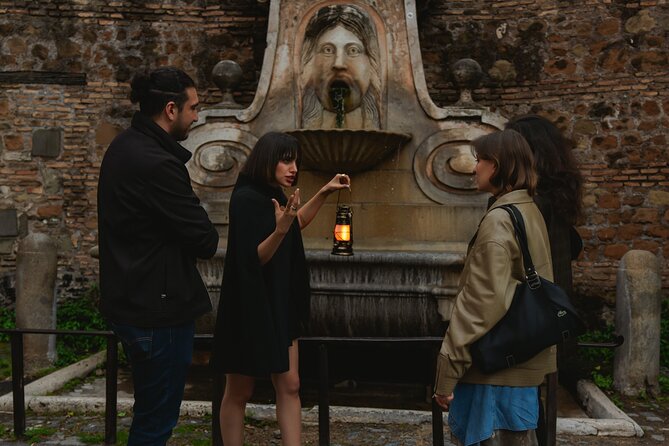
The next stop is Fontana del Mascherone. Unlike Rome’s famous monumental fountains, this one carries a warning to anyone who dares drink from it. The detail is small, but that is the appeal. The tour keeps finding odd fragments of the city instead of relying only on the landmarks everyone already knows.
You might want to stay alert between stops. The most interesting details are often on side streets, doorways, fountains, and small religious images, not only at the main meeting points.
More walking tours in Rome:
- Rome: Trastevere & Campo de Fiori Street Food Walking Tour
★ 4.9 · 2,768 reviews - Rome: Paranormal Night Walking Tour & Secret Backstreets
★ 4.9 · 1,921 reviews - Rome: Guided City Center Evening Sightseeing Walking Tour
★ 4.4 · 953 reviews - Best of Rome Walking Tour including Trevi Fountain
★ 4.5 · 923 reviews
Santa Maria dell’Orazione e Morte
The Church of Santa Maria dell’Orazione e Morte brings the tour’s subject into a more direct encounter with death. This seventeenth-century church is decorated with human remains from long ago.
That makes it one of the strongest stops for anyone drawn to macabre religious art. It also gives the guide a chance to explain how death was kept visible in earlier Roman life. The lesson is not only about horror. It is about how churches and communities used reminders of mortality.
The stop may not suit every child or every adult. The tour is popular with families, including children around 11 to 13, but human remains are a serious subject. If your group prefers light ghost stories, this may be the point where the tone feels more somber.
Prison, scandal, and a Spanish church on Via di Monserrato
Via di Monserrato was once the site of one of Rome’s worst prisons and is now associated with a haunted apartment block. The contrast between an everyday residential setting and a grim former prison site is classic for this route.
You do not need an entrance ticket to get the story. The guide uses the street itself as the setting, which is a good reminder that Rome’s past is not confined to formal monuments.
Nearby, Santa Maria in Monserrato degli Spagnoli offers a different kind of scandal. This Spanish church has a saucy story with the feel of a telenovela, bringing romance, religion, and bad decisions into the evening.
That variety helps the walk. The tour is not two hours of executions. It moves between crime, belief, family trouble, beauty, politics, and death. The result is broader than a standard ghost tale, even if the subject remains dark.
Via Giulia and cosmetics that could kill
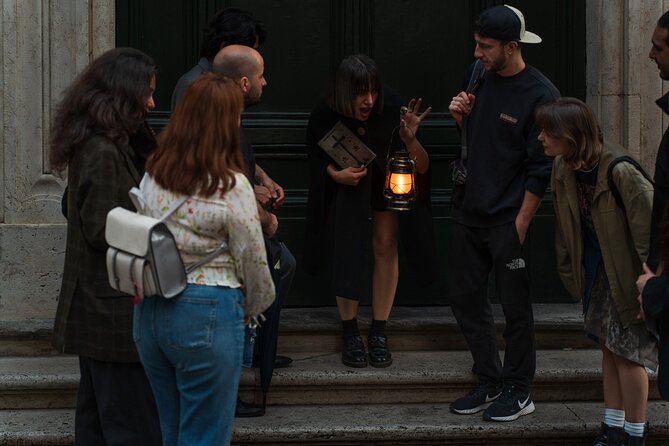
Via Giulia is one of the route’s more surprising stops. A former bar here had an earlier life as a beauty shop, and the story concerns cosmetics that could kill.
The tale shows how the tour uses small historical clues to build a larger picture of old Rome. Beauty products sound harmless until you learn what they contained or how they were used. The guide’s job here is to make a familiar street feel newly suspicious without overstating the scare factor.
This is also a good example of why the tour suits people who have already seen Rome’s major sights. After several days of churches, ruins, and formal art, you may want stories about ordinary businesses, private scandals, and dangerous habits. One guide even helped a group notice historical details they had missed during four days in the city.
Mastro Titta and the final approach to Castel Sant’Angelo
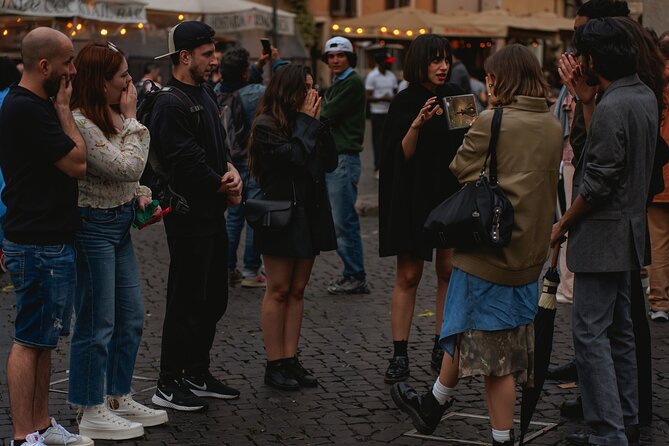
On Via dell’Arco dei Banchi, the route reaches the home of Mastro Titta, Rome’s most famous executioner. This stop ties several earlier themes together: public punishment, scandal, fear, and the way Rome preserved memories of violence in ordinary neighborhoods.
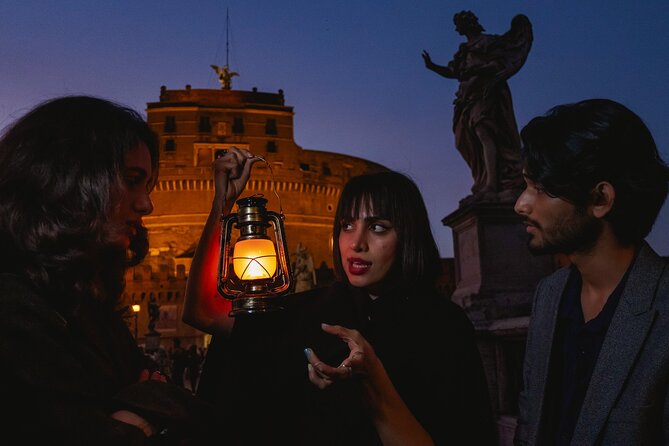
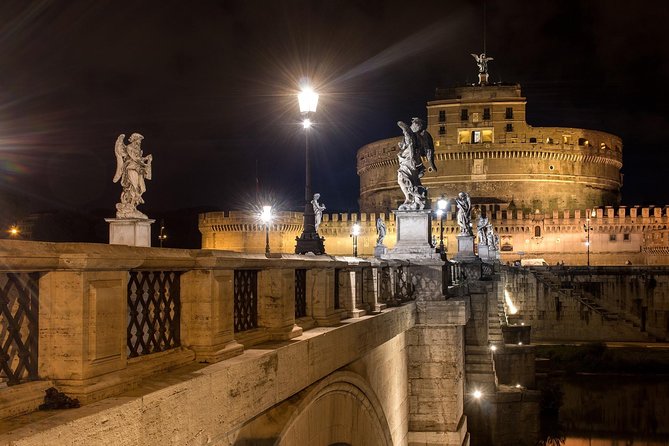
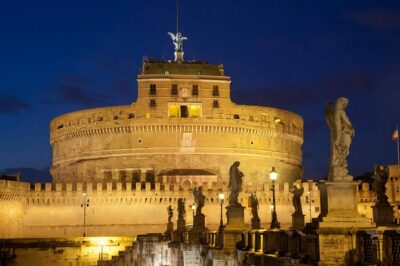
The final section leads toward Castel Sant’Angelo. On the bridge, executed bodies were once exposed as a warning to sinners. The setting has since been surrounded by angel statues, creating one of the tour’s clearest visual contrasts.
The guide also tells the story of the Cenci family and its fatal end. That gives the finale a personal and tragic focus after the broader tales of prisons, executions, and crime.
The tour ends at Castel Sant’Angelo, on Lungotevere Castello. You can continue your evening from there rather than having to return to the starting square. That is useful if you want a late meal, a stroll by the river, or a simple place to finish the night.
Guides, storytelling, and group size
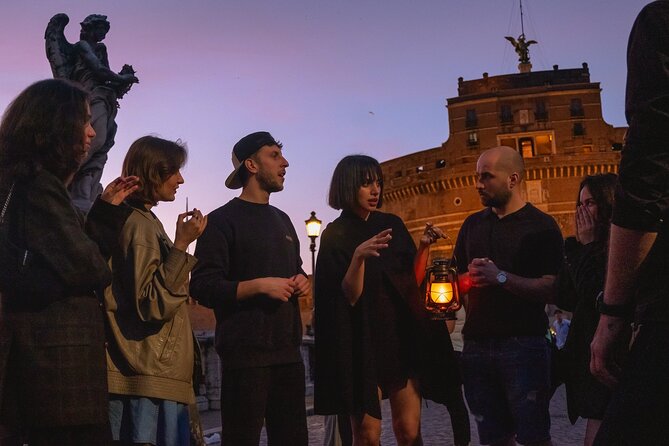
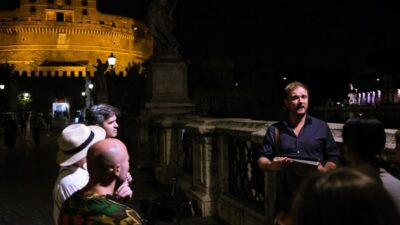
The strongest praise is directed at the guides. Ana is repeatedly described as energetic, funny, and passionate. Youssef is praised for his local knowledge, humor, kindness, and willingness to help when rain arrived. Dominica and Domenica are noted for keeping groups engaged, while Sarah is remembered for making the stories inclusive and easy to follow.
Those details point to an important part of the experience: the guide matters a great deal. The same route can feel flat with a rushed narrator and memorable with someone who can handle questions, vary the tone, and connect one story to the next.
The tour is offered in English and has a maximum group size of 20. That is not a tiny private walk, but it is far more personal than a huge city tour. Still, Rome at night has traffic, restaurant noise, and other groups on the streets. One participant found the guide hard to hear and suggested headphones for larger groups.
If you have hearing concerns, stand near the guide and avoid drifting to the back. A private upgrade is available if you want a more personal experience, easier conversation, or greater control over the pace.
Is $35.07 a fair price?
At $35.07 per person, the tour is fairly priced for a two-hour guided walk in central Rome. The value comes from the route and the interpretation. Every listed stop has free admission, so the fee is not paying for access to churches, bridges, or fountains.
I see this as a good use of an evening, especially if you are already planning to walk around the center after dinner. You get a structured route, an English-speaking guide, and a set of stories that would be difficult to assemble on your own.
The price is less attractive if you only want dramatic ghost effects. The tour is historical and story-led. It does not promise that you will enter a haunted building, see a ghost, or encounter theatrical performances.
Group discounts can lower the cost for larger parties. A private upgrade may make sense for families or small groups that want more direct contact with the guide, but the standard group already caps attendance at 20.
Practical advice before you go
Wear shoes suited to two hours of walking. The route passes through squares, lanes, bridges, and streets, and the tour keeps moving between stops.
Bring a light layer in colder months. One guide specifically advised bundling up for winter walks. In warm weather, the night timing helps you avoid the strongest daytime heat, but you should still prepare for an outdoor walk.
Check the meeting point carefully: Piazza Campo de’ Fiori, 00186 Rome. The endpoint is Castel Sant’Angelo at Lungotevere Castello 50, 00193 Rome. Both start and finish points are near public transportation.
Confirmation arrives when you book, and most people can participate. Free cancellation is available up to 24 hours before the start time for a full refund. Changes or cancellations made inside that 24-hour window are not accepted, and the cut-off follows local Rome time.
Who should book this Rome ghost tour?
I would choose this walk if you enjoy history with a grim edge, prefer local streets to formal attractions, or want something different after spending days with ancient ruins and religious art.
It also suits families with older children and teenagers. Several guides have made the stories work for mixed ages, and the tour is not built around extreme scares. Still, the human remains, executions, prison stories, and fatal family scandals may be too heavy for younger children.
Couples and first-time visitors can use it as an evening introduction to central Rome. Returning visitors may get even more from it because they are likely to recognize the streets while learning what happened there.
I would skip it if you need step-free indoor sightseeing, dislike walking at night, or want a strongly theatrical ghost show. The route is outdoors, the group can be difficult to hear at times, and the fear comes from real or legendary events rather than stage tricks.
Should you book the Haunted Rome Ghost Night Walking Tour?
Book it if you want dark Roman history in a walkable evening format. The route is well chosen, the price is reasonable, and the finish at Castel Sant’Angelo lets you carry on with your night.
For the best experience, arrive ready to listen closely, watch the side streets, and accept that the tour is more about crimes, legends, religious reminders, and human cruelty than literal ghosts. If possible, take it early in your stay, so you can return to the churches, fountains, and lanes that catch your attention.
FAQ
Where does the Haunted Rome Ghost Night Walking Tour begin?
It begins at Piazza Campo de’ Fiori, 00186 Rome, Italy.
Where does the tour end?
The tour ends at Castel Sant’Angelo, Lungotevere Castello 50, 00193 Rome.
How long is the tour?
The walk lasts approximately two hours.
What language is the tour offered in?
The tour is offered in English.
How much does the tour cost?
The listed price is $35.07 per person.
How many people can join the standard tour?
The activity has a maximum group size of 20 people.
Is there a private tour option?
Yes. You can upgrade to a private tour for a more personal experience.
Does the tour enter paid attractions?
The listed stops have free admission tickets. The experience is primarily an outdoor walking tour.
Is the tour suitable for children?
Most people can participate, and families with children and teenagers have enjoyed it. The content includes executions, prisons, human remains, suspicious deaths, and other dark subjects.
Can I cancel for a full refund?
Yes. You must cancel at least 24 hours before the experience start time to receive a full refund. Cancellations or changes made less than 24 hours before the start time are not accepted.
More Evening Experiences in Rome
- Rome: City Highlights Open-Top Bus Night Tour
★ 4.1 · 2,038 reviews - Vespa Sidecar Tour By Night with Pickup
★ 5.0 · 1,803 reviews - Rome by Night – Ebike Small Group Tour – Food and Wine (Option)
★ 5.0 · 1,275 reviews - Colosseum Sunset Tour with Entry
★ 4.5 · 1,230 reviews
Newest reviews from Rome
- Rome: Vatican Museums & Sistine Chapel Skip-the-Line Ticket★ 4.4 · 148 reviews
- Shared Shuttle Transfer from Rome to Civitavecchia Port★ 5.0 · 148 reviews
- Rome: Crypts & Catacombs After Hours Tour with Bone Chapel★ 4.6 · 149 reviews
- Ghosts Legends and Mysteries of Rome Walking Tour★ 5.0 · 149 reviews
- Skip the Line: Vatican and Sistine Chapel with Guided Tour★ 4.0 · 149 reviews
- Tivoli: Villa Gregoriana Entrance Ticket★ 4.7 · 150 reviews
- Pizza and Tiramisu Cooking Class in Rome, Piazza Navona★ 5.0 · 150 reviews
- Rome: Borghese Gallery Skip-the-Line Entry and Guided Tour★ 4.7 · 150 reviews
Rome Ghost & Legend Tours, compared.
Rome by Night Walking Tour – Legends & Criminal Stories
Read our review →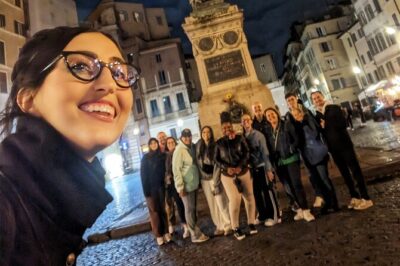

Small Group Rome’s Dark Side – Ghosts & Legends Tour
Read our review →
Dark Heart of Rome – Facts, Legend & Mystery Walking Tour
Read our review →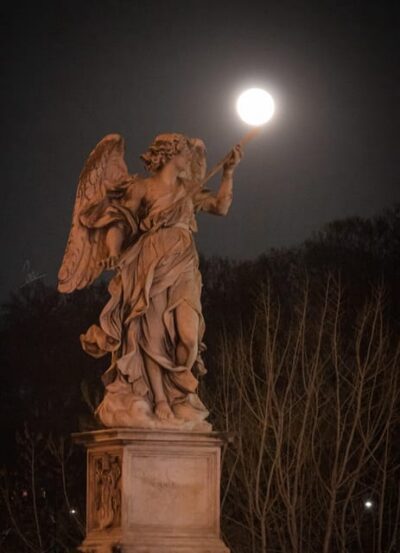
Ghosts, Legends & Mysteries of Rome Tip-Based Walking Tour
Read our review →
Ghosts Legends and Mysteries of Rome Walking Tour
Read our review →Browse the lists this tour appears in