
Reviewed · GELATO & TIRAMISU CLASSES
Ostia Antica Archaeological Park with Italian Gelato
Ostia Antica gives you something Rome’s famous center often cannot: room to think. This was a working river port, not a grand parade of imperial monuments, and its streets reveal ordinary Roman life through shops, bakeries, baths, apartment blocks, temples, and public offices. Chiara and Federico guide the walk in English, keeping the group to no more than six people.
I like the careful route through the archaeological park and the stop at the medieval Borghetto, where a castle and quiet courtyard add a second layer of history. I also like that the tour ends with Italian gelato rather than another lecture. The main drawback is practical: the archaeological park entrance fee is not included, and you must make your own way from central Rome to the meeting point.
In This Review
- Key points before you book
- Why Ostia Antica is worth leaving central Rome
- Meeting Chiara and Federico near the train station
- The necropolis and the Roman gate
- Neptune Baths and their large mosaics
- Theater, guilds, and the business of the port
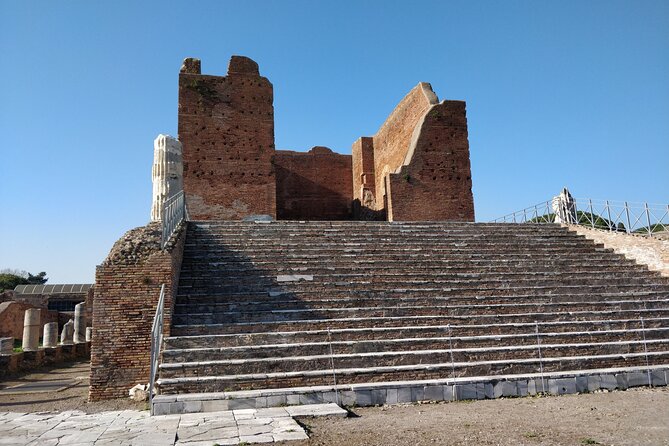
- The Forum, Capitolium, and Castrum
- Painted houses, Diana’s house, and the Thermopolium
- Bakeries, firemen, and the harbor sidewalk
- The Borghetto and Giulio II castle
- Gelato at the right moment
- What the $119.27 price really covers
- Who should book this Ostia Antica walk
- Should you book it?
- FAQ
- How long does the Ostia Antica tour last?
- What time does the tour begin?
- Where does the tour meet and finish?
- Is the archaeological park entrance fee included?
- Is gelato included?
- How many people can join the tour?
Key points before you book
- Ancient Rome beyond the center: Walk through a substantial port city with streets, businesses, homes, baths, temples, and public buildings.
- A genuinely small group: A maximum of six people makes it easier to ask questions and hear the guides clearly.
- Chiara and Federico lead the walk: Their focus is on explaining how Ostia worked, not simply naming ruins.
- The Borghetto adds medieval Rome: See the Giulio II castle and its courtyard after the ancient site.
- Plan for several miles on foot: The route takes about two hours in the archaeological park, with short steep stairways at some viewpoints.
- Gelato is included, admission is not: Budget separately for the park ticket and allow time to reach Ostia Antica.
Why Ostia Antica is worth leaving central Rome
Ostia Antica was Rome’s river port, founded traditionally by King Anco Marzio and later developed into a major commercial city. That role gives the site a different feel from the grand monuments around the Colosseum and Roman Forum.
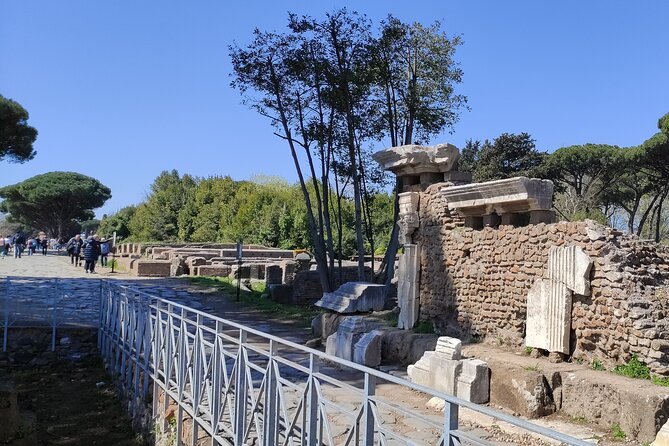
Here, you can trace the practical machinery of Roman life. Goods moved through the port. Bakers worked, firemen had a headquarters, guilds organized trades, and residents used public baths, taverns, theaters, and shops. The ruins are not just isolated columns. They form a city plan you can walk through.
That makes Ostia especially useful if you want to understand how Roman society functioned below the level of emperors and triumphal arches. You see where people worked, ate, washed, worshiped, and gathered.
The site also rewards patience. It was not preserved in one sudden disaster. Instead, it lived through centuries, was abandoned, and was later excavated. That means the buildings reflect a long urban story rather than a single frozen moment. The guides can help you read those changes as you move from one part of the city to another.
More gelato and tiramisu classes:
- 3 in 1 Cooking Class near Navona: Fettuccine, Ravioli & Tiramisu
★ 5.0 · 7,376 reviews - Rome: Pasta & Tiramisu Class with Fine Wine by the Vatican
★ 4.9 · 4,852 reviews - Rome: 3-in-1 Fettuccine, Ravioli, and Tiramisu Cooking Class
★ 4.9 · 2,704 reviews
Meeting Chiara and Federico near the train station
The meeting point is on Viale della Stazione di Ostia Antica, close to public transportation and the archaeological park. The tour begins at 9:30 a.m., and the activity ends back at the meeting point.
If you are staying in Rome, the simplest route described for reaching Ostia Antica is to take the metro to Piramide. That station connects with Porta San Paolo, where you can change to the Ostia-Lido commuter train. The ride is described as easy and inexpensive, but you still need to allow enough time to reach the station area before the start.
You can also reach the meeting point by car. Parking near the site has been described as ample, though the tour information does not promise a particular parking arrangement. If you drive, leave a cushion for Rome traffic and the walk to the meeting place.
The small group format matters here. With no more than six people, Chiara and Federico can stop for questions and adjust the pace. A family group of six can fill the entire tour, or you may share it with only a few other people. Either way, this is a more personal setup than a large coach excursion.
The advertised duration is about two hours and thirty minutes. The archaeological portion takes about two hours, followed by roughly thirty minutes in the medieval village and for gelato. Actual timing can run closer to three hours, especially if the group asks questions or takes its time at the Borghetto.
The necropolis and the Roman gate
The walk begins at the Necropolis of Ostia Antica, where monumental tombs and mausoleums introduce you to the city before you enter its main streets. This is a useful opening because it shows that Ostia was not only a place of trade. It was also a settled community with families, customs, and different ways of marking the dead.
From there, the route continues through the Roman gate and Victory Square along the Decumanus Maximus. The Decumanus was one of the city’s main streets, so this section helps you get your bearings. Instead of viewing scattered ruins, you begin to see a connected urban center with major routes, public spaces, and neighborhoods.
I find this sort of progression more helpful than rushing straight to the most famous mosaic. You first understand the city’s layout, then the guide can explain how individual buildings fit into it.
Neptune Baths and their large mosaics
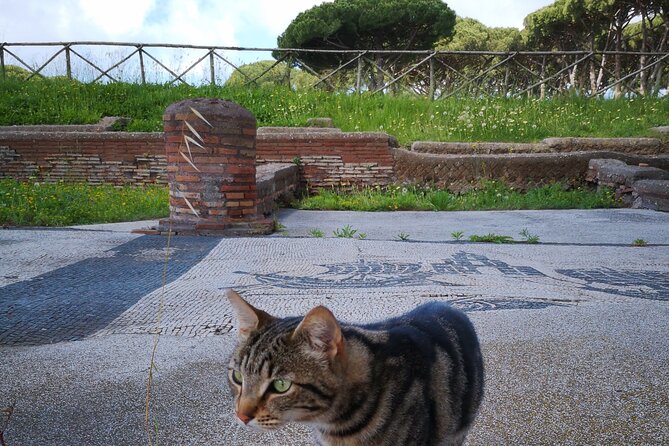
The Baths of Neptune are one of the visual highlights. Their mosaics are large and dramatic, and the route includes a viewpoint from above. That higher position gives you a clearer sense of the design than you get while standing at ground level.
The baths also show how public facilities were part of daily Roman life. They were not simply places to wash. They were social and civic spaces, and their scale tells you something about the resources available to the city.
There are short steep stairways at some points where you can climb for a better view. These climbs are optional, so you can skip them if stairs are uncomfortable. Still, anyone who wants the clearest look at the Neptune mosaics should be prepared for some uneven walking and at least the possibility of a short ascent.
More Ostia Antica visits:
- Ancient Ostia Antica Semi-Private Day Trip from Rome by Train with Guide
★ 4.5 · 579 reviews - From Rome: Ostia Antica Guided Half-Day Trip by Train
★ 4.8 · 486 reviews - Horse Sanctuary & Trail Ride in Ostia Antica
★ 4.5 · 276 reviews - Ostia Antica Semi Private Tour from Rome
★ 5.0 · 238 reviews
Theater, guilds, and the business of the port
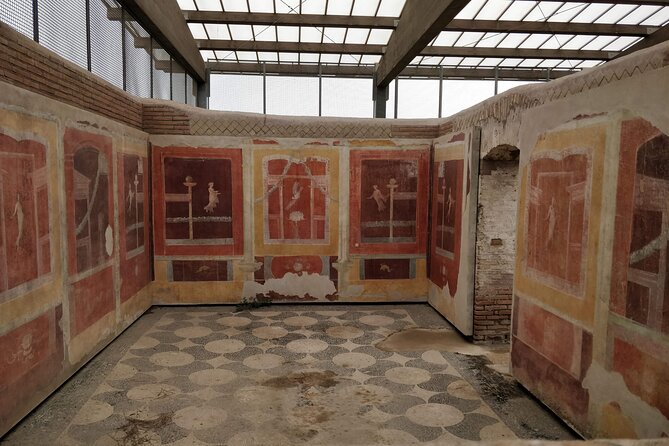
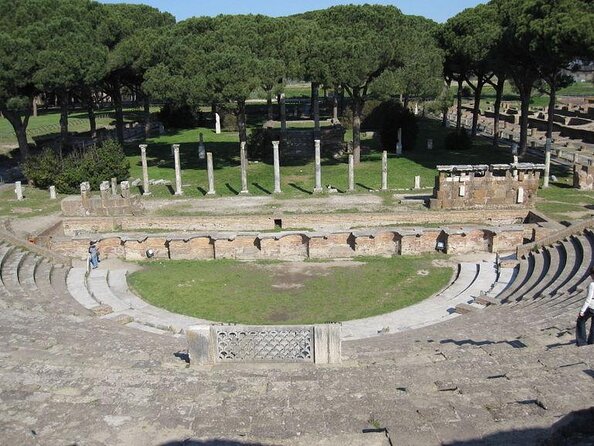
The Roman Theatre and Corporation Square shift the focus from private life to public and commercial activity. The theater helps you picture entertainment in the city, while Corporation Square connects to the organizations that supported Rome’s trade.
The route also includes the Ara of Romulus and Remus. This detail ties the working port to Rome’s traditional foundation story. It is a reminder that even a commercial city on the edge of Rome’s world used familiar symbols to express its place within Roman culture.
This is one of the strongest reasons to take a guide. Without context, a square, theater, or inscription can blur into another ancient ruin. With explanation, you can ask what the building did, who used it, and how it connected to the port economy.
The Forum, Capitolium, and Castrum
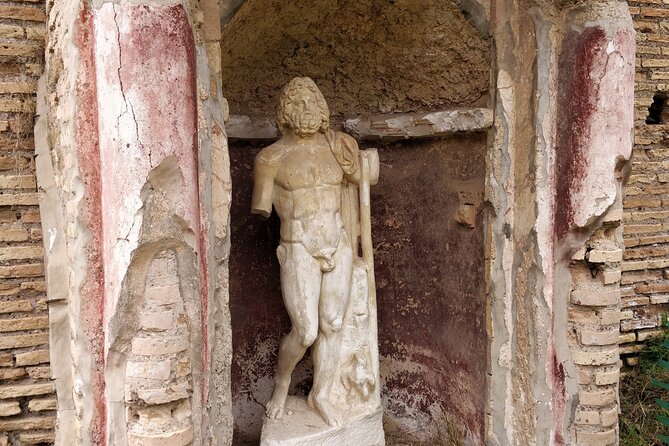
The Forum and Forum Baths bring you to the civic core. The Capitoline Triad temple reflects the official religious life of the city, while the Castrum points to Ostia’s earlier military and defensive role.
These stops give the tour a useful balance. You are not only looking at stores and residences. You also see the official center, the religious institutions, and the older structure beneath the later city.
The site is large, so the two-hour archaeological walk has to make choices. You will see a broad set of highlights, but this is not a leisurely full-day study of every building. If you are an archaeology specialist or want extensive time for photography, you may wish to return independently for a longer visit.
For most first-time visitors, the guided route is a sensible introduction. It covers the city’s major functions without requiring you to decode the entire park on your own.
Painted houses, Diana’s house, and the Thermopolium
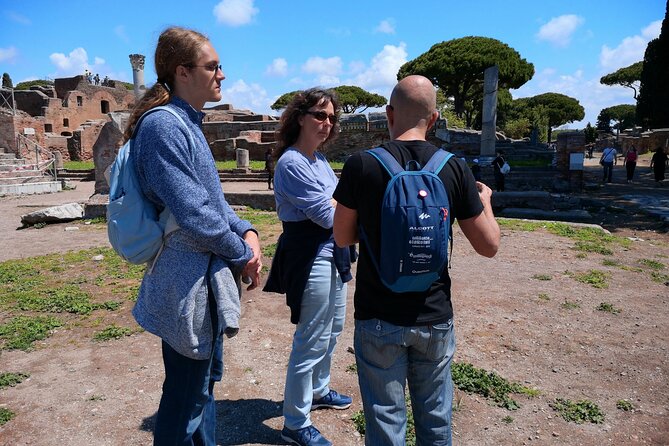
The painted houses and Diana’s house bring you closer to domestic life. These buildings help you imagine Ostia as a lived-in city, not simply a port filled with warehouses and officials.
The Thermopolium is especially appealing because it offers a glimpse of Roman food service. The preserved counter and surviving decoration make it easier to picture an everyday stop for food or drink. It is the kind of place that gives the ruins human scale.
You might find this part more memorable than another temple because it connects directly to habits you still recognize: eating out, stopping for refreshments, and living in compact urban buildings. The guides’ explanations are important here, since modest structures often need more interpretation than grand monuments.
Bakeries, firemen, and the harbor sidewalk
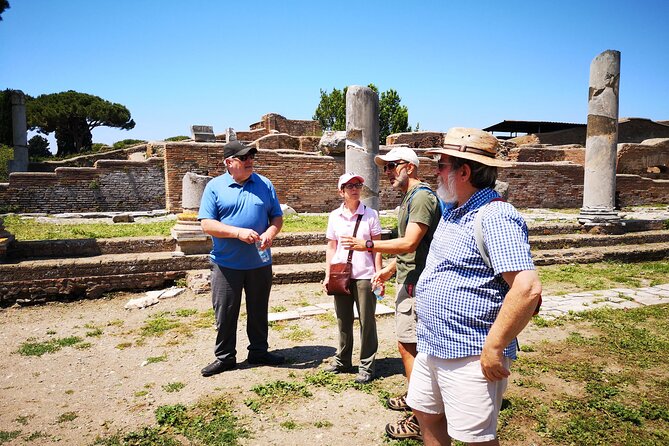
The route continues to Silvano’s Mills, the Guild of Pistores, and the firemen’s headquarters. Together, these sites show the systems that kept the city supplied and safe.
The bakers’ guild and mills point to food production and trade. The firemen’s headquarters reveal that urban Rome had organized responses to one of the constant dangers of dense ancient cities. These are not glamorous ruins, but they are among the most useful for understanding daily operations.
The Cisiari’s Baths and the harbor’s sidewalk bring the tour toward its final archaeological sections. The harbor connection is central to Ostia’s identity. This was a city shaped by movement, commerce, and the river route into Rome.
The walking distance is roughly three miles, according to the practical guidance provided for the tour. Wear supportive shoes, bring water, and be ready for sun exposure. The information does not specify shade, seating, or restroom locations along the route, so do not assume that every stop offers a place to rest.
The Borghetto and Giulio II castle
After the ancient city, the tour moves to Centro Storico di Ostia Antica, known locally as the Borghetto. The change is striking. You go from Roman streets and mosaics to a medieval village dating to the ninth century.
The village includes the well-preserved fifteenth-century Giulio II castle. It was built to help the Papal States control trade on the Tiber and protect local farmers from raids by the Saracens. The castle is associated with a design by Michelangelo, adding an important artistic connection to the site.
This stop is not an extended castle tour. It is a short visit of about thirty minutes, and admission is listed as free. Think of it as a compact second act that shows how the area continued to matter long after ancient Ostia was abandoned.
I like this pairing because it prevents the day from becoming a single-period history lesson. You see ancient commerce, then medieval defense and local settlement, all close to the same meeting point.
Gelato at the right moment
The included Italian gelato comes just outside the medieval walls. It is a small detail, but it improves the shape of the morning. After several miles on foot and a steady stream of history, a simple cold treat gives you time to relax and ask follow-up questions.
The gelato is listed as the included snack. Other food and drinks are not specified as part of the tour. One family also received a lunch recommendation, but you should treat that as local guidance rather than a guaranteed part of the package.
An aperitivo with drinks, cheeses, and cold cuts was also described in one account, but the standard inclusion provided here is Italian gelato. Do not book expecting an aperitivo unless the provider confirms it for your date.
What the $119.27 price really covers
At $119.27 per person, this is not the cheapest way to visit Ostia Antica. The price pays for a guided small-group experience in English, the archaeological walk, the Borghetto visit, and gelato. The park entrance fee is extra, which raises the total cost.
The value depends on how much help you want at a large archaeological site. If you already know Roman urban history and enjoy reading signs at your own pace, you may prefer to visit independently. If you want the ruins explained in a clear order, the small group and guide attention make the price easier to justify.
You are also paying for time efficiency. The route covers the necropolis, main street, baths, theater, forum, homes, commercial buildings, fire station, and harbor area in a limited morning window. A guide keeps the visit moving and helps you avoid spending too long at one spot while missing the wider story.
The tour is booked an average of 71 days in advance, so planning ahead is wise. That is especially true if you want a particular date or are traveling with a full family group of six.
Who should book this Ostia Antica walk
I would recommend it most strongly to:
- First-time visitors who want ancient Rome explained in practical terms
- Families with a curious teenager or older child
- People who prefer small groups to large guided crowds
- History lovers interested in ordinary work and city life
- Visitors who have already seen the central Roman monuments and want a quieter morning
- Anyone who likes combining an archaeological site with a medieval village
It may be less suitable if you want a slow, unstructured day, dislike several miles of walking, or need the entrance fee included in the advertised price. It is also not a good choice if you expect a full-day archaeological study. The route is focused and efficient rather than exhaustive.
Most participants can take part, but the walk includes uneven ancient surfaces and some optional steep stairs. Good weather is required. If poor weather cancels the experience, you are offered another date or a full refund.
Should you book it?
Book this tour if you want to understand how a Roman port city worked, not just photograph another famous ruin. Chiara and Federico’s small-group format, the carefully chosen route, the medieval Borghetto, and the included gelato create a well-shaped morning outside central Rome.
Before booking, check the total cost after adding archaeological park admission and confirm your transport plan to Ostia Antica. If you can handle several miles on foot and want more context than a self-guided visit provides, this is a strong use of a Rome morning. If you prefer complete freedom or need a lower-cost outing, visit independently and allow yourself more time.
FAQ
How long does the Ostia Antica tour last?
The experience is listed as approximately two hours and thirty minutes. About two hours are spent in the archaeological park, followed by about thirty minutes in the Borghetto and for gelato. The walking portion may take closer to three hours depending on questions and pace.
What time does the tour begin?
The tour starts at 9:30 a.m.
Where does the tour meet and finish?
You meet on Viale della Stazione di Ostia Antica, near the archaeological site and public transportation. The activity ends back at the meeting point.
Is the archaeological park entrance fee included?
No. The entrance fee for the archaeological park is not included in the $119.27 tour price.
Is gelato included?
Yes. Italian gelato is included as the tour snack. Other items not specifically listed are not included.
How many people can join the tour?
The maximum group size is six people. The tour is offered in English, and most participants can take part.
Newest reviews from Rome
- ROME:Colosseum & Ancient Rome – private/small group TOUR★ 5.0 · 24 reviews
- Off the Beaten Track in Rome: Rione VI Parione Private Tour★ 5.0 · 24 reviews
- Cinematic Photoshoot in Rome★ 5.0 · 24 reviews
- Rome: Best of Colosseum and Roman Forum Small Group Guided Tour★ 4.5 · 24 reviews
- The Labyrinth of Rome between catacombs and ancient quarries★ 4.5 · 24 reviews
- Vatican and Trionfale Market Tour with Wine and Food Tasting★ 5.0 · 24 reviews
- private tour: Vatican Museums, Sistine Chapel, St. Peter’s Basilica★ 4.5 · 24 reviews
- Colosseum guided tour with Virtual Reality★ 5.0 · 24 reviews
Gelato & Tiramisu Classes, compared.

3 in 1 Cooking Class near Navona: Fettuccine, Ravioli & Tiramisu
Read our review →
Pasta & Tiramisu Class with Fine Wine by the Vatican
Read our review →
3-in-1 Fettuccine, Ravioli, and Tiramisu Cooking Class
Read our review →
Learn to Make Pasta & Tiramisu with Wine and Limoncello Included
Read our review →
Fettuccine and Tiramisu Cooking Class with Wine
Read our review →
Pasta & Tiramisu Cooking Class near the Spanish Steps
Read our review →
Cooking Class in the Heart of Rome: Pizza and Tiramisu Making
Read our review →
Rome Pasta and Tiramisu Class: Ravioli, Fettuccine & Fine Wine 5*
Read our review →Browse the lists this tour appears in