
Reviewed · WORKSHOPS
Rome by Day, Beauty and History Unique Photo Tour and Workshop
Rome is easiest to remember when you stop treating it like a checklist of monuments and start looking for the right frame. This four-hour walk with Giulio D’Ercole turns central Rome into a hands-on photography class, moving from St. Peter’s Square and Castel Sant’Angelo to ancient ruins, Baroque churches, and market streets.
I like two things right away: you do not need a DSLR, and Giulio adjusts his instruction to your level. I also like the small maximum group of four, which gives you time to ask about exposure, composition, camera settings, and the story behind each place.
The tradeoff is pace. The route covers a large part of central Rome, with roughly 10 to 20 minutes at many stops. You will collect a wide range of subjects, but this is not a slow, tripod-based session at one location.
In This Review
- Key points to know before booking
- What this Rome photo walk is really about
- A small group makes a real difference
- Starting at Ponte Sant’Angelo and St. Peter’s Square
- Castel Sant’Angelo and the Bridge of Angels
- Piazza Navona and the Pantheon
- Sant’Ignazio and Rome’s Baroque illusion
- From the Victorian monument to Campidoglio
- Trajan’s Market and the ancient Roman center
- Teatro di Marcello and the old Jewish Quarter
- Finishing at Campo de’ Fiori and near the Colosseum
- What you will learn during four hours
- Timing, walking, and practical concerns
- Who will get the most from this experience
- Should you book Rome by Day?
- FAQ
- Do I need a DSLR camera for the tour?
- Who leads the photo tour?
- How many people can join?
- Where does the tour begin and end?
- Are admission tickets included?
- Can non-photographers join?
- Can I rent photography equipment?
- What happens if the weather is poor?
Key points to know before booking
- Smartphones are welcome: You can use an iPhone or Android phone, as well as a dedicated camera.
- Giulio teaches as he walks: Expect practical help with settings, composition, and visual storytelling.
- The group is very small: The maximum is four people, so the instruction can be personal.
- The route crosses central Rome: It begins at Ponte Sant’Angelo and finishes near the Colosseum.
- The focus is outdoor photography: Most stops involve exterior views, streets, ruins, people, and architecture.
- Non-photographers can join: Spouses, partners, and children may be accommodated by arrangement.
What this Rome photo walk is really about
This is not simply a sightseeing walk with a camera in your hand. Giulio uses Rome’s monuments as working examples, showing you how the same place can produce different photographs depending on viewpoint, light, subject, and timing.
You may work on a wide view of St. Peter’s Square, a detail on a fountain, a portrait-like image of a Swiss Guard, or a street scene in the old Jewish Quarter. The point is not just to photograph famous places. It is to learn how to decide what belongs in the frame.
That makes the tour suitable for a wide range of ability levels. If you use your phone on automatic mode, you can learn how to make stronger choices about composition and exposure. If you already use manual settings, you can ask more focused questions about camera control and scene interpretation.
Giulio also brings cultural and historical context into the walk. Several people who spent time with him praised his explanations of Rome, architecture, and local details, as well as his ability to speak clear English. The result is a useful mix of photo coaching and city orientation.
More Rome tours worth comparing
- Rome Vespa Scooter Tour with Professional Photographer
★ 5.0 · 857 reviews - Rome Vespa Tour with Professional Photoshoot
★ 5.0 · 576 reviews - Rome: Personalized Photoshoot outside the Colosseum
★ 5.0 · 526 reviews
A small group makes a real difference
The maximum group size is four. That is one of the most important details in the whole experience.
Photography instruction works best when you can show the guide your screen or camera and get an answer that relates to the exact picture you are trying to make. In a large group, you might hear general advice and then wait while several other people take their turn. Here, Giulio can focus on your skill level and the kind of images you want.
This small format also helps if members of your party have different interests. Non-photographing spouses, partners, and children can be accommodated by arrangement. Be sure to discuss that before booking, since the activity is designed around photography.
At $215.69 per person, the price is not low for a four-hour walk. The value rests in the small group and the professional guidance, not in admission tickets. Most stops are free outdoor locations, and souvenir photos are not included. If you want instruction rather than a standard group tour, the cost is easier to justify.
Starting at Ponte Sant’Angelo and St. Peter’s Square
The meeting point is at St. Angelo Bridge, or Ponte Sant’Angelo, across from Castel Sant’Angelo. This is a practical start because the bridge itself offers strong subjects before the formal route gets going.
At St. Peter’s Square, you can photograph the sweeping colonnades, fountains, sculptures, Swiss Guards, and the facade of St. Peter’s Basilica. It is a useful first exercise because the square has both grand scale and small details. You can work on symmetry, repeating columns, human scale, and the challenge of fitting a huge architectural setting into one image.
The scheduled time here is about 20 minutes. That is enough for several approaches, but not for a slow architectural study from every angle. You should arrive ready to shoot and listen, rather than spend the first few minutes changing lenses or organizing your phone.
The tour does not promise entry into St. Peter’s Basilica. The focus is the square and exterior views, so dress requirements may be less of an issue at this particular stop. Still, places of worship later in the route require covered knees and shoulders for both men and women.
Castel Sant’Angelo and the Bridge of Angels
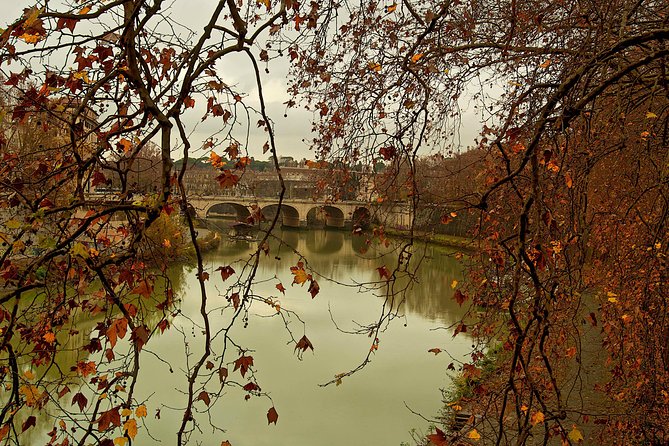
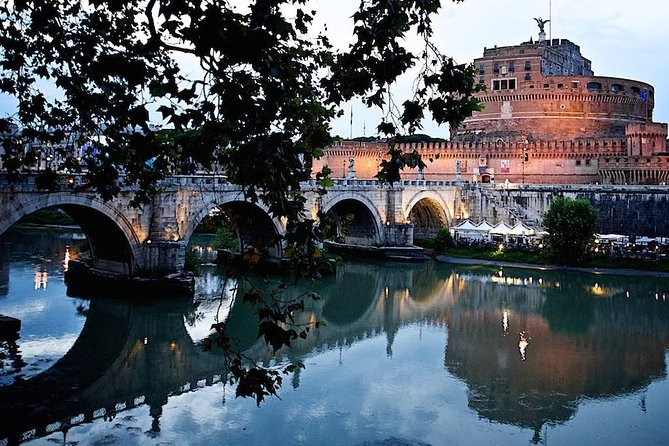
The next photo subjects are Castel Sant’Angelo, the Bridge of Angels, and views from the riverbanks. This section gives you a change from the open geometry of St. Peter’s Square.
The fortress has a strong shape and a clear connection to the river. The bridge adds statues and perspective lines, while the river shores can offer a different angle than the usual frontal photograph. Giulio can help you decide when to include the full structure and when to concentrate on a detail, such as a sculpture or the relationship between bridge and fortress.
Only about 15 minutes are assigned here. That short stop is a reminder that this is a moving photo walk. You will not have time to explore the fortress interior, and the experience does not include an admission ticket for it.
A completely different way to spend the day in Rome:
- Vatican: Museums & Sistine Chapel Entrance Ticket
★ 4.5 · 144,003 reviews - Vatican Museums & Sistine Chapel Tour with Optional Basilica
★ 4.3 · 67,413 reviews - Vatican Museums, Sistine Chapel & St Peter’s Basilica Guided Tour
★ 4.5 · 39,149 reviews - Rome: Colosseum, Palatine Hill and Roman Forum Guided Tour
★ 4.8 · 32,814 reviews
Piazza Navona and the Pantheon
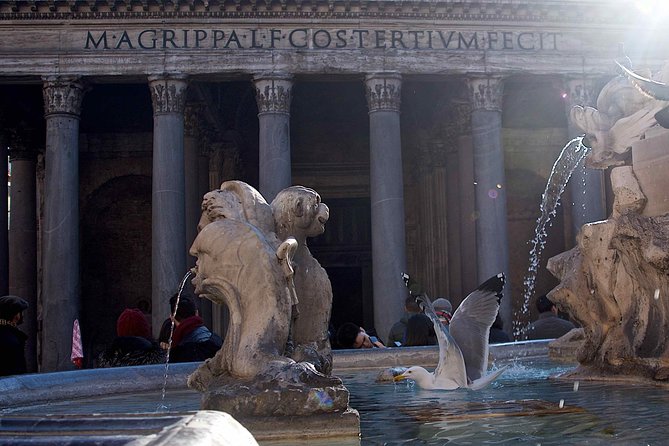
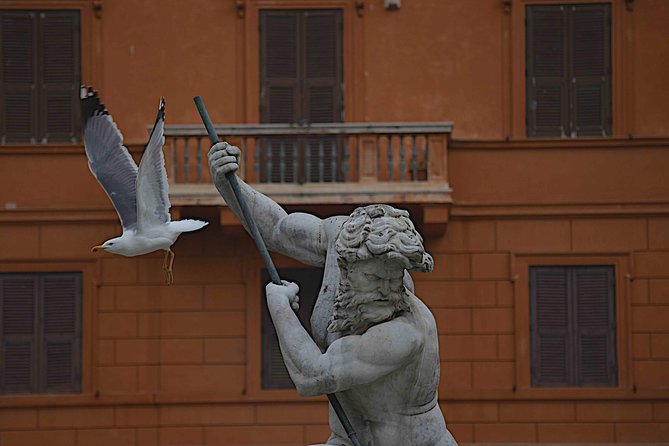
At Piazza Navona, you can photograph fountains, churches, the surrounding buildings, and people moving through the square. This is a good place to practice visual storytelling because it combines architecture with daily Roman life.
Do not frame the square as an empty monument unless that is your goal. People can give the scene scale and energy. A fountain detail can tell a smaller story than a full view of the piazza, while the church facades offer chances to practice vertical composition.
The Pantheon comes next, with about 20 minutes in the square. You can photograph the exterior of the Pantheon, the fountain, the surrounding buildings, and people in the space. The information provided describes exterior photography, not a guaranteed interior visit, so plan your expectations accordingly.
This is another place where a guide’s input can save time. The Pantheon is so familiar that it is easy to make the same picture everyone else makes. Giulio’s role is to help you find a better angle, a cleaner composition, or a detail that says something about the place.
Sant’Ignazio and Rome’s Baroque illusion
The Church of Sant’Ignazio di Loyola offers a different kind of subject: sculptures, frescoes, and Baroque art. The scheduled time is about 15 minutes.
This stop is especially useful if you want to photograph interiors rather than only streets and monuments. Church photography brings technical problems of its own, including low light, bright highlights, vertical lines, and the need to be discreet. Giulio’s instruction on exposure and camera settings can be put to practical use here.
Church entry requires suitable clothing. Knees and shoulders must be covered for both men and women, and shorts or sleeveless tops can lead to refused entry at places of worship and selected museums. Casual clothing is fine, but pack accordingly.
The stop description also refers to a square and its surrounding buildings before the route continues. Because the tour covers many places in limited time, the exact amount of time at any one view may depend on the group and the day’s conditions.
From the Victorian monument to Campidoglio
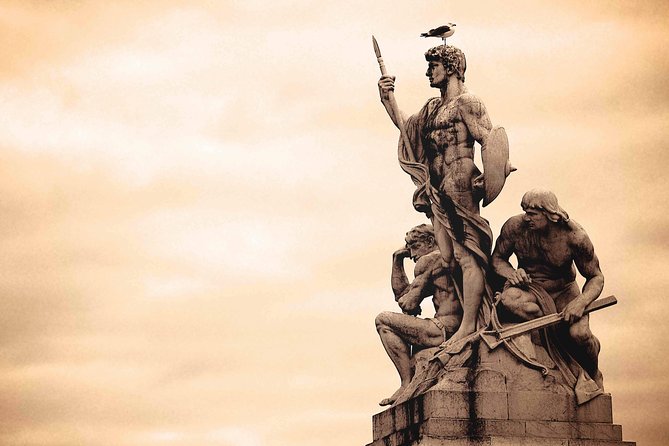
The route then moves toward the Complex of the Victorian Ala Brasini, with time for photographs of the monument, sculptures, Rome’s skyline, and the surrounding city view. This section shifts the emphasis from individual buildings to broad urban scenes.
You can use the monument as a large architectural subject, then look for smaller sculpture details. The skyline view is useful for practicing layers: foreground objects, middle-distance buildings, and the wider city beyond.
At Piazza del Campidoglio, Giulio brings you to Michelangelo’s designed square, the statue of Marcus Aurelius, the surrounding facades, and a view over Rome. The square’s patterned pavement and carefully arranged buildings reward attention to lines and balance.
Campidoglio is a good place to think about how architecture guides the eye. A straight-on shot may emphasize symmetry, while a lower or angled view can make the facades feel more imposing. You will have about 20 minutes, enough to try more than one approach if you work efficiently.
Trajan’s Market and the ancient Roman center
The Mercati di Traiano and the Museum of the Imperial Forums area provide photographs of ancient ruins, Roman forums, Trajan’s Market, Trajan’s Column, and broad views across the archaeological zone.
The stop is listed as about 20 minutes, but the experience described here is photography from the route rather than a guaranteed museum visit. If you want to enter a museum or archaeological site, availability must be checked after booking, and entry is not part of the standard inclusions.
This part of the walk is valuable because ruins can be difficult to photograph well. A pile of old stone does not automatically make a strong image. You need to choose a readable shape, find a useful foreground, or use the surviving columns and walls to create depth.
Trajan’s Column is a natural focal point, but it can be photographed in several ways. You might emphasize its height, isolate its carved detail, or place it within a wider view of the surrounding ruins. Giulio’s instruction can help you move beyond a quick record shot.
Teatro di Marcello and the old Jewish Quarter
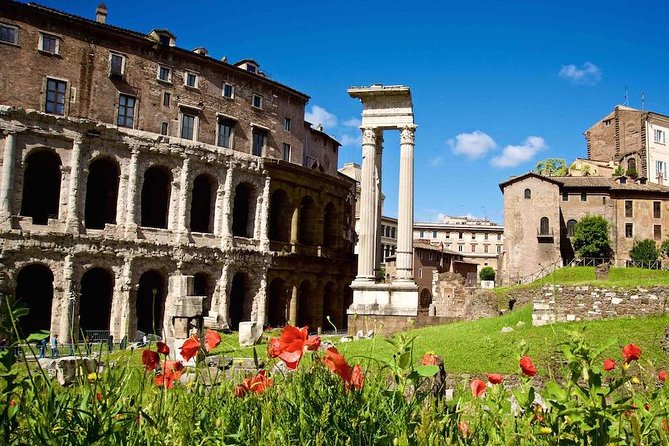
The stop at Teatro di Marcello is brief, about 10 minutes. You can photograph the ancient theater and its surrounding ruins. Because the time is short, think of this as a focused pause rather than a full visit.
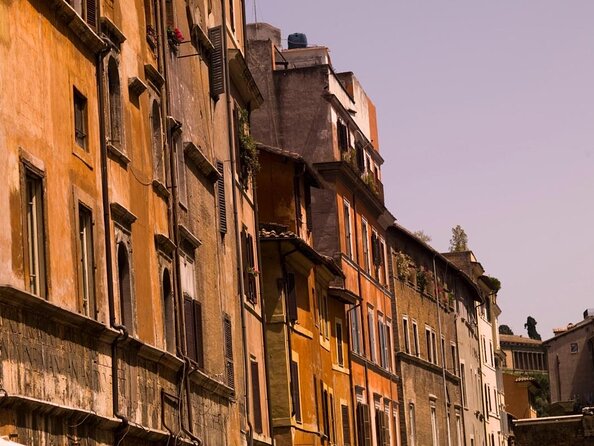
The route then becomes more intimate in Rome’s old Jewish Quarter. Here you can photograph characteristic corners, narrow lanes, and typical shops. After so many major monuments, this change matters. Small streets often give you the chance to practice texture, color, signs, doorways, and everyday scenes.
The Jewish Quarter is a place to slow your eye, even if the schedule does not allow a long pause. Look for relationships between old walls and newer shopfronts. Watch your surroundings and be respectful when photographing people, businesses, and places connected to local community life.
This is also one of the strongest reasons to choose the photo walk over a standard highlights tour. You still see major Roman sights, but you also get prompts to notice less formal scenes along the way.
Finishing at Campo de’ Fiori and near the Colosseum
The final photography stop is Campo de’ Fiori, where you can photograph a traditional Roman market and the surrounding lanes. The market gives you a chance to work with people, produce, stalls, colors, and quick moments rather than fixed architecture.
This is a useful final test of what you have learned. A market scene asks you to choose a subject quickly, avoid clutter, and decide whether the story is about a person, an object, or the whole setting. You can also move into the nearby alleys for quieter images.
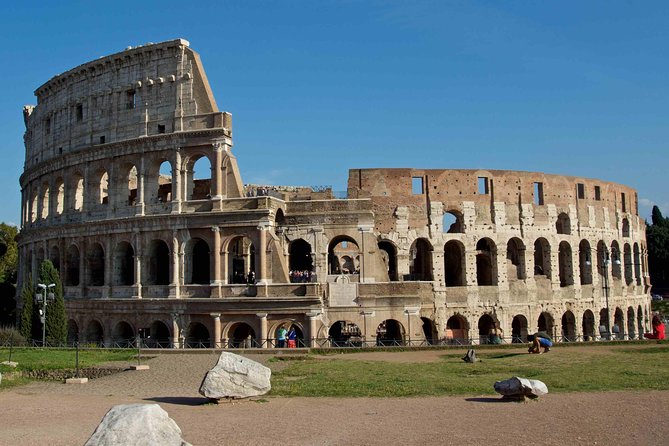
The tour ends at Piazza del Colosseo, on Via dei Fori Imperiali, close to the Colosseum and a subway stop. The end point is convenient if you want to continue sightseeing, return to your accommodation, or connect with another part of Rome.
The Colosseum is the endpoint, not a guaranteed interior visit. If you specifically want the Roman Forum or Colosseum included as an archaeological visit, arrangements may be considered, but availability cannot be checked without a booking. Credit cards are charged only after show availability is confirmed for those requested additions.
What you will learn during four hours
The workshop covers more than pressing the shutter. Giulio works with:
- Exposure and camera settings
- Composition and framing
- Visual storytelling
- Photography of architecture, art, ruins, people, and streets
- Choosing viewpoints for familiar monuments
- Adjusting technique to different light and subjects
You do not need to arrive with advanced skills. The experience is designed to help beginners and experienced photographers alike, and phones are accepted. If you bring a smartphone, you can still ask about framing, exposure control, focus, and the strongest use of the camera’s built-in tools.
If you have no camera, Nikon equipment and tripods may be rented for 50 euros per kit, payable in cash. That cost is separate from the tour price, so include it when comparing options.
Several people who worked with Giulio appreciated his patience and his ability to make the session enjoyable without losing the teaching element. One person also received help downloading the photos taken during the walk afterward, after making that arrangement with him. Do not assume that souvenir photos or file transfers are included, but it is worth asking what can be arranged.
Timing, walking, and practical concerns
The experience lasts about four hours and covers many central Roman sights. You should expect substantial walking over city streets and pauses for photography, though the supplied information does not give a total distance.
Comfortable shoes are the sensible choice. Keep your camera or phone easy to reach, since the value of the walk comes from trying ideas quickly at each stop. A small bag is easier than a heavy pack when you are changing from monument shots to street scenes.
The tour requires good weather. If poor weather causes cancellation, you will be offered another date or a full refund. Otherwise, you can cancel for a full refund up to 24 hours before the start time. Changes or cancellations made less than 24 hours before the start time are not accepted for a refund.
Confirmation arrives at booking. The activity is offered in English, and the guide may also operate in French, Italian, or basic Spanish. The route is near public transportation, begins at Ponte Sant’Angelo, and finishes near the Colosseum Metro area.
Who will get the most from this experience
I would choose this tour if you want practical help making better photographs while seeing Rome’s central sights. It suits a solo photographer, a couple, or a small family group with at least one person eager to take pictures.
It is also a good fit for someone visiting Rome for a second time. You may already know the big monuments, but Giulio can help you see them in a different way and point out streets or viewpoints you might otherwise miss.
I would be more cautious if you want long visits inside museums, a slow portrait session, or a full tour of every monument. The schedule is broad, and the many stops mean short working periods. You should also compare the price carefully if you mainly want sightseeing, since the main value is the personal photography coaching.
Should you book Rome by Day?
Book it if the idea of returning home with better photographs appeals to you more than simply collecting snapshots. Giulio brings together technical instruction, Roman history, architecture, and local details, and the maximum group of four gives the experience a personal feel.
The strongest reasons to book are the flexible camera options, the small group, and the route’s variety. In four hours, you can photograph grand squares, bridges, churches, ruins, markets, and side streets without committing to a full-day class.
Skip it if your main goal is interior access to St. Peter’s, the Pantheon, the Colosseum, or museums. Those visits are not guaranteed in the standard experience. For photographers who want both a city walk and useful guidance, though, this is a focused way to make Rome’s famous sights feel more personal.
FAQ
Do I need a DSLR camera for the tour?
No. The experience welcomes iPhone and Android smartphone photographers, as well as people using dedicated cameras.
Who leads the photo tour?
The tour is led by Giulio D’Ercole, a professional photographer who also provides historical and cultural explanations during the walk.
How many people can join?
The maximum group size is four travelers.
Where does the tour begin and end?
The tour begins at Ponte Sant’Angelo, near Castel Sant’Angelo. It ends at Piazza del Colosseo on Via dei Fori Imperiali, close to the Colosseum and a subway stop.
Are admission tickets included?
The standard route lists free admission for most outdoor stops. St. Peter’s Square is included, but entry into the basilica, museums, archaeological sites, or other interiors is not guaranteed.
Can non-photographers join?
Yes. Arrangements can be considered for non-photographing spouses, partners, and children who come as guests.
Can I rent photography equipment?
Yes. Customers without cameras can rent Nikon equipment and tripods for 50 euros per kit, payable in cash.
What happens if the weather is poor?
The activity requires good weather. If it is canceled because of poor weather, you will be offered a different date or a full refund.
More Historical Tours in Rome
- Rome in a Day Tour with Vatican, Colosseum and Historic Center
★ 4.5 · 1,042 reviews - Rome Food Tour in the Historic Centre with 8+ Food Tastings
★ 5.0 · 1,000 reviews - Rome: Forbidden History Walking Tour & Pub Crawl with Drinks
★ 4.9 · 688 reviews - Twilight Treasures: An Evening Tour Through Rome’s Rich History
★ 4.5 · 263 reviews
Newest reviews from Rome
- ROME:Colosseum & Ancient Rome – private/small group TOUR★ 5.0 · 24 reviews
- Off the Beaten Track in Rome: Rione VI Parione Private Tour★ 5.0 · 24 reviews
- Cinematic Photoshoot in Rome★ 5.0 · 24 reviews
- Rome: Best of Colosseum and Roman Forum Small Group Guided Tour★ 4.5 · 24 reviews
- The Labyrinth of Rome between catacombs and ancient quarries★ 4.5 · 24 reviews
- Vatican and Trionfale Market Tour with Wine and Food Tasting★ 5.0 · 24 reviews
- private tour: Vatican Museums, Sistine Chapel, St. Peter’s Basilica★ 4.5 · 24 reviews
- Colosseum guided tour with Virtual Reality★ 5.0 · 24 reviews
Workshops, compared.
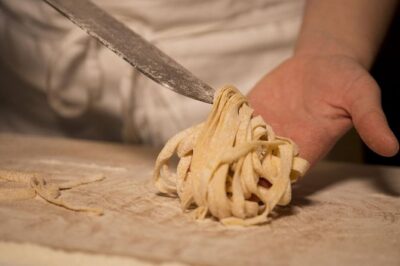
3 in 1 Cooking Class near Navona: Fettuccine, Ravioli & Tiramisu
Read our review →
Pasta & Tiramisu Class with Fine Wine by the Vatican
Read our review →
Pasta Making Class with Wine, Limoncello, and Dessert
Read our review →
3-in-1 Fettuccine, Ravioli, and Tiramisu Cooking Class
Read our review →
Fettuccine Pasta Cooking Class in Rome’s City Center
Read our review →
Traditional Pasta with Cocktails Cooking Class
Read our review →
Become a Masterchef in Rome: Pasta, Ravioli and Tiramisù Class
Read our review →
Fettuccine and Tiramisu Cooking Class with Wine
Read our review →Browse the lists this tour appears in