
Reviewed · CAPITOLINE MUSEUMS TOURS
Rome: Capitoline Museums Private Guided Tour
Rome’s Capitoline Museums give you an unusually compact lesson in Roman power, myth, art, and daily life. In one private visit, you move from the Capitoline Wolf and ancient bronze statues to Caravaggio paintings, then cross an underground passage for views over the Roman Forum.
I like the private format because your guide can spend time on the works that catch your eye instead of following a fixed speech. I also like the route itself: it joins the two museum palaces and includes the original equestrian statue of Marcus Aurelius, not merely a copy in an outdoor square. The main drawback is pace. Two and a half hours is enough for a strong overview, but not enough to study every gallery, and the collection is large.
In This Review
- Key points to know before booking
- Why the Capitoline Museums deserve your time
- Starting with Constantine in the Palace of the Conservatives
- The Capitoline Wolf, the Spinario, and Roman symbols
- The Pinacoteca’s Caravaggio and Renaissance color
- Marcus Aurelius and the ancient temples below
- Walking through the Tabularium above the Roman Forum
- The New Palace and its ancient Roman masterpieces
- What the private guide adds
- Price, timing, and who gets good value
- Who should book this Capitoline Museums tour?
- FAQ
- Where does the tour begin?
- Where does the tour end?
- How long does the tour last?
- What does the price include?
- Is hotel transportation included?
- What languages are available?
- Is this a private tour?
- Which famous works can I see?
- What should I bring?
- Can I cancel if my plans change?
- Should you book it?
Key points to know before booking
- The Capitoline Wolf is part of a much wider collection: You will also see the Spinario, Capitoline Brutus, Roman inscriptions, mosaics, sarcophagi, and Renaissance paintings.
- The private guide is the real value: Martin is praised for making connections between art, history, and different societies.
- You see the original Marcus Aurelius statue: The museum’s indoor exedra protects this important Roman monument.
- The Pinacoteca adds major Italian and European painting: Look for works by Caravaggio, Titian, Rubens, Veronese, and Guido Reni.
- The Tabularium passage creates a memorable change of scene: You finish with views across the Roman Forum before entering the New Palace.
- The tour is tightly timed: Plan for 2.5 hours, comfortable shoes, and no oversize luggage.
Why the Capitoline Museums deserve your time
Many first-time visitors focus on Rome’s Colosseum, Pantheon, and Vatican Museums. The Capitoline Museums offer a different kind of visit. Here, the city’s ancient identity is presented alongside medieval, Renaissance, and Baroque art, all on the hill that has long symbolized Rome’s civic power.
The museum was founded in the 15th century, making it the oldest public museum in the world. That age matters because this is not simply a room full of excavated objects. The collection grew through papal gifts, archaeological discoveries, and important private collections. You can see how Rome chose to present its own past.
A private guide helps because the displays cover a lot of ground. A Roman bust may lead to a discussion of political authority. A bronze statue may raise questions about Greek influence on Roman art. A painting in the Pinacoteca may show how Renaissance and Baroque artists turned ancient themes into something new.
You meet at the Capitoline Museums entrance, where your guide waits with a sign bearing your name. The tour is offered in English or Italian and is designed for a private group, with bookings allowed for up to 20 people. That maximum is worth noting: private does not always mean intimate if you fill the booking with a large party.
More Capitoline Museums visits:
- Rome: Capitoline Museums Experience with Multimedia Video
★ 4.3 · 1,093 reviews - Capitoline Museum Experience with Multimedia Video
★ 4.0 · 98 reviews - Private Tour – Capitoline Museums
★ 5.0 · 90 reviews
Starting with Constantine in the Palace of the Conservatives
The visit begins in the courtyard of the Palace of the Conservatives, one of the museum’s two historic buildings. Before you reach the most famous statues, you encounter the remains of a colossal acrolith representing Constantine.
An acrolith combined different materials, often using marble for visible flesh and other materials for the rest of the body. Even in fragments, a statue of this scale gives you a sense of how emperors were presented: larger than ordinary people, physically imposing, and designed to project authority.
The courtyard is a useful opening because it sets the scale for what follows. Rome’s art was not made only for quiet galleries. Statues marked temples, public buildings, civic spaces, and imperial sites. Your guide can help you read the fragments as parts of a political message rather than isolated pieces of stone.
This first stop also reminds you to look at the buildings themselves. The museum occupies historic palaces, and ancient remains are visible in the structure. You are not walking through a neutral modern container. The setting is part of the story.
The Capitoline Wolf, the Spinario, and Roman symbols
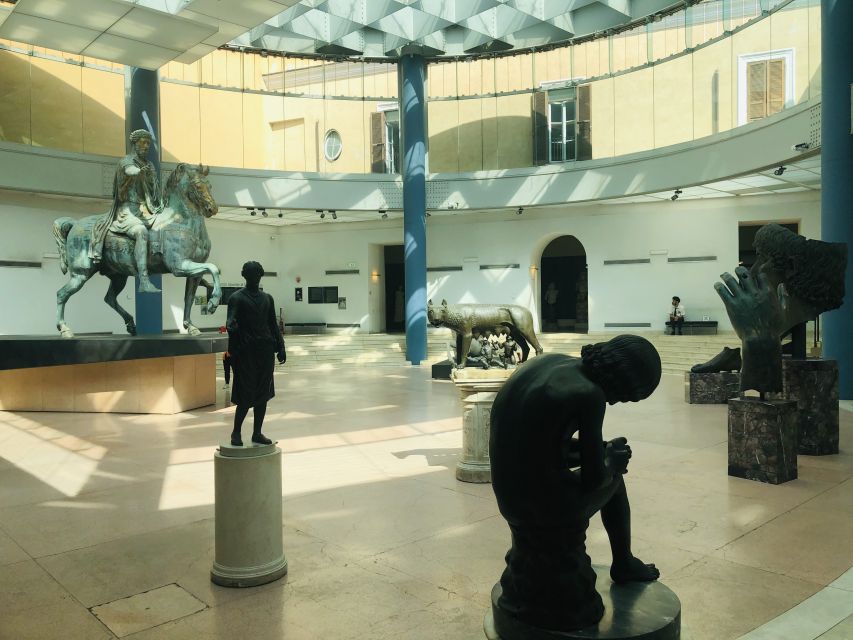
On the first floor, the collection shifts from massive imperial imagery to objects with more familiar human scale. The Capitoline Brutus is a bronze bust often linked with the early Roman Republic. Its stern face and severe expression have helped make it one of the museum’s most recognizable portraits.
The Spinario shows a boy removing a thorn from the sole of his foot. This Greco-Roman Hellenistic bronze is appealing because it is so ordinary in subject. The boy is not posing as a god or emperor. He is absorbed in a small physical problem, and the sculpture captures that concentration.
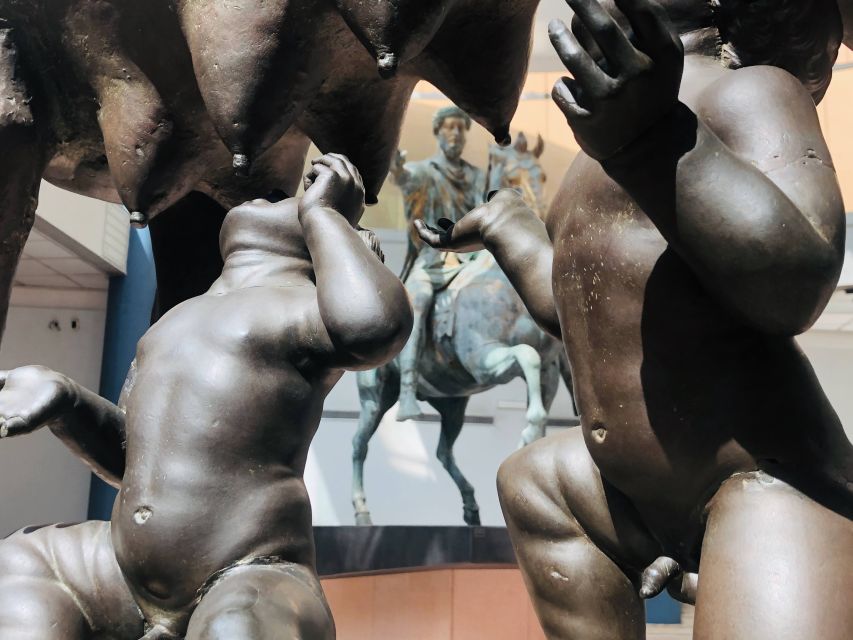
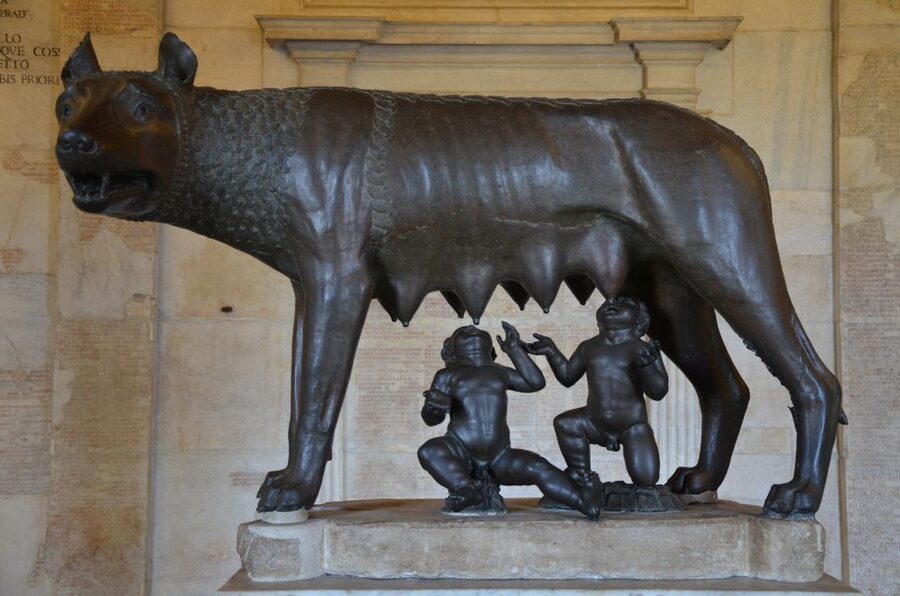
Then comes the Capitoline Wolf, the bronze she-wolf nursing Romulus and Remus. The image has become one of the main symbols of Rome, so seeing it in person can feel familiar before you even enter the room. The myth tells of the twins who founded Rome, while the object itself raises questions about style, date, and restoration.
Do not expect every popular story about the wolf to be settled in a single glance. The important point for you is how powerfully the image works as civic branding. Rome uses a founding myth, a she-wolf, and two vulnerable infants to tell a story about survival and destiny.
The Castellani collection adds another layer. It includes about 700 Greek and Etruscan vases, giving you a chance to see how ancient pottery carried scenes, patterns, and clues about trade and cultural contact. This is a good place to stay alert to the difference between Greek influence and Etruscan identity. The objects may look decorative, but they also record movement between cultures.
The Pinacoteca’s Caravaggio and Renaissance color
The second floor holds the Pinacoteca Capitolina, described as the oldest public collection of paintings. This section changes the mood of the tour. After the bronze statues, inscriptions, and ancient mythology, you are looking at canvas, color, gesture, and religious drama.
The collection includes works by Caravaggio, Guido Reni, the Carracci, Guercino, Domenichino, Veronese, Titian, Tintoretto, Rubens, and Pietro da Cortona. That is an impressive list, but the value is not simply in counting famous names. The guide’s role is to help you notice how each artist handles light, movement, emotion, and the human body.
Caravaggio is often the natural focus. His paintings can make sacred scenes feel immediate and physical, with strong contrasts between light and shadow. Titian and Tintoretto offer a different experience of Venetian color and movement. Rubens brings a powerful Baroque energy, while Guido Reni and the Carracci show other approaches to idealized form and religious storytelling.
You may find this floor especially rewarding if you want more than ancient Rome. The Capitoline Museums are not only an archaeology stop. The Pinacoteca shows how later artists looked back at the ancient world and reshaped it for their own audiences.
The collection also includes frescoes and sculptures from Renaissance and Baroque Rome. Look up and around rather than heading straight from one famous painting to the next. The room decoration, wall paintings, and architectural details help explain how art was meant to work in a Roman palace.
More museums and galleries in Rome:
- Vatican: Museums & Sistine Chapel Entrance Ticket
★ 4.5 · 144,003 reviews - Vatican Museums & Sistine Chapel Tour with Optional Basilica
★ 4.3 · 67,413 reviews - Vatican Museums, Sistine Chapel & St Peter’s Basilica Guided Tour
★ 4.5 · 39,149 reviews - Rome: Vatican Museums, Sistine Chapel & Basilica Tour
★ 4.3 · 13,872 reviews
Marcus Aurelius and the ancient temples below
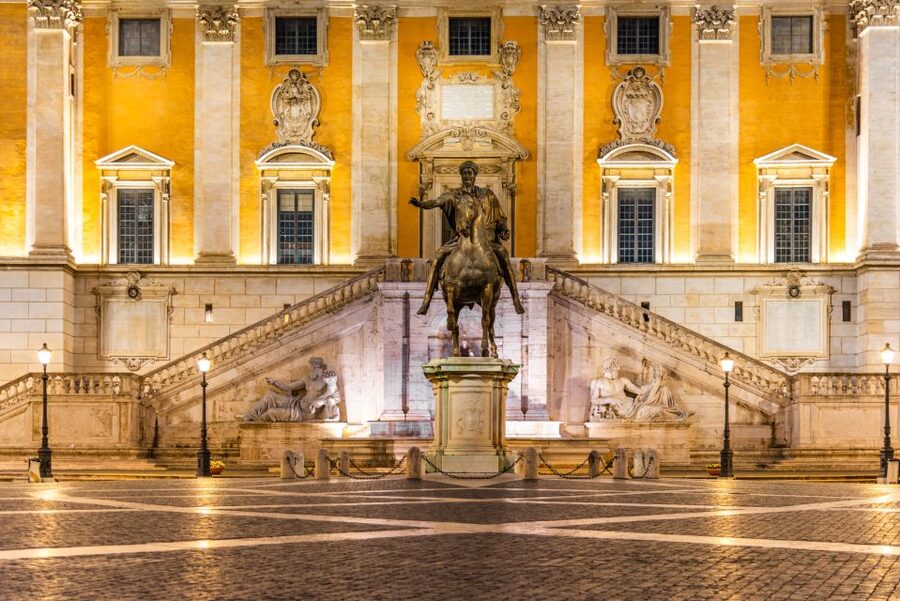
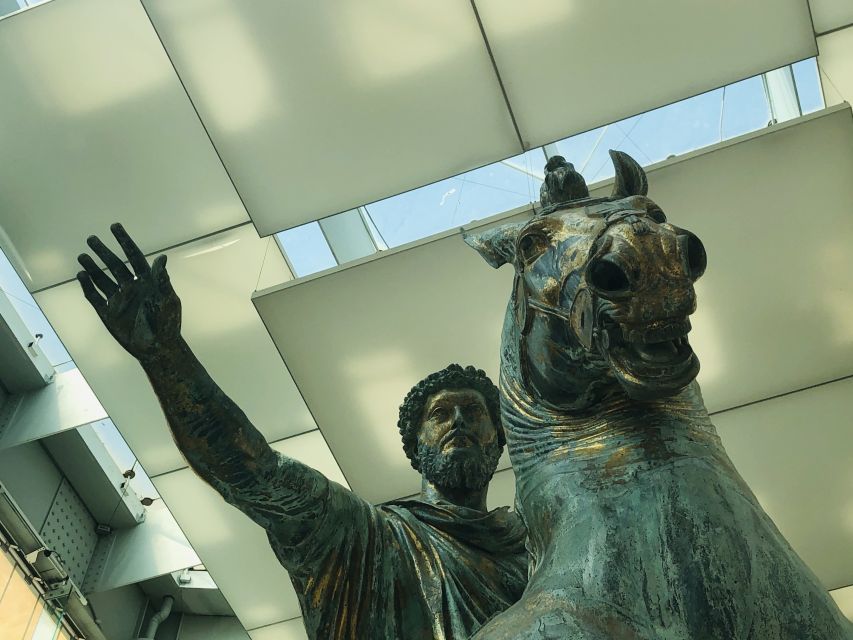
The tour then returns to the ground floor and the exedra containing the original equestrian statue of Marcus Aurelius. This is one of the visit’s major moments.
The statue once occupied a public position in Rome, where an emperor on horseback could be seen as a calm and commanding presence. Its survival is partly connected to a historical mistake: it was long believed to depict Constantine, the Christian emperor, rather than a less favored pagan ruler. That identification helped protect it from destruction.
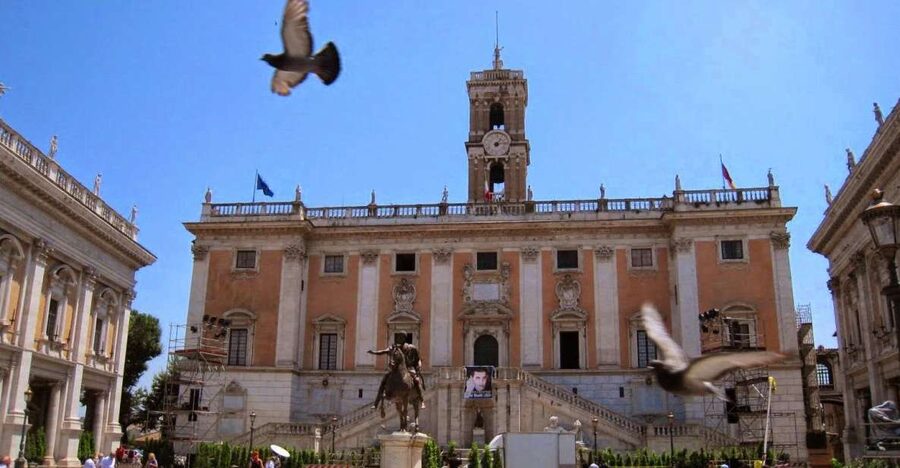
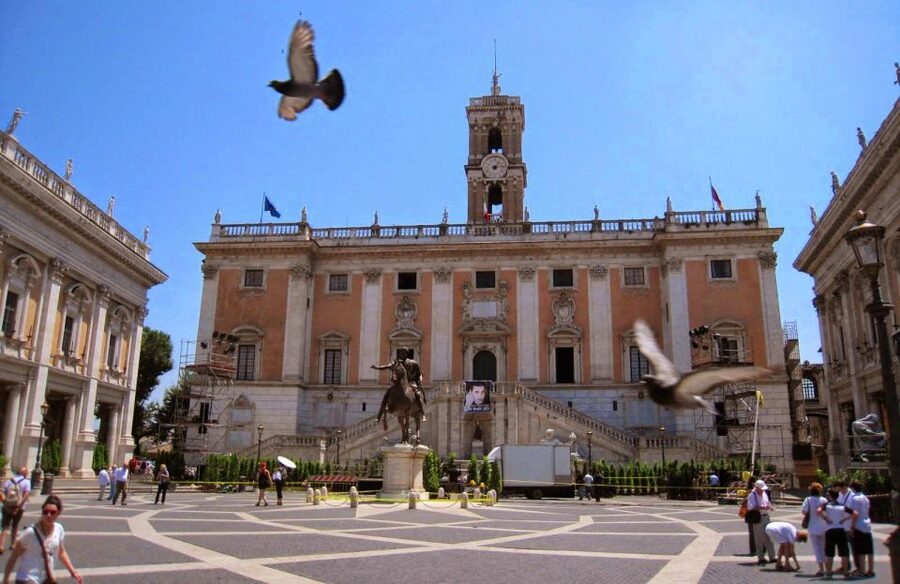
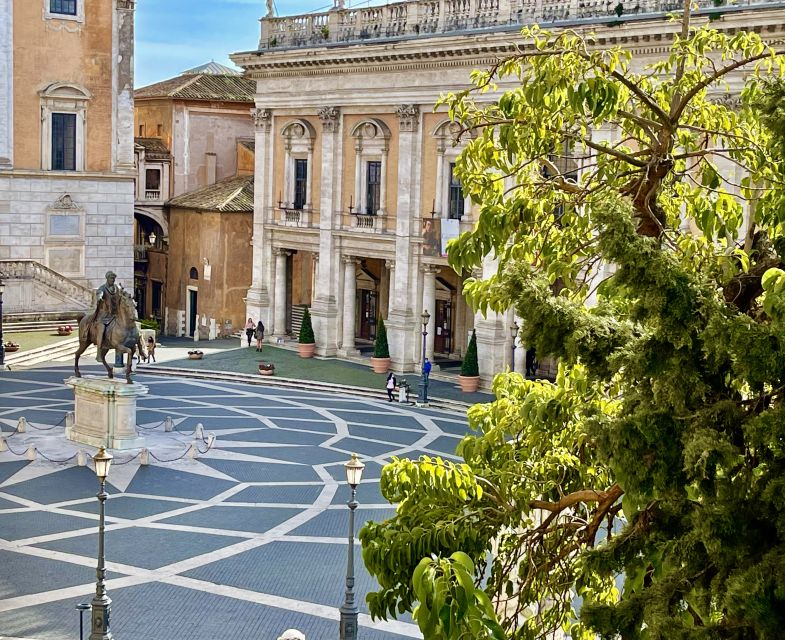
Today, the statue is displayed indoors, while a replica occupies the center of Michelangelo’s Capitoline Piazza outside. Knowing this before you arrive helps you understand why the museum version matters. You are not simply seeing a second copy after visiting the square. You are seeing the original work that carries the marks and material history of antiquity.
The exedra also lets you see ruins of ancient temples incorporated into the building. This is one of the most useful features of the museum. Rome often gives you several time periods in one view: ancient foundations, Renaissance design, Baroque decoration, and modern museum protection.
Your guide can connect the statue to Roman government, imperial portraiture, and the redesign of the Capitoline Hill. This is where a private tour can be more useful than a quick visit with a map. The visual details are strong, but the meaning depends on context.
Walking through the Tabularium above the Roman Forum
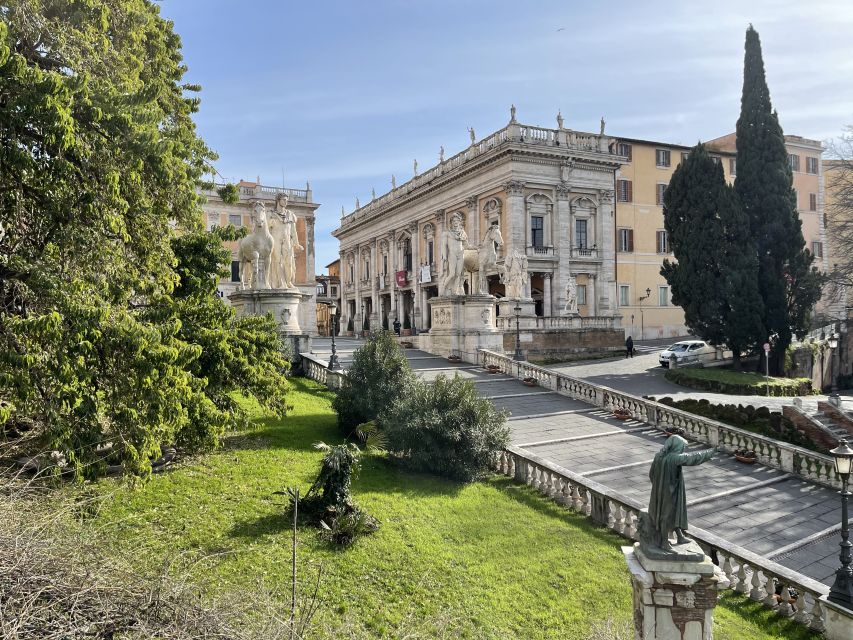
From the Marcus Aurelius display, you pass through an underground tunnel crossing the Tabularium. The passage connects the Palace of the Conservatives with the New Palace, the museum’s second historic seat.
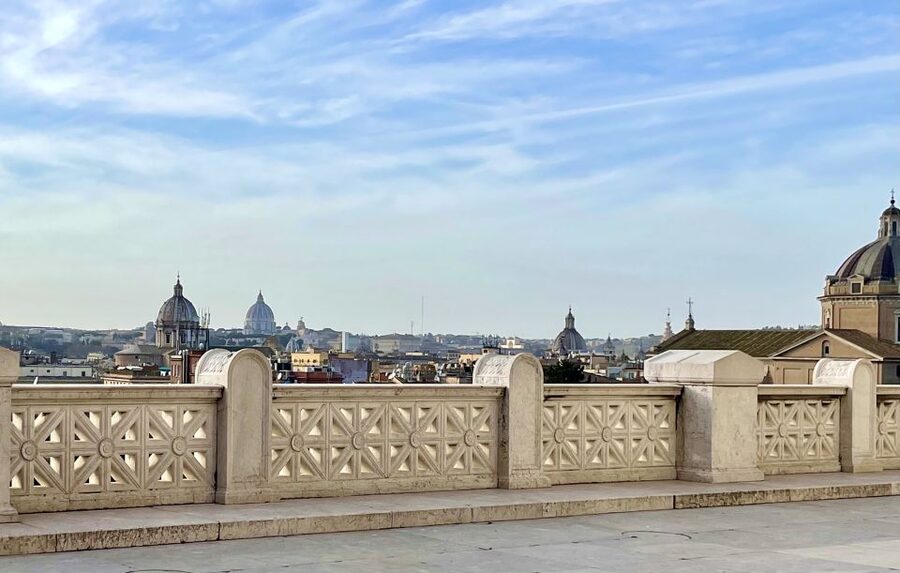
The route is not just a practical corridor. The Tabularium was connected with ancient Roman records and civic administration, and the passage gives you a physical link between the museum buildings. It also opens onto views of the Roman Forum.
Allow yourself a few minutes here. The Forum can be hard to understand from ground level because its ruins are spread across a wide area. From above, the layout becomes easier to read. You can see the remains as part of a civic center rather than a collection of disconnected columns.
This is also the tour’s best pause for photographs, although the exact views and light will depend on the day and starting time. The itinerary allows about 20 minutes for scenic views on the way, so do not treat this as a full Roman Forum tour. You see the Forum from the Capitoline Museums, but you do not tour the archaeological area itself.
The New Palace and its ancient Roman masterpieces
The final museum section is the New Palace. It houses statues, busts, inscriptions, sarcophagi, mosaics, and other ancient Roman objects. After the paintings and the high viewpoint, the return to sculpture brings the focus back to Rome’s classical collection.
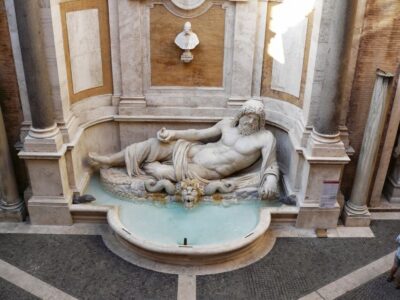
The statue of Marforio is one of the key works here. It is a large reclining river god, and its presence connects to Rome’s tradition of using ancient statues in public spaces and political conversation. The Dying Gaul offers a different emotional register. Its wounded figure is often praised for the care given to the body, hair, posture, and expression.
Cupid and Psyche provides another contrast. The subject comes from classical mythology, but the sculpture’s appeal lies in the tenderness and movement between the two figures. Seeing it alongside portraits, sarcophagi, and civic inscriptions helps you compare private emotion with public identity.
This palace is a good reason not to leave after the Capitoline Wolf and Marcus Aurelius. Those are the headline pieces, but the New Palace completes the story. You see how Romans represented emperors, gods, enemies, lovers, and ordinary human lives.
What the private guide adds
The tour includes a professional art historian guide, and the strongest praise centers on the guide’s ability to explain connections rather than recite labels. Martin is specifically named in the feedback, with strong comments about his museum knowledge and his ability to link historical events and societies.
That kind of guidance is useful here because the museums mix periods and styles. You may move from a Roman bronze to a Greek vase, then to Caravaggio, then back to imperial sculpture. Without help, the visit can feel like a series of famous objects. With a good guide, the shifts become part of the point.
The private format also gives you room to ask questions. If you care most about Roman mythology, you can spend longer with the Capitoline Wolf and Cupid and Psyche. If painting is your priority, you can ask for more time in the Pinacoteca. The exact balance depends on the guide and your group.
One practical detail is worth taking seriously. A couple on a rainy 1 p.m. visit had trouble locating the guide at first, but the operator connected them with help by phone. During the tour, one participant felt light-headed and needed water. The guide paused, went to the café, and added roughly 30 minutes afterward. You should not count on extra time, but the episode suggests that a considerate guide can make sensible adjustments when needed.
Price, timing, and who gets good value
At $201.65 per person, this is a premium museum tour. The price includes museum admission, skip-the-line access, and a private art historian guide, but not hotel pickup or drop-off.
The value depends heavily on your group size. For one or two people, the cost is high compared with entering independently. For a family or group that would otherwise book several separate guided visits, the private arrangement may make more sense, especially if you care about questions and a flexible focus.
Skip-the-line access matters most when queues are long. It does not make the museum smaller, so the benefit is time saved at the entrance rather than a faster route through the galleries.
The scheduled duration is 2.5 hours. That is long enough for the main route, but you should wear comfortable shoes and avoid bringing oversize luggage. Walking frames are not allowed, and the stated dress code is smart casual. Bring a passport or ID card, as requested for the activity.
English and Italian are available. The group can contain up to 20 people, although your actual party may be much smaller if you book privately with only your own companions. The tour begins and ends at the Capitoline Museums, so arrange your own way there and onward.
You can cancel up to 24 hours before the tour for a full refund, and the reserve-now, pay-later option gives you some flexibility while your Rome plans settle.
Who should book this Capitoline Museums tour?
I would recommend it most strongly to first-time Rome visitors who want ancient sculpture explained in context, art lovers who do not want to ignore the Pinacoteca, and families or groups that benefit from a guide’s attention.
It is also a good choice if you have limited time but still want more than a quick look at the Capitoline Wolf. The route covers both museum palaces, the main paintings, Marcus Aurelius, the Tabularium, and the Roman Forum viewpoint in one organized visit.
I would think twice if your main goal is to spend half a day studying paintings in detail or examining every archaeological object. The museum is too large for that within 2.5 hours. I would also skip it if you mainly want to walk through the Roman Forum itself, since this experience provides views of the Forum rather than entry and a full archaeological tour.
For a private visit, the best strategy is to arrive ready with one or two interests. Tell your guide if you care most about Roman myths, portrait sculpture, Renaissance painting, or the city’s ancient infrastructure. That simple preparation can make the tour feel more personal and less like a march through a checklist.
FAQ
Where does the tour begin?
The tour begins at the entrance to the Capitoline Museums. Your guide waits with a sign showing your name.
Where does the tour end?
The activity ends back at the Capitoline Museums meeting point.
How long does the tour last?
The tour lasts 2.5 hours. The museum portion is listed as about two hours, with roughly 20 minutes for scenic views on the way.
What does the price include?
The price includes entry to the Capitoline Museums, skip-the-line access, and a professional art historian guide.
Is hotel transportation included?
No. Hotel pickup and drop-off are not included.
What languages are available?
The live guide is available in English or Italian.
Is this a private tour?
Yes. The activity is offered as a private group tour, with a maximum of 20 people per booking.
Which famous works can I see?
The route includes the Capitoline Wolf, Capitoline Brutus, the Spinario, the original equestrian statue of Marcus Aurelius, the Dying Gaul, Marforio, and Cupid and Psyche. The Pinacoteca includes works by artists such as Caravaggio, Titian, Rubens, Veronese, and Guido Reni.
What should I bring?
Bring a passport or ID card and wear comfortable shoes.
Can I cancel if my plans change?
Yes. You can cancel up to 24 hours in advance for a full refund. You can also reserve now and pay later.
Should you book it?
Book this tour if you want the Capitoline Museums explained as a connected story rather than a room-by-room collection. You will see Rome’s founding myth, imperial power, ancient sculpture, Renaissance painting, Baroque drama, and the Roman Forum from above in a single visit.
The price is not modest, but the private art historian and skip-the-line entry can justify it for a couple, family, or small group that values clear explanations. Choose it for context and conversation, not for unlimited gallery time. If that sounds like the right balance, this is one of Rome’s most efficient ways to meet the city’s artistic and civic past.
Newest reviews from Rome
- Vatican private tour –Museums and Sistine Chapel with Raphael rooms★ 4.5 · 20 reviews
- Rome Semi-Private Tour from Civitavecchia★ 4.0 · 20 reviews
- The Pasta Factory Class★ 4.5 · 21 reviews
- Much More Than Just a Cooking Class in Rome★ 5.0 · 21 reviews
- 2 Hour Tasting of Overlooked Wines of Rome and Lazio★ 5.0 · 21 reviews
- Circo Maximo entrance ticket + virtual experience★ 3.0 · 21 reviews
- Sistine Chapel and Vatican Museum Guided Tour★ 3.5 · 21 reviews
- Italian Gelato Making Experience in Rome★ 5.0 · 21 reviews
Capitoline Museums Tours, compared.
Capitoline Museums Experience with Multimedia Video
Read our review →
Capitoline Museum Experience with Multimedia Video
Read our review →
Percy Jackson and the Olympian Gods Tour at the Capitoline Museums
Read our review →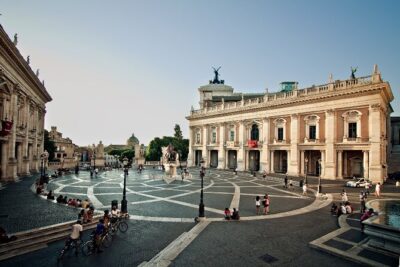
Percy Jackson Tour for Kids at the Capitoline Museums of Rome with Special Guide
Read our review →
Capitoline Museum English Guided Tour & skip the line ticket
Read our review →Browse the lists this tour appears in