
Reviewed · WALKING TOURS
Rome Art Walking Tour Who Killed Caravaggio
Caravaggio’s Rome was a place of brilliant paintings, street fights, secret patrons, and one unanswered question: who killed the artist? This two-hour evening walk turns central Rome into a crime story, with original Caravaggio paintings still hanging in the churches where they were made for.
I like the way the tour links art to real streets, especially the murder site on Via di Pallacorda and the homes connected to Caravaggio and his model Lena. I also like the guide-led storytelling. Simone, Ivan, and Jacopo have each been praised for clear explanations, patience, and genuine enthusiasm.
The main consideration is the walking commentary. One strong guide sometimes keeps answering questions while moving, and you may miss parts of the conversation unless you stay close. The group can reach 25 people, so claim a good spot near the guide.
In This Review
- Key points at a glance
- Why Caravaggio makes such a good Rome walking tour
- Starting at Piazza della Minerva
- A quick look at the Pantheon
- San Luigi dei Francesi and Caravaggio’s St. Matthew
- Sant’Agostino, where Caravaggio meets Raphael
- Via di Pallacorda and the violent turn
- Lena’s home and Caravaggio’s address
- Palazzo Borghese and the Hunting Club
- The guide makes or breaks the experience
- Is $4.83 a good value?
- Who should book this walk?
- Final call on Who Killed Caravaggio?
- FAQ
- How long does the Rome Art Walking Tour Who Killed Caravaggio last?
- Where does the tour begin?
- What time does the tour start?
- Where does the tour finish?
- Are Caravaggio’s original paintings included?
- Is the tour available in English and how many people can join?
Key points at a glance
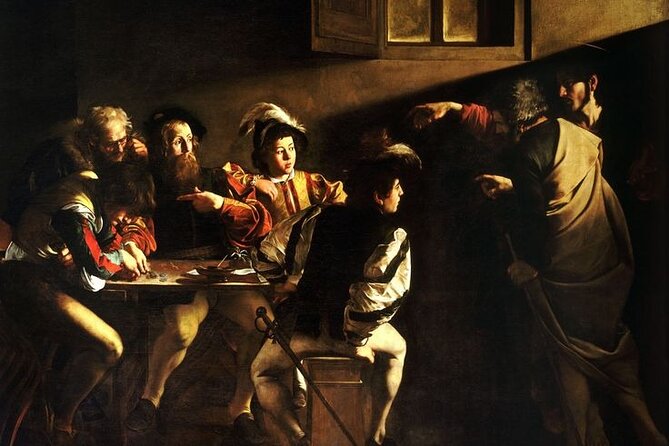
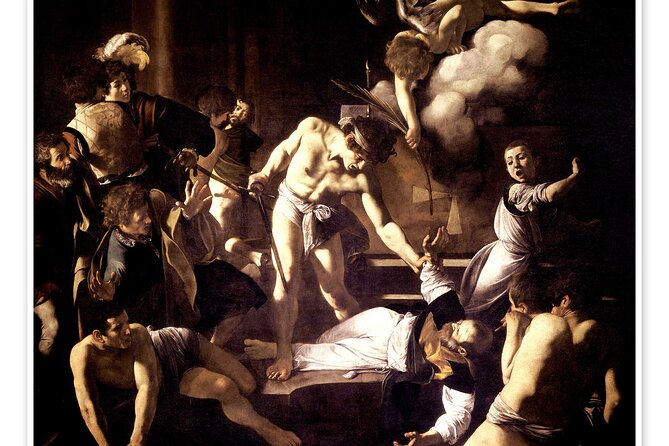
- See three Caravaggio paintings in one church: San Luigi dei Francesi holds the famous Contarelli Chapel scenes of St. Matthew.
- Stand at the reported murder scene: Via di Pallacorda connects the art lesson to the violent event that changed Caravaggio’s life.
- Visit Sant’Agostino for another original: The church displays Caravaggio’s Madonna di Loreto alongside Raphael’s Isaiah.
- Begin beside Bernini’s elephant: Piazza della Minerva gives you a compact lesson in ancient Rome, Gothic architecture, and Baroque design.
- Pay is tip-based: The listed price is only $4.83 per person, but your tip is the guide’s main payment.
- Finish near Palazzo Borghese: The final stop adds a look at elite Roman society and the old Hunting Club linked to the Borghese family.
Why Caravaggio makes such a good Rome walking tour
Caravaggio is not a tidy museum subject. His paintings show saints with dirty feet, startled faces, hard shadows, and bodies that look startlingly real. His personal story is just as dramatic: he was celebrated by powerful patrons, yet repeatedly involved in fights and legal trouble.
That mix gives the tour a useful shape. You are not simply moving from one church to another to admire famous canvases. You are following the places, people, and conflicts that help explain why the paintings feel so tense.
The title asks who killed Caravaggio, but this is not presented as a simple detective case with a neat final answer. Instead, the question draws you through the artist’s life and the tangled world around him. As you walk, each painting becomes part of the larger story.
You also get a practical advantage. Many of Rome’s best Caravaggio paintings are in churches rather than museums, and this route shows you how to find them. You can return later at your own pace, armed with enough background to understand what you are seeing.
More Bernini and Caravaggio art walks:
- Renaissance Scarlet Ladies Tour: Caravaggio’s and Borgia’s Women
★ 5.0 · 65 reviews - Caravaggio Art Walking Tour of Rome with Pantheon Visit
★ 4.5 · 35 reviews - Rome’s Baroque Art Walking Tour: Who Killed Caravaggio?
★ 5.0 · 27 reviews
Starting at Piazza della Minerva
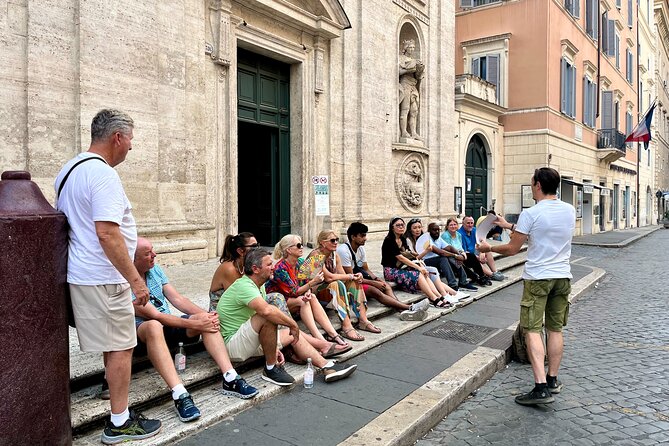
Meet at 5:00 pm in Piazza della Minerva, near the Pantheon. This is a smart starting point because the square is small, central, and packed with contrasts.
At its center is Bernini’s famous elephant carrying an obelisk. Behind it rises Santa Maria sopra Minerva, a Gothic basilica built over an ancient temple dedicated to Minerva. In just a few steps, you move from ancient Roman religion to medieval church design and then to the theatrical Baroque style that shaped Caravaggio’s world.
The first stop lasts about 15 minutes and has no admission charge. That matters because the tour uses public spaces and churches rather than adding a costly museum ticket to the price.
Arrive with enough time to find the meeting point. The Pantheon area can be crowded, and a tour that begins with a clear introduction is easier to follow than one joined at the last moment.
A quick look at the Pantheon
The route passes the Pantheon, one of Rome’s great ancient buildings. Built around 126 AD, it is known for its huge dome and central oculus, which sends a shaft of daylight into the interior.
The Pantheon is now a church and also the burial place of Raphael, one of the artists who helps frame the period before Caravaggio. Even if the group pauses only briefly, this is a useful piece of context. Rome’s Baroque painters were working in a city already filled with ancient monuments, Renaissance masterpieces, and powerful churches.
You will not receive a separate Pantheon entry as part of the tour details provided, so treat this as an exterior or passing sight unless your guide says otherwise. The value here is the setting and the connection to Rome’s wider art story, not a guaranteed interior visit.
San Luigi dei Francesi and Caravaggio’s St. Matthew
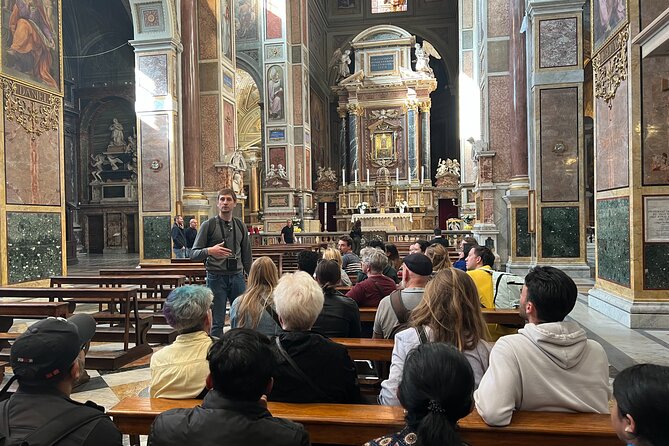
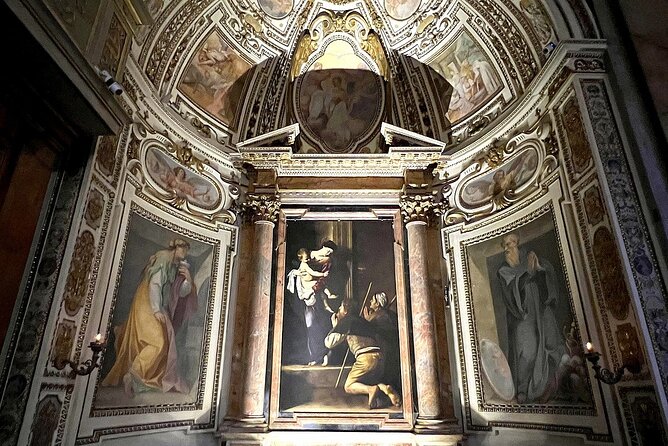
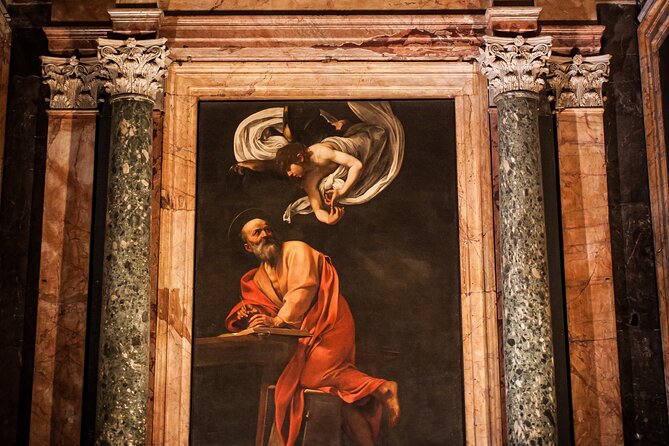
The artistic center of the walk is San Luigi dei Francesi, the Church of St. Louis of the French. Its Contarelli Chapel contains three Caravaggio paintings devoted to the life of St. Matthew.
This is where the tour earns its subject. Seeing reproductions in a book is useful, but standing in front of the originals inside a Roman church gives the work a different force. Caravaggio’s strong light and dark shadows pull your eye toward gestures, faces, and moments of sudden action.
The visit is scheduled for about 15 minutes, with no admission fee listed. That is enough time for a focused explanation, though not enough for a slow, private study of every detail. If you want long periods of silence with each painting, a self-guided return visit may suit you better.
Pay attention to how the guide explains the stories behind the pictures. The strongest part of this tour is not simply naming the paintings. It is showing how the scenes connect to Caravaggio’s patrons, his style, and the difficult world he inhabited.
Keep close to the guide here. Church interiors can make group movement awkward, and a large group may spread out quickly.
More walking tours in Rome:
- Rome: Trastevere & Campo de Fiori Street Food Walking Tour
★ 4.9 · 2,768 reviews - Rome: Paranormal Night Walking Tour & Secret Backstreets
★ 4.9 · 1,921 reviews - Rome by Night Walking Tour – Legends & Criminal Stories
★ 4.5 · 1,003 reviews - Rome: Guided City Center Evening Sightseeing Walking Tour
★ 4.4 · 953 reviews
Sant’Agostino, where Caravaggio meets Raphael
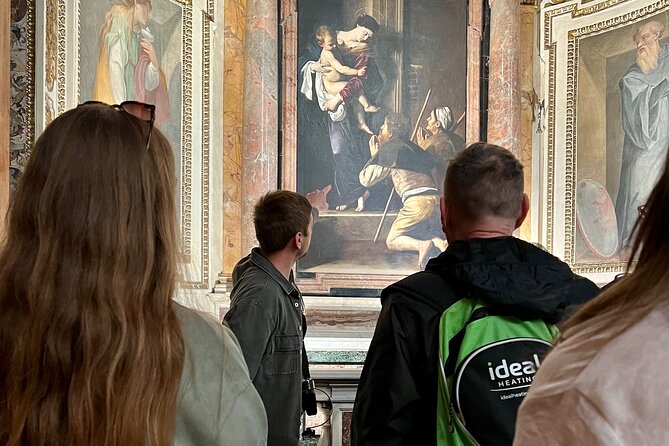
Sant’Agostino brings a second major Caravaggio work into the route: the Madonna di Loreto. The church also contains Raphael’s fresco of Isaiah, giving you a direct comparison between two very different artists.
Caravaggio’s Madonna is famous for its direct, human presentation of a sacred subject. The painting does not feel remote or polished in the usual idealized way. The people look like people, and that plainness helps explain why his work could excite some viewers and disturb others.
The guide’s job here is to help you notice choices that might otherwise pass in a few minutes. Look for the way light controls the scene, how ordinary details affect the mood, and how the painting asks you to confront its figures rather than admire them from a safe distance.
Again, the planned stop is about 15 minutes and free to enter. Churches can sometimes have their own opening rules or interruptions, so the stop should be understood as part of the walking experience rather than a guaranteed extended viewing session.
Via di Pallacorda and the violent turn
The route then leaves the churches and reaches Via di Pallacorda, identified as the murder scene of Tomassoni, Caravaggio’s victim. This is one of the most effective parts of the experience because it changes the mood completely.
A painting can seem detached from daily life when you see it on a museum wall. Here, the guide connects the artist’s career to a real Roman street and the violence that helped drive the rest of his story. The setting is not presented as a grand monument. That is precisely why it can be so striking.
Allow about 10 minutes for this stop. There may be little to see in the street itself, so the value depends heavily on the explanation. If you prefer tours built around monuments and interiors at every stop, this section may feel modest. If you enjoy social history and a good story, it gives the route its dramatic backbone.
Lena’s home and Caravaggio’s address
The walk continues to Vicolo del Divino Amore, where you hear about the home of Lena, described as Caravaggio’s most scandalous model. The stop lasts around five minutes.
This short pause adds a personal dimension to the artist’s work. Models, patrons, friends, rivals, and landlords all belonged to the world behind the paintings. Lena is not just a name attached to a canvas. Her connection helps show how Caravaggio drew from people around him and how his private life could become part of his public reputation.
The same vicolo also marks the house associated with Caravaggio himself. Another five-minute stop gives you a physical point of reference for the artist’s daily life.
Do not expect a preserved studio or a grand museum display. The appeal is the address and the story attached to it. You are using ordinary streets to picture the artist outside the gallery, which is one reason this route feels different from a standard art lecture.
Palazzo Borghese and the Hunting Club
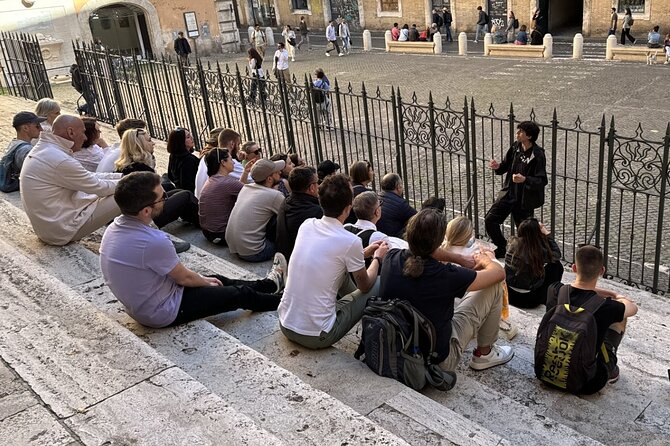
The final stop is Palazzo Borghese in Piazza Borghese, near the Spanish Steps. The palace was once home to the powerful Borghese family and is an example of Roman Baroque aristocratic architecture.
The tour also discusses Il Circolo della Caccia, or the Hunting Club, a private 17th-century gathering associated with the Borghese family. It brought together noblemen and intellectuals for conversation, art exhibitions, and private hunting activities.
This stop widens the story beyond Caravaggio. His career depended on Rome’s network of churches, aristocrats, artists, and patrons. Understanding that network helps explain why a painter could rise quickly, fall into disgrace, and still find protection among influential people.
The stop lasts about 15 minutes and is free. Do not assume that you will enter the palace or visit private club rooms. The supplied details describe the building and its historical connections, so the main experience is the guide’s account from the public area.
Finishing here is convenient for a central Rome evening, but the tour does not return to Piazza della Minerva. Plan your route afterward from Piazza Borghese.
The guide makes or breaks the experience
This walk depends more on storytelling than on tickets or special equipment. The guide needs to make paintings readable, keep the group together, and turn streets with few visible clues into meaningful places.
Simone has been praised for his enthusiasm and gently interactive style. That combination matters. You may be asked to think about a painting or solve part of the mystery, but the interaction is described as low-pressure rather than theatrical.
Ivan has been noted for clear information and a respectful approach. Jacopo has received praise for taking time with questions and responding carefully. Guide assignments can change, so you cannot book a specific person unless the operator confirms it.
One practical point deserves attention: stay close during transitions. A guide may continue answering questions while the group walks. That creates a friendly conversation for people beside him, but it can leave those at the back without the full explanation.
With a maximum of 25 people, this is not a private tour. It is still a manageable size for city walking, but your position in the group matters. Move forward when the group gathers at a stop, especially inside churches.
Is $4.83 a good value?
At $4.83 per person, the listed cost is remarkably low for a two-hour guided walk through central Rome. But this is a tip-based tour, and the guides work for tips alone. The price is therefore not the full measure of what the experience costs.
Think of the listed amount as access to the walking tour, with the guide’s main income coming from your gratuity. If you value the tour, budget for a fair tip rather than treating the low booking price as the final expense.
The value is strongest if you want a focused introduction to Caravaggio without paying for several museum admissions. The churches and outdoor locations on the route are listed as free, and the guide supplies the interpretation that connects them.
The value is weaker if you want a private art lesson, long viewing periods, or guaranteed time inside every building. This is a compact group walk with several short stops, not a full-day art seminar.
Who should book this walk?
I would recommend it to anyone with even a small interest in art, especially if you want more than a checklist of Rome’s famous buildings. The route suits first-time visitors who need a clear introduction to Caravaggio and returning visitors looking for a new angle on familiar streets.
It is also a good choice for people who enjoy biography, crime stories, and local details. The murder site, Lena’s home, and Caravaggio’s former address give the tour enough human drama to hold your attention between paintings.
You may want to skip it if you dislike walking tours centered on storytelling or if you need a slow pace with plenty of time for photographs. The duration is about two hours, but the route includes several short stops, so the experience moves steadily.
Wear comfortable shoes and keep your attention on the guide during walks between stops. The tour is offered in English, uses a mobile ticket, allows service animals, and is near public transportation. Most people can participate, though no specific accessibility details beyond that are supplied.
Final call on Who Killed Caravaggio?
Book this tour if you want to see original Caravaggio paintings in their Roman church settings and understand the turbulent life behind them. The strongest reasons are the Contarelli Chapel, the Madonna di Loreto, and the walk through places tied to the artist’s violence and private life.
I especially like that the route does not stop at art appreciation. It asks you to connect painting, personality, patronage, and place. Just stay near the guide, remember that tips are the real payment, and keep your expectations realistic about short church visits and outdoor stops.
For a very small listed price, this offers a lively way to meet Caravaggio on Rome’s streets rather than only in a textbook.
FAQ
How long does the Rome Art Walking Tour Who Killed Caravaggio last?
The tour lasts approximately two hours.
Where does the tour begin?
The meeting point is Piazza della Minerva, near the Pantheon, in central Rome.
What time does the tour start?
The tour starts at 5:00 pm.
Where does the tour finish?
The tour ends at Palazzo Borghese, Piazza Borghese, in Rome.
Are Caravaggio’s original paintings included?
Yes. The route visits San Luigi dei Francesi, where three Caravaggio paintings about St. Matthew are displayed, and Sant’Agostino, where the Madonna di Loreto is located.
Is the tour available in English and how many people can join?
The tour is offered in English and can include a maximum of 25 travelers.
Newest reviews from Rome
- Rome: Vatican Museums & Sistine Chapel Skip-the-Line Ticket★ 4.4 · 148 reviews
- Shared Shuttle Transfer from Rome to Civitavecchia Port★ 5.0 · 148 reviews
- Rome: Crypts & Catacombs After Hours Tour with Bone Chapel★ 4.6 · 149 reviews
- Ghosts Legends and Mysteries of Rome Walking Tour★ 5.0 · 149 reviews
- Skip the Line: Vatican and Sistine Chapel with Guided Tour★ 4.0 · 149 reviews
- Tivoli: Villa Gregoriana Entrance Ticket★ 4.7 · 150 reviews
- Pizza and Tiramisu Cooking Class in Rome, Piazza Navona★ 5.0 · 150 reviews
- Appian Way E-bike Tour with Gourmet Picnic and Catacombs★ 4.5 · 150 reviews
Walking Tours, compared.
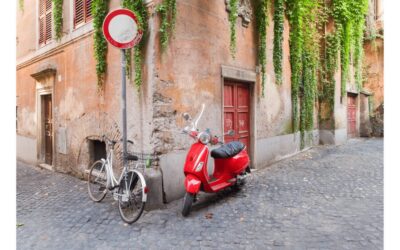
Trastevere & Campo de Fiori Street Food Walking Tour
Read our review →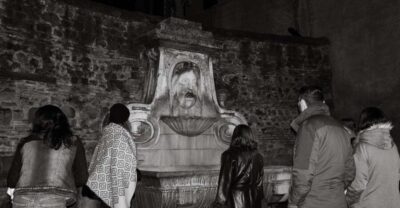
Paranormal Night Walking Tour & Secret Backstreets
Read our review →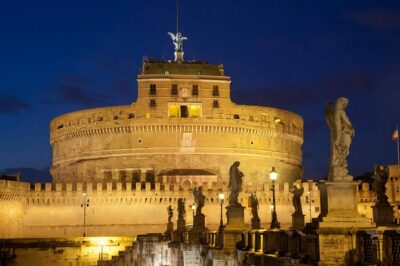
Rome by Night Walking Tour – Legends & Criminal Stories
Read our review →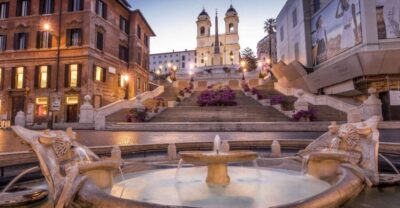
Guided City Center Evening Sightseeing Walking Tour
Read our review →
Best of Rome Walking Tour including Trevi Fountain
Read our review →

Forbidden History Walking Tour & Pub Crawl with Drinks
Read our review →
Guided Small Group Walking Tour of City Highlights
Read our review →Browse the lists this tour appears in