

Reviewed · JEWISH GHETTO TOURS
Rome: Jewish Ghetto Walking Tour
Rome’s Jewish Ghetto is one of the few places in Rome where ancient ruins, Jewish memory, Renaissance art, and modern city life meet within a short walk. This 2.5-hour tour begins near Trajan’s Column and follows a thoughtful route through the Theater of Marcellus, Portico d’Ottavia, the Great Synagogue, and Tiber Island.
I like the storytelling. Guides such as James, Angela, Tom, Daniel, and Maria have a gift for connecting Roman history with personal stories and everyday life. I also like the small-group feel reported on many departures, including occasions when a scheduled group became a private tour. The main consideration is that the tour does not include entry inside the Great Synagogue, which some visitors will wish had been part of the experience.
The walking route is not hard to understand, but Rome’s paving stones and warm summer sun call for comfortable shoes, water, sunscreen, and a hat. Tours run in all weather, and the group cannot wait for late arrivals, so arrive early at the meeting point and look for the orange Roman Vacations sign.
In This Review
- Key points to know before booking
- Why the Jewish Ghetto is worth two and a half hours
- Starting at Trajan’s Column and the Theater of Marcellus
- The Turtle Fountain and a story of unrequited love
- Walking through the Jewish Ghetto
- Portico d’Ottavia and ancient stone in a living neighborhood
- The Great Synagogue and what you will not see
- Kosher gelato and a useful pause
- Crossing to Tiber Island
- The guides are the main reason to book
- Is $65 a fair price?
- Who will enjoy this walk most?
- Should you book the Rome Jewish Ghetto Walking Tour?
- FAQ
- How long is the Rome Jewish Ghetto Walking Tour?
- How much does the tour cost?
- Where does the tour begin?
- What language is the tour conducted in?
- Which major sites are included?
- Can you enter the Great Synagogue during the tour?
- Is food included?
- What should you bring?
- What happens if you arrive late or the weather is bad?
Key points to know before booking
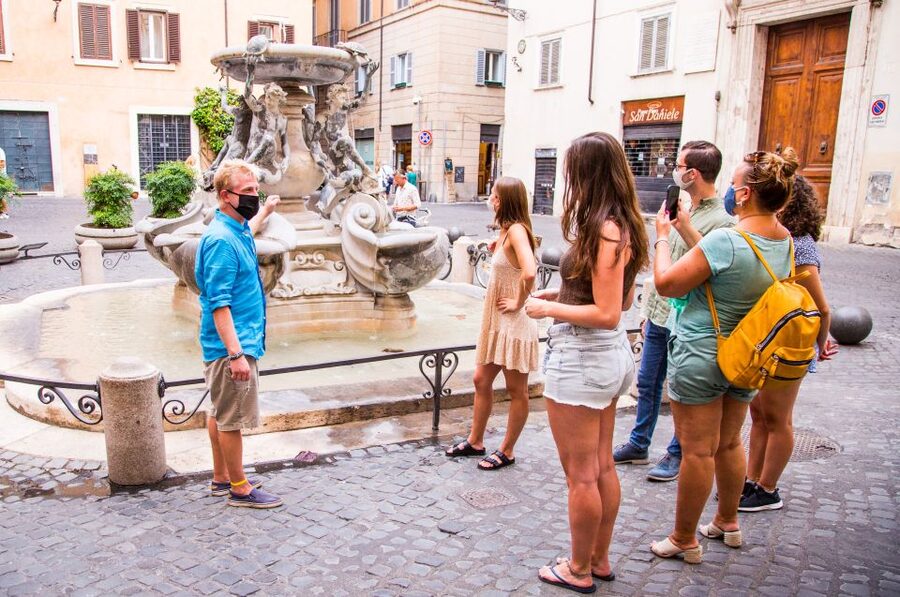
- Ancient Rome before the Colosseum: The Theater of Marcellus gives you a striking look at a working Roman structure that predates the Colosseum.
- Jewish history told through real places: The route passes the former ghetto wall, Portico d’Ottavia, and the Great Synagogue while explaining the long, difficult story of Rome’s Jewish community.
- A guide makes the difference: James, Angela, Tom, Daniel, Maria, and others have been praised for clear explanations, warm personalities, and lively storytelling.
- A sweet pause included: Your tour includes kosher gelato or coffee at a gelateria.
- A walk beyond the usual center: Crossing Rome’s oldest functioning bridge to Tiber Island adds ancient religion, wartime courage, and a change of scene.
- One important limitation: You see the Great Synagogue from the outside rather than entering it as part of the standard route.
Why the Jewish Ghetto is worth two and a half hours

Rome can feel like an open-air museum, but it is easy to look at ruins without understanding how they fit together. The Jewish Ghetto solves that problem in a compact neighborhood. You are not simply moving from monument to monument. You are following the changing fortunes of a community that lived beside, within, and sometimes under pressure from the city’s larger Roman and Christian worlds.
The name ghetto refers to the enclosed district where Rome’s Jewish population was forced to live for centuries. The route helps you see the physical traces of that confinement while also showing how the area has changed. Ancient stonework is still part of modern streets, and memorial markers bring more recent memory into the walk.
I especially like the way the tour begins with broader Roman history. That approach gives the Jewish Ghetto a proper setting rather than treating it as an isolated subject. You first encounter imperial Rome, then Renaissance Rome, then the Jewish community’s story, and finally the wider human story of survival and rescue on Tiber Island.
This is also a useful choice if you are not Jewish. Several visitors who came without a personal connection to Jewish history found the tour meaningful because it explains Rome as a whole. You come away with a better sense of how religion, politics, architecture, and daily life have overlapped here for more than two thousand years.
More Jewish Ghetto walks:
- Rome: Trastevere or Jewish Quarter Street Food Tour
★ 4.8 · 3,839 reviews - Jewish Ghetto and Trastevere Tour Rome
★ 4.5 · 1,729 reviews - Jewish Ghetto and Synagogues with Jewish Roman Guide 3 Hours
★ 5.0 · 907 reviews
Starting at Trajan’s Column and the Theater of Marcellus
The meeting point is at Foro Traiano, 84, near Trajan’s Column in central Rome. Look for the orange Roman Vacations sign. Since the group will not wait for late arrivals, allow time to find the exact spot, especially if you are coming from another sight in the historic center.
The first major stop is the Theater of Marcellus, with about 20 minutes of guided explanation. It is an excellent opening because it challenges the familiar idea that the Colosseum is Rome’s only great ancient performance venue. The theater is older than the Colosseum, and its surviving structure has been incorporated into later buildings.
That mixture of old and new is one of the tour’s strongest themes. Your guide can point out how Roman construction was reused over time, rather than leaving you with the false impression that ancient Rome ended when the empire declined. The Theater of Marcellus is a physical lesson in continuity.
This stop also rewards a good guide. James and Tom, in particular, have been praised for placing Roman history in a clear sequence and explaining it in manageable sections. If you enjoy dates and political history, you will have plenty to consider. If you prefer stories, the guides have also been praised for turning facts into scenes you can picture.
The Turtle Fountain and a story of unrequited love
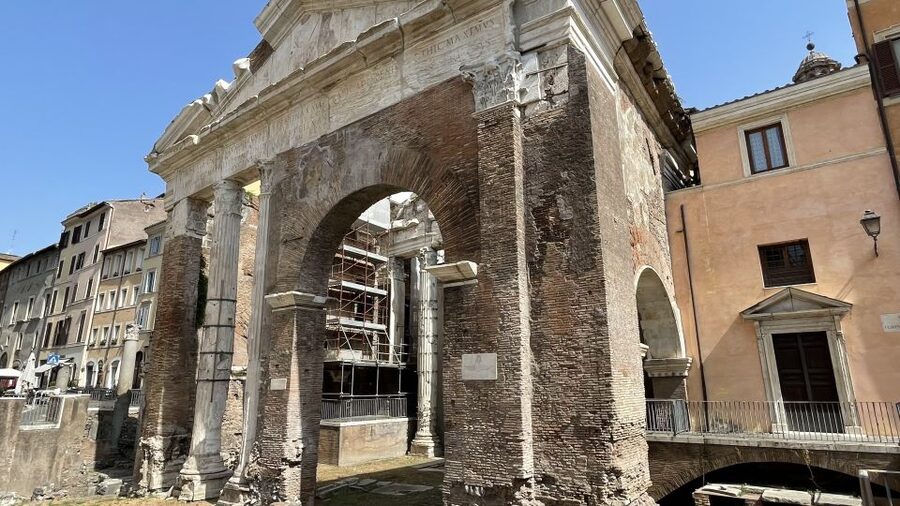
From the theater, the route continues to Piazza Mattei and the Fontana delle Tartarughe, or Turtle Fountain. The guided stop lasts about 20 minutes, giving you time to look closely at the sculpture and hear the story connected with it.
The fountain is a fine example of why a walking tour can add value even when the monument itself is free to see. On your own, you might admire the turtles, take a photograph, and keep moving. With a guide, the fountain becomes part of Rome’s social history, complete with a tale of unrequited love.
The story adds a human touch to the architecture. This is not a major museum visit or a grand church interior. It is a small urban space where art, romance, patronage, and local memory meet. Angela and Daniel have both been praised for making such stops easy to follow and enjoyable without turning the tour into a lecture.
Piazza Mattei is also a natural point to notice the pace of the experience. The group walks between stops, then pauses for explanations. Guides have adjusted their pace for visitors who needed to walk slowly, and small groups make it easier to hear without crowding around the speaker.
Walking through the Jewish Ghetto
The central Jewish Ghetto stop lasts about 20 minutes, though the neighborhood’s story continues through the nearby sites. Here, the guide explains how Rome’s Jewish community lived through centuries of restrictions, upheaval, and change.
One particularly effective detail is the remaining piece of the wall that once enclosed the community. A surviving fragment can say more than a long list of dates. It helps you understand that the ghetto was not just a name on a map. It was a controlled physical space that shaped where people could live, work, worship, and move.
The strongest guides make this history personal without losing accuracy. Reviews consistently praised guides for telling stories about what life was like in the area, not just reciting political events. That distinction matters. You learn about the people who lived in the neighborhood, the pressures they faced, and the ways the community endured.
The tone can become serious, especially when the tour reaches the persecution and murder of Jews during the Second World War. This is not a light sightseeing stroll, and it should not be. At the same time, the experience is not limited to tragedy. It also presents resilience, living culture, and the continued presence of Jewish life in Rome.
If you are visiting on a Friday afternoon, plan carefully. One visitor specifically advised against scheduling the tour just before the Sabbath begins. The timing may affect the atmosphere and the activities of local businesses and religious sites, so another day or an earlier start may suit you better.
More walking tours in Rome:
- Rome: Trastevere & Campo de Fiori Street Food Walking Tour
★ 4.9 · 2,768 reviews - Rome: Paranormal Night Walking Tour & Secret Backstreets
★ 4.9 · 1,921 reviews - Rome by Night Walking Tour – Legends & Criminal Stories
★ 4.5 · 1,003 reviews - Rome: Guided City Center Evening Sightseeing Walking Tour
★ 4.4 · 953 reviews
Portico d’Ottavia and ancient stone in a living neighborhood
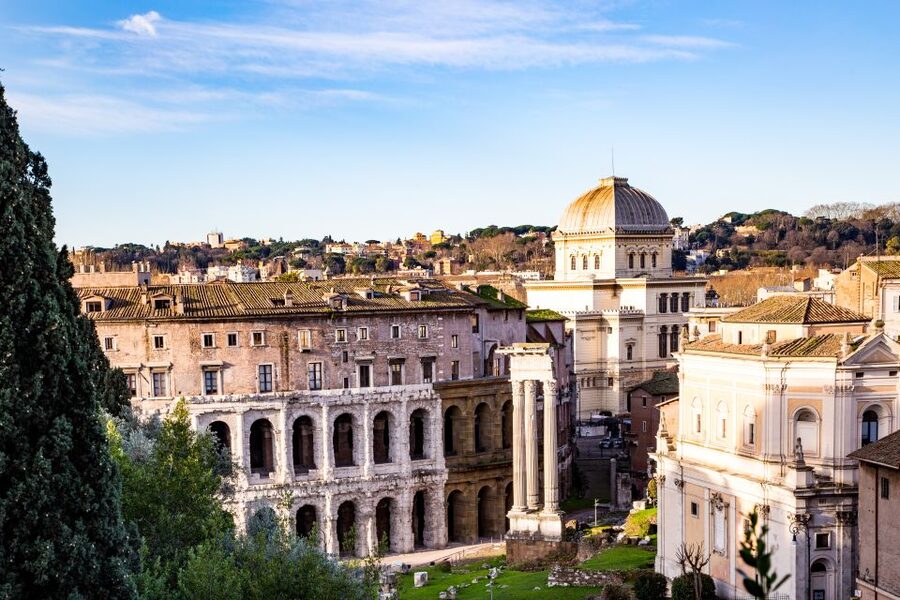
The Portico d’Ottavia receives about 15 minutes of guided attention. This ancient complex is one of the route’s most impressive reminders that the Jewish Ghetto is built among Roman ruins, not far away from them.
The portico once formed part of a large public area in ancient Rome. Today, its surviving columns and arches sit within the neighborhood, where the past is part of the daily setting. Your guide explains what you are seeing and how the site relates to the surrounding streets.
I like this stop because it keeps the tour from becoming narrowly focused on one period. The Jewish Ghetto is not presented as a separate pocket with no connection to Rome’s earlier civilizations. Instead, you see how the neighborhood grew around ancient structures and how different eras left marks on the same small area.
The Portico d’Ottavia also makes a good photographic stop, but remember that the guide’s explanation is the point. If you rush ahead for pictures, you may miss the links between the ruins, the old ghetto, and the modern neighborhood. Stay close enough to hear, then take your photographs during the pauses.
The Great Synagogue and what you will not see
The Great Synagogue of Rome is one of the tour’s major landmarks. You pass by it while learning about the Jewish community’s history and its place in the city. The building is an important symbol of Rome’s Jewish life, but the standard tour does not include an interior visit.
That limitation deserves clear attention because it has affected the expectations of some visitors. If entering the synagogue is essential to you, check whether a separate admission or coordinated visit is available before booking. Do not assume that seeing the synagogue on this walking route means you will go inside.
Even from the outside, the stop has value. The guide supplies context that a quick photograph cannot provide, including the community’s long relationship with Rome and the painful events that shaped its modern memory. The tour’s strength is interpretation, not interior access.
You should also bring something to cover bare shoulders if the tour enters any church. The instructions specifically call for appropriate clothing, so a light scarf is a simple addition to your day bag.
Kosher gelato and a useful pause
A kosher gelato or coffee stop is included. The tour description places this pause after the early neighborhood stops, giving you a chance to sit with the material before continuing toward the river.
This is a small inclusion, but it improves the rhythm of the walk. Two and a half hours of history can be a lot to absorb, especially in warm weather. A cold treat or coffee gives you a physical break and creates space for questions.
The included refreshment is not a full meal. Extra food and drinks are not covered, so do not treat the gelato stop as lunch. Some tour comments refer to broader food and wine experiences, but the stated inclusion for this activity is kosher gelato or coffee. Plan separately if you need more substantial food.
The kosher element also connects the refreshment to the subject of the tour in a simple, respectful way. It is not a staged performance or a large tasting session. It is a brief local food moment along a history walk.
Crossing to Tiber Island

The final section takes you across Rome’s oldest functioning bridge to Tiber Island. The island adds a change of pace after the dense streets and monuments of the Jewish Ghetto.
Here, the guide tells two very different stories. One concerns Asclepius, the ancient Greek god of healing, whose temple site later became a church. The other concerns the hospital on the island and its role in saving people during the Second World War.
That pairing is classic Rome. Ancient religious practice, Christian tradition, medical care, and wartime courage occupy the same small piece of land. The island helps bring the tour’s larger message into focus: Rome’s past is not arranged in neat chapters. Different periods overlap in the places you are walking through.
The tour concludes on Tiber Island. That ending works well because it leaves you with a sense of movement beyond the ghetto itself. You have followed the Jewish community’s story, but you have also seen how it connects to Rome’s ancient foundations and the city’s modern moral history.
The guides are the main reason to book
The most praised part of this experience is the guide. Names that appear repeatedly in the feedback include James, Angela, Tom, Daniel, and Maria. Each is described in slightly different terms, but the pattern is clear: visitors value guides who know Roman history, explain it plainly, answer questions, and tell stories rather than reciting a script.
James has been praised for making history engaging for teenagers and for adding useful anecdotes. Angela is often described as warm, energetic, and passionate about Rome’s Jewish past. Tom has been singled out for connecting several thousand years of Roman history in a way that stays understandable.
Daniel has been praised for adjusting the pace to accommodate a visitor with walking difficulty and for keeping the explanations clear. Maria has been appreciated for turning the tour into an open discussion about how the past relates to the present.
Group size can shape the experience. Several departures were small, with four people or fewer, and some scheduled small-group tours became private because no one else booked. That can give you more time for questions and a pace suited to your group, though you should not assume every departure will be private.
The tour is in English only. If you enjoy asking questions, stand where you can hear the guide and take advantage of the stops. This experience gets its value from conversation and explanation, not from simply following a route.
Is $65 a fair price?
At $65 per person, this is not a cheap way to spend an afternoon in Rome. You can walk through the Jewish Ghetto without paying an entrance fee, and most of the outdoor sites are visible from public streets.
The price makes more sense if you want the history explained as you go. You are paying for a live guide, a structured route, the kosher gelato or coffee, and the chance to connect sites that are easy to overlook or misunderstand on your own. The tour also saves you the work of piecing together the Theater of Marcellus, Turtle Fountain, ghetto wall, synagogue, Portico d’Ottavia, and Tiber Island.
I would consider it good value for first-time visitors who want historical context and for anyone especially interested in Jewish Rome. It is less compelling if you already know the neighborhood well, prefer to read at your own pace, or mainly want interior access to the Great Synagogue.
The 2.5-hour length is useful. It is long enough for a serious explanation but short enough to fit around other Rome plans. Remember that the route is on foot and includes outdoor exposure, so the true cost of the experience includes the right shoes, water, and weather protection.
Who will enjoy this walk most?
This tour suits you if you want to understand Rome beyond its most famous monuments. It is especially good for:
- First-time visitors who want a clear introduction to the Jewish Ghetto.
- History fans who enjoy links between ancient, medieval, modern, and wartime Rome.
- Families with teenagers, provided they are comfortable with serious historical subjects.
- Visitors who prefer a small-group conversation to a large, fast-moving tour.
- People who want a respectful introduction to Jewish life and memory in Rome, whether Jewish or not.
- Anyone who appreciates a slower route with time for questions and stories.
It may not suit you if you have trouble walking on uneven streets, dislike outdoor tours in uncertain weather, or require a synagogue interior visit. Tours continue in all weather, and the operator does not refund missed tours caused by late arrival.
Should you book the Rome Jewish Ghetto Walking Tour?
I would book this tour if you want the Jewish Ghetto to become more than a collection of attractive streets and ancient stones. The guides are the central strength, and the best departures combine Roman history, Jewish history, local stories, and thoughtful answers in a way that stays human.
Book it for the storytelling, the compact route, and the unusual connection between the Theater of Marcellus, the old ghetto wall, the Great Synagogue, and Tiber Island. Choose another option if entering the synagogue is your main goal or if you would rather explore independently.
Arrive early, wear comfortable shoes, bring water and sun protection, and avoid a Friday afternoon start if possible. With those points in mind, this is a worthwhile addition to a Rome visit, especially for anyone ready to look beyond the Colosseum and Vatican.
FAQ
How long is the Rome Jewish Ghetto Walking Tour?
The tour lasts 2.5 hours.
How much does the tour cost?
The listed price is $65 per person.
Where does the tour begin?
The meeting point is at Foro Traiano, 84, near Trajan’s Column in central Rome. Look for an orange Roman Vacations sign.
What language is the tour conducted in?
The tour is conducted in English with a live guide.
Which major sites are included?
The route includes the Theater of Marcellus, Turtle Fountain in Piazza Mattei, the Jewish Ghetto, Portico d’Ottavia, the Great Synagogue of Rome, and Tiber Island.
Can you enter the Great Synagogue during the tour?
The standard tour passes the Great Synagogue and explains its importance, but entry inside is not listed as included.
Is food included?
Kosher gelato or coffee is included. Extra food and drinks are not included.
What should you bring?
Bring comfortable shoes, a sun hat, sunscreen, a reusable water bottle, an umbrella, and clothing suited to the weather. Bring a cover for bare shoulders if you enter a church.
What happens if you arrive late or the weather is bad?
The tour cannot be delayed for late arrivals, and missed tours or late arrivals are not refunded. Tours proceed in all weather conditions.
Newest reviews from Rome
- Rome: Vatican Museums & Sistine Chapel Skip-the-Line Ticket★ 4.4 · 148 reviews
- Shared Shuttle Transfer from Rome to Civitavecchia Port★ 5.0 · 148 reviews
- Rome: Crypts & Catacombs After Hours Tour with Bone Chapel★ 4.6 · 149 reviews
- Ghosts Legends and Mysteries of Rome Walking Tour★ 5.0 · 149 reviews
- Skip the Line: Vatican and Sistine Chapel with Guided Tour★ 4.0 · 149 reviews
- Tivoli: Villa Gregoriana Entrance Ticket★ 4.7 · 150 reviews
- Pizza and Tiramisu Cooking Class in Rome, Piazza Navona★ 5.0 · 150 reviews
- Rome: Borghese Gallery Skip-the-Line Entry and Guided Tour★ 4.7 · 150 reviews
Jewish Ghetto Tours, compared.

Trastevere or Jewish Quarter Street Food Tour
Read our review →
Eat Like a Roman Ghetto & Campo de’ Fiori Food Tour
Read our review →
Jewish Ghetto & Piazza Navona: Food, Wine & Sightseeing Rome Tour
Read our review →
Food & Wine Tour of Campo de Fiori, Ghetto, Trastevere
Read our review →
Jewish Ghetto and Campo Dè Fiori By Night Food, Wine and Sightseeing Tour
Read our review →
Trastevere and Rome’s Jewish Ghetto Half-Day Walking Tour
Read our review →
Jewish Ghetto & Campo de Fiori by Night Food Wine Tour
Read our review →
Eternal Rome Food Tour: Campo de Fiori, Jewish Ghetto, Trastevere
Read our review →Browse the lists this tour appears in