
Reviewed · JEWISH GHETTO TOURS
Discover the Jewish Ghetto of Rome on a Small Group Walking Tour
Rome’s Jewish Ghetto is one of Rome’s most moving neighborhoods, and this walk connects it to ancient ruins, Renaissance design, WWII memorials, and everyday Roman life. You begin near Trajan’s Column and finish on Tiber Island, with the hardest history explained along the way.
I like the small group limit of 15, since guides such as James, Paul, Angela, and Daniel can answer questions and adjust their pace. I also like the kosher gelato stop, a simple but memorable break in a tour that deals with painful subjects.
The main drawback is meeting-point confusion. Look for the Roman Vacations guide, not a Viator or Jewish Tour sign, and arrive early. The synagogue and museum are not included, so plan a separate visit if you want to go inside.
In This Review
- Key points at a glance
- Why this two-hour walk matters
- Starting at Trajan’s Column and Piazza Venezia
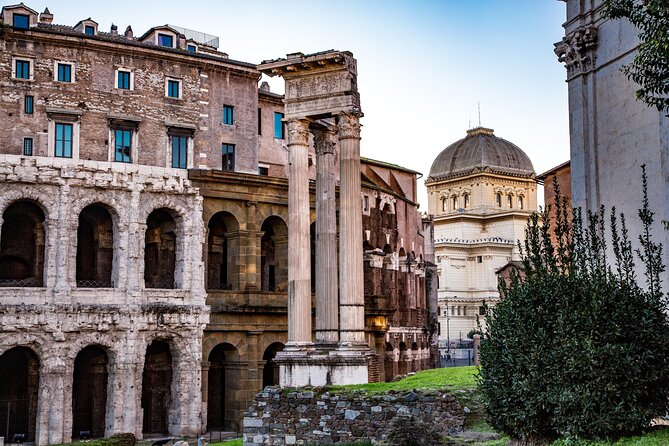
- The Theater of Marcellus and Rome’s layered streets
- Turtle Fountain and the gelato pause
- The Great Synagogue and the meaning of the Ghetto
- Portico of Octavia and the entrance to the old Ghetto
- Ending on Tiber Island beside Trastevere
- Guide style and group size
- Is $48.37 a fair price?
- Meeting advice and who should book
- Should you book this Jewish Ghetto walk?
- FAQ
- How long does the Jewish Ghetto walking tour last?
- Where does the tour start and finish?
- Is the Great Synagogue included?
- Is food included?
- How large is the group?
- What happens if I need to cancel?
Key points at a glance

- A broad Rome walk: The route links Trajan’s Column, Piazza Venezia, Michelangelo’s Capitoline square, the Theater of Marcellus, and the Jewish Ghetto.
- A serious look at Jewish Rome: You hear about the 1555 restrictions, local customs, Jewish-Roman cuisine, WWII deportations, and life in the community today.
- Small enough for real questions: Groups can include up to 15 people, though some departures may be much smaller.
- Kosher gelato or coffee included: This gives you a pleasant pause and a taste of the neighborhood.
- A useful final location: Tiber Island puts you close to both the Ghetto and Trastevere, with bus connections along the river.
- Good guide variety: James, Paul, Angela, Daniel, Brian, and others have been praised for clear explanations, warmth, and strong command of Roman history.
Why this two-hour walk matters
Rome can make it easy to focus only on emperors, popes, fountains, and grand churches. This tour adds a human story that is often missed. The Jewish community has lived in Rome for centuries, and the walk shows how that community endured restrictions, built businesses, developed its own Roman Jewish dialect, and maintained religious and cultural life.
The route also gives you useful city context. Ancient ruins do not sit in a separate archaeological park here. They appear beside apartments, restaurants, traffic, and working neighborhoods. That contrast helps you see Rome as a living city rather than a museum.
The subject becomes especially serious when the tour reaches the WWII period and the Nazi roundup of Roman Jews. Guides have been praised for treating this material with care and empathy. The mood is sober, but the experience is not without warmth. A stop for gelato, conversation, and practical restaurant advice gives the walk a human rhythm.
You do not need to be Jewish to find this worthwhile. The tour deals with Jewish life in Rome, but it also covers political power, religious prejudice, fascism, courage, and the choices ordinary people make during dark periods. I would especially consider it if you have already seen the Colosseum and Roman Forum and want a different side of the city.
More Jewish Ghetto walks:
- Rome: Trastevere or Jewish Quarter Street Food Tour
★ 4.8 · 3,839 reviews - Jewish Ghetto and Trastevere Tour Rome
★ 4.5 · 1,729 reviews - Jewish Ghetto and Synagogues with Jewish Roman Guide 3 Hours
★ 5.0 · 907 reviews
Starting at Trajan’s Column and Piazza Venezia
The meeting point is Foro Traiano, 84, near Trajan’s Column. This is a central location, but it can be busy and confusing, so allow time to find the guide. The operator is Roman Vacations, and that name matters because the guide may hold a Roman Vacations sign rather than one marked with the name of the booking platform or Jewish tour.
The walk begins with Trajan’s Column and moves through Piazza Venezia. The opening section places the Jewish story within the larger story of Rome. Guides have used this stretch to explain Roman history before turning toward the community that later lived inside the Ghetto.
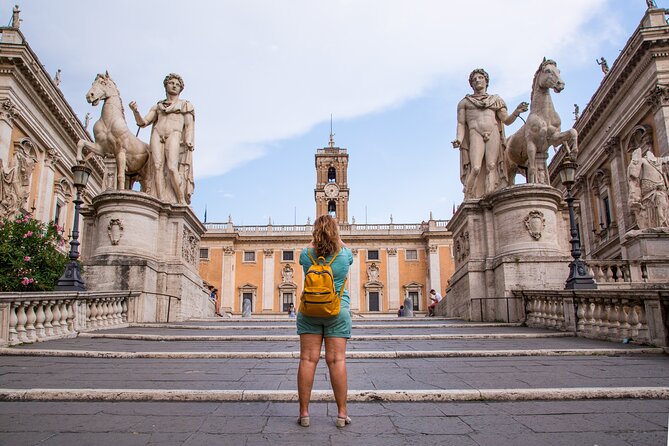
You then climb gently toward Piazza del Campidoglio, the elegant square designed by Michelangelo. You will not enter the Capitoline Museums on this experience, and there is no admission charge for the outdoor stop. Still, the square is worth seeing for its careful geometry, broad approach, and unusual sense of order above the busy streets.
This beginning is a strength because you get more than a narrow neighborhood tour. The drawback is that the tour’s central subject does not arrive immediately. If you want to stand in the Ghetto from the first minute, this route may feel like a slow start. If you enjoy connecting different periods of Rome, the opening works well.
The Theater of Marcellus and Rome’s layered streets

From the Capitoline area, the group walks to the Theater of Marcellus. Built in 12 BC, it is often compared with the Colosseum because of its curved arches and stacked design. The comparison helps you picture ancient Roman entertainment buildings, but the guide also points out an important difference: the Theater of Marcellus did not host the blood sports associated with the Colosseum.
The theater now has apartments above the ancient structure. That detail is pure Rome. Ancient stone is not sealed off from modern life. People live in and around buildings that once served emperors and the public, and your guide can use the site to explain how Rome kept adapting old structures.
You spend about 10 minutes here, then continue on foot. This is a walking tour over historic streets, not a series of long museum visits. Wear comfortable shoes and expect some uneven pavement. The provided information does not give an exact distance, but the listed stops and walking time fit into roughly two hours.
Turtle Fountain and the gelato pause
The Fontana delle Tartarughe, or Turtle Fountain, is one of the prettiest stops on the route. This late Renaissance fountain is known for its turtles and for the story that it was constructed in a single day. The guide explains the tale and the design while you pause in the square.
Before or around this part of the route, you stop for authentic kosher gelato or coffee. The included refreshment is not a full meal, and additional food or drink costs extra. Still, it is a useful part of the experience. You get a break from walking, a chance to ask questions privately, and a taste connected to the neighborhood’s Jewish-Roman food tradition.
Several guides have received special praise for making the tour work for different ages. Paul, for example, has been able to hold the attention of children as young as eight and nine while explaining Jewish life, political movements, and persecution in clear terms. Angela has been especially good at making centuries of events understandable in a short time.
The gelato stop also helps keep the tour from becoming a nonstop lecture. One fair criticism of Paul’s style is that he can speak at length, with less back-and-forth than some people prefer. If you enjoy a professor-style talk, that may be a plus. If you want constant interaction, use the small group to ask questions and bring the discussion back to the sites around you.
More walking tours in Rome:
- Rome: Trastevere & Campo de Fiori Street Food Walking Tour
★ 4.9 · 2,768 reviews - Rome: Paranormal Night Walking Tour & Secret Backstreets
★ 4.9 · 1,921 reviews - Rome by Night Walking Tour – Legends & Criminal Stories
★ 4.5 · 1,003 reviews - Rome: Guided City Center Evening Sightseeing Walking Tour
★ 4.4 · 953 reviews
The Great Synagogue and the meaning of the Ghetto

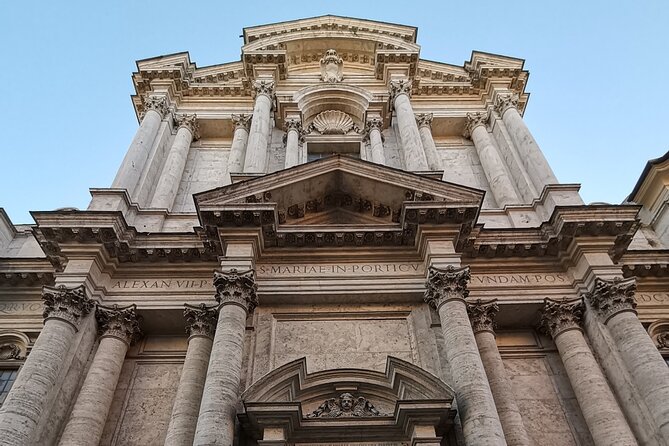
The Tempio Maggiore di Roma is the key religious landmark on the walk. The Roman Ghetto was established in 1555 after the pope revoked rights held by Roman Jews, barred them from many types of trade, and prevented them from owning real estate. The restrictions forced the community into a confined area, but did not erase its identity.
Inside those limits, Roman Jews developed businesses, food traditions, and a distinct dialect of Italian. That is one of the most useful ideas to take from the tour. The Ghetto was not only a place of suffering. It was also a place where people worked, raised families, worshipped, cooked, argued, adapted, and preserved community life.
The Great Synagogue functions as a place of prayer and as a cultural center for Rome’s Jewish community. The tour does not include admission to the synagogue or its museum. You see and discuss the building from the route, then you can arrange a separate visit if you want to explore the interior and museum.
I would plan that extra visit for another time or immediately afterward only if the opening hours and your energy fit. The walking tour itself gives you context, but it cannot cover every exhibit inside the synagogue complex in two hours. The nearby Holocaust Museum is also a separate experience. One person used the tour as an introduction before visiting the museum, describing that visit as graphic but important. That is a good way to think about the pairing: the walk gives you place and context, while the museum requires more focused time.
Portico of Octavia and the entrance to the old Ghetto

The Porticus Octaviae is only a short walk from the synagogue area. Emperor Augustus built this large structure in honor of his sister Octavia. From the 15th century into the early 20th century, it served as Rome’s fish market.
That history gives the site a pleasingly ordinary layer. You are not just looking at imperial ruins. You are also standing where vendors worked, residents shopped, and the neighborhood carried on with daily business.
This is where the route enters the Ghetto itself. The change is subtle, not theatrical. You move through streets lined with restaurants and old structures, while the guide explains how the neighborhood changed over time. The best guides connect the stones to actual lives instead of reciting dates alone.
The subject of Nazi persecution comes into sharper focus here. Memorial markers and addresses connected to deportations make the history feel local and specific. The walk does not ask you to treat the Ghetto as a backdrop for tragedy. It shows you where people lived and what was taken from them.
Ending on Tiber Island beside Trastevere

The tour ends at Isola Tiberina, or Tiber Island. Ancient Romans used the island as a hospital site, with the river acting as a natural barrier that helped limit the spread of disease. A major hospital remains on the site today.
This final stop gives you a change of pace. After the tight streets and difficult stories of the Ghetto, you have a view of the river and an easy place to decide what to do next. The island sits between the Ghetto and Trastevere, so you can find a meal in either neighborhood.
The restaurant advice at the end is useful, especially if you are new to Rome. Angela’s dining suggestions have been singled out as particularly helpful, and the Ghetto has several places where you can continue exploring Roman Jewish cuisine. You can also walk into Trastevere for a broader choice of Roman restaurants.
Buses run along the Lungotevere, making the finish practical for getting back to other parts of Rome. Transportation to the starting point and from the end is not included, so check your route before booking. The tour does not return you to where you began.
Guide style and group size
The guide can shape this experience more than any single monument. James has been praised for extensive Roman and Jewish history, along with compassion when discussing painful events. Paul brings a history-professor approach and can speak in great detail. Angela is warm, responsive, and good at answering many questions. Daniel has been praised for clear explanations and for making the walk accessible in English.
The operator uses local guides, but the exact guide is not guaranteed. One guide may be American, which can make the English especially easy to follow, while another may be a Roman with personal ties to the city. The important point is to expect different personalities and presentation styles.
The group limit is 15 people. That is small enough to hear commentary more easily than on a large city walk, and it gives you a better chance to ask about family history, religious practice, architecture, or current life in the neighborhood. Some departures have been much smaller, even only a few people, but you should not count on a private tour.
The pace has worked well for people who prefer a slower walk. Still, Rome can be hot, humid, or rainy. One departure had to end early during heavy rain, while another was difficult in intense heat. Choose a morning or late-day departure when possible, carry water, and bring protection from the weather.
Is $48.37 a fair price?
At $48.37 per person, this is not the cheapest way to stroll through the Ghetto. You are paying for an English-speaking guide, a small group, historical interpretation, and one kosher gelato or coffee.
I think the value is good if you want the story explained as you walk. You could see the fountain, Theater of Marcellus, synagogue exterior, Portico of Octavia, and Tiber Island on your own. What you would miss is the link between those places, especially the explanation of how Roman Jewish life survived under legal restrictions and how WWII affected specific streets and families.
The two-hour length is another point in its favor. It is short enough to fit beside major sightseeing plans, but long enough to move beyond a quick photo stop. If you want extensive time inside the synagogue museum, a full meal, or a longer food tour, you will need to add those separately.
The tour is often booked well ahead, with bookings averaging about 42 days before the experience. That suggests planning early, especially if your Rome schedule is fixed. Free cancellation is available until 24 hours before the start time. Changes or cancellations inside that window are not accepted for a refund.
Meeting advice and who should book
Arrive early at Foro Traiano, 84, and confirm the exact guide identity before the start time. The most useful practical tip is simple: search for Roman Vacations branding. Some people have looked for a Viator or Jewish Tour sign and nearly missed the group.
The guide reportedly waits 15 minutes after the scheduled start, but the tour cannot hold for a late arrival indefinitely. Do not rely on a phone call or a last-minute email to solve a meeting problem. Save the meeting details, allow for traffic, and keep the provider’s name visible on your phone.
This walk suits:
- First-time Rome visitors who want more than ancient monuments.
- Returning visitors who have already seen the major sights.
- Families with older children and teenagers, especially with a guide who adjusts the explanation.
- Anyone interested in Jewish life, WWII in Italy, fascism, religion, or urban history.
- People who prefer a short, guided walk rather than a full-day activity.
It may not suit you if you dislike outdoor walking, want guaranteed synagogue entry, or prefer a light sightseeing tour with little discussion of persecution and the Holocaust. The subject is handled with care, but it is serious.
Should you book this Jewish Ghetto walk?
I would book it if you want Rome to feel more human and less like a checklist of famous ruins. The route gives you ancient architecture, Renaissance design, local food, Jewish history, and a thoughtful look at the crimes of the 20th century in one compact outing.
Book with realistic expectations. The exact guide will vary, some guides talk more than others, the synagogue and museum cost extra, and meeting instructions deserve careful attention. If you arrive prepared, the small group, excellent guide options, kosher gelato, and finish near Trastevere make this a strong value for an unusually meaningful two hours.
FAQ
How long does the Jewish Ghetto walking tour last?
The experience lasts approximately two hours. The listed stops include Trajan’s Column, Piazza del Campidoglio, the Theater of Marcellus, Turtle Fountain, the Great Synagogue, the Portico of Octavia, and Tiber Island.
Where does the tour start and finish?
It starts at Foro Traiano, 84, near Trajan’s Column. It ends on Tiber Island, between the Jewish Ghetto and Trastevere.
Is the Great Synagogue included?
No. Admission to the Tempio Maggiore di Roma is not included. The tour discusses and visits the area around the synagogue, but entry requires a separate plan and ticket.
Is food included?
One authentic kosher gelato or coffee is included. Any additional food or drink is not included.
How large is the group?
The maximum group size is 15 people. Some departures may have fewer participants, but a private tour is not guaranteed.
What happens if I need to cancel?
You can receive a full refund if you cancel at least 24 hours before the experience start time. Cancellations or changes made less than 24 hours before the start are not accepted for a refund.
Newest reviews from Rome
- ROME:Colosseum & Ancient Rome – private/small group TOUR★ 5.0 · 24 reviews
- Off the Beaten Track in Rome: Rione VI Parione Private Tour★ 5.0 · 24 reviews
- Cinematic Photoshoot in Rome★ 5.0 · 24 reviews
- Rome: Best of Colosseum and Roman Forum Small Group Guided Tour★ 4.5 · 24 reviews
- The Labyrinth of Rome between catacombs and ancient quarries★ 4.5 · 24 reviews
- Vatican and Trionfale Market Tour with Wine and Food Tasting★ 5.0 · 24 reviews
- private tour: Vatican Museums, Sistine Chapel, St. Peter’s Basilica★ 4.5 · 24 reviews
- Colosseum guided tour with Virtual Reality★ 5.0 · 24 reviews
Jewish Ghetto Tours, compared.

Trastevere or Jewish Quarter Street Food Tour
Read our review →
Eat Like a Roman Ghetto & Campo de’ Fiori Food Tour
Read our review →
Jewish Ghetto & Piazza Navona: Food, Wine & Sightseeing Rome Tour
Read our review →
Food & Wine Tour of Campo de Fiori, Ghetto, Trastevere
Read our review →
Jewish Ghetto and Campo Dè Fiori By Night Food, Wine and Sightseeing Tour
Read our review →
Trastevere and Rome’s Jewish Ghetto Half-Day Walking Tour
Read our review →
Jewish Ghetto & Campo de Fiori by Night Food Wine Tour
Read our review →Browse the lists this tour appears in