
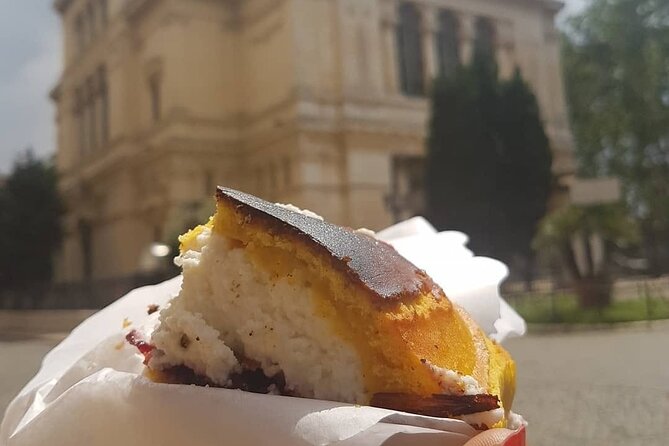
Reviewed · JEWISH GHETTO TOURS
Rome Jewish Ghetto and Great Synagogue Small Group Walking Tour
Rome’s Jewish Ghetto is one of the most meaningful corners of central Rome, and this tour connects its narrow lanes to the imposing Great Synagogue of Rome. The story reaches across more than 2,000 years, from ancient Roman life and papal rule to wartime persecution and the modern Jewish community.
I like the small maximum of 12 people, which gives you room to ask questions. I also like the guide’s personal link to the neighborhood. Sara Terracina, in particular, brings family history and present-day community life into the conversation. The main consideration is the price, $169.31 per person, which is high for a two to three-hour walk, especially if you are mainly seeking an exterior look at the quarter.
In This Review
- Key points
- Why Rome’s Jewish Quarter deserves two hours of your time
- Meeting at Largo 16 ottobre 1943
- The Jewish Museum of Rome, where objects carry the story
- The Great Synagogue and its huge square dome
- Walking the Antico Quartiere Ebraico
- Sara Terracina’s personal approach
- How the small group changes the experience
- Is $169.31 a fair price?
- Who should book this Rome Jewish Ghetto tour?
- Booking and cancellation details to keep in mind
- Should you book it?
- FAQ
- How long does the Rome Jewish Ghetto tour last?
- Where does the tour begin and end?
- Is the tour offered in English?
- What is the maximum group size?
- Are the Jewish Museum and Great Synagogue entrance tickets included?
- Can I visit the synagogue and museum on Jewish holidays?
- What is the cancellation policy?
Key points
- Sara Terracina adds a personal connection: Her family ties to Rome’s Jewish community give the history a human voice.
- The Great Synagogue and Jewish Museum are central: You get both the building and the objects, stories, and traditions connected with it.
- A maximum of 12 people keeps the tour intimate: This is far more workable than a large city walk when you want to ask questions.
- The Jewish Quarter is easy to pair with lunch: Traditional Jewish restaurants and bakeries are close by, including kosher dining options.
- The tour covers painful history with care: Expect discussion of deportation, wartime events, social injustice, and Jewish endurance.
- Check the synagogue access before booking: The information supplied for the experience conflicts on ticket inclusion, so confirm the current policy and holiday closures.
Why Rome’s Jewish Quarter deserves two hours of your time

Rome can make history feel almost too large to grasp. Ancient ruins, grand churches, imperial forums, and Baroque fountains compete for your attention. The Jewish Quarter offers a smaller, more human scale: narrow streets, quiet squares, old buildings, fountains, restaurants, bakeries, and the visible traces of a community that has lived in Rome for centuries.
I like this tour because it does not treat the neighborhood as a quick photo stop. The walk gives context to the places you see. You learn how Roman Jewish life developed, how outside Jewish communities influenced local practice, and how politics and religion shaped daily life.
The word ghetto needs care here. This was not simply a picturesque old quarter. The area carries the memory of forced restriction, discrimination, deportation, and loss. A good guide helps you hold both truths at once: the quarter has beautiful architecture and food, but its beauty does not erase the suffering connected with it.
That balance is one of the strongest reasons to choose a guided visit. You can walk these streets alone, but you may miss why they matter.
More Jewish Ghetto walks:
- Rome: Trastevere or Jewish Quarter Street Food Tour
★ 4.8 · 3,839 reviews - Jewish Ghetto and Trastevere Tour Rome
★ 4.5 · 1,729 reviews - Jewish Ghetto and Synagogues with Jewish Roman Guide 3 Hours
★ 5.0 · 907 reviews
Meeting at Largo 16 ottobre 1943
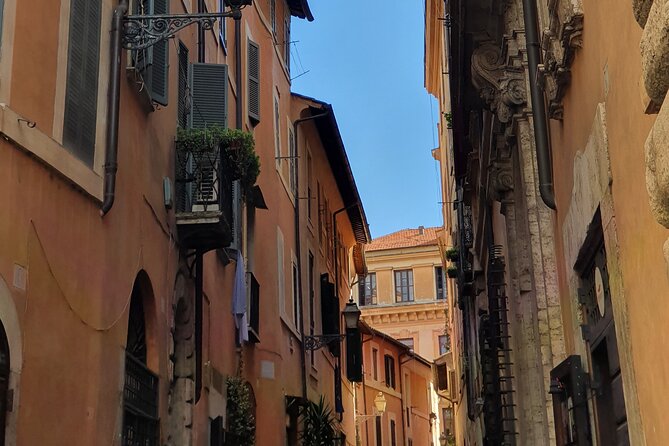
The tour begins at Largo 16 ottobre 1943, a location whose name refers to the deportation of Rome’s Jews. It is a fitting, serious starting point. The activity ends back at the same meeting point, so you do not need to arrange transport from a different neighborhood afterward.
The meeting point is in central Rome and is near public transportation. Still, I would allow extra time to find it. A tour that deals with a precise historical site benefits from arriving calm and ready, rather than rushing in from another attraction.
The experience is offered in English, Spanish, or Italian. English is the default if you want another language but do not contact the guide promptly. The group is confirmed with at least four people and capped at 12, so the size can vary. A minimum of four also means the tour may not operate if that number is not reached.
The Jewish Museum of Rome, where objects carry the story
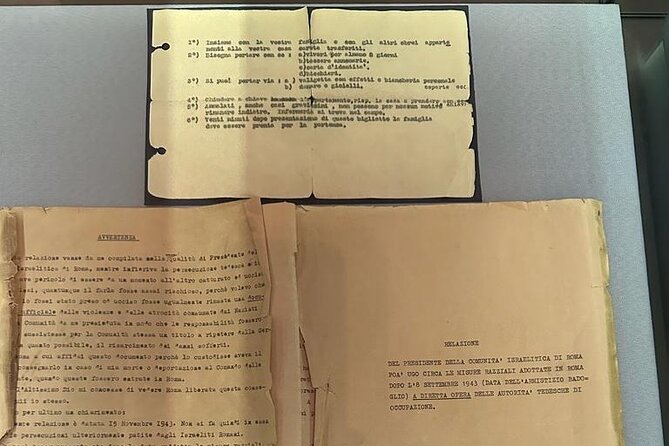
The Jewish Museum is scheduled for about one hour, making it the longest stop. That is sensible. The quarter gives you streets and buildings, while the museum helps explain the customs, communities, and events behind them.
You will see the museum together with the guide, who explains the inside of the Great Synagogue and the museum as part of the same experience. This is important because religious objects and historical displays can be hard to understand without context. The guide can connect what you are seeing with the different Jewish groups that settled in Rome or arrived from elsewhere.
The museum also adds texture to a story that might otherwise remain political. Instead of hearing only about papal decrees, war, and persecution, you get a clearer sense of religious practice, community life, and the ways people preserved identity.
Sara Terracina is repeatedly praised for explaining complex subjects clearly and answering questions from both adults and children. Her personal connection to Rome’s Jewish community can make the museum feel less like a collection of objects and more like part of an ongoing story.
One practical issue needs attention. The tour details say in one place that admission is not included and that tickets can be bought on the spot with cash or a credit card. Elsewhere, the package is described as including entrance to the Jewish Museum and Great Synagogue. Do not assume the answer. Confirm the current ticket arrangement before you go, and bring a payment card or cash as a sensible backup.
The Great Synagogue and its huge square dome
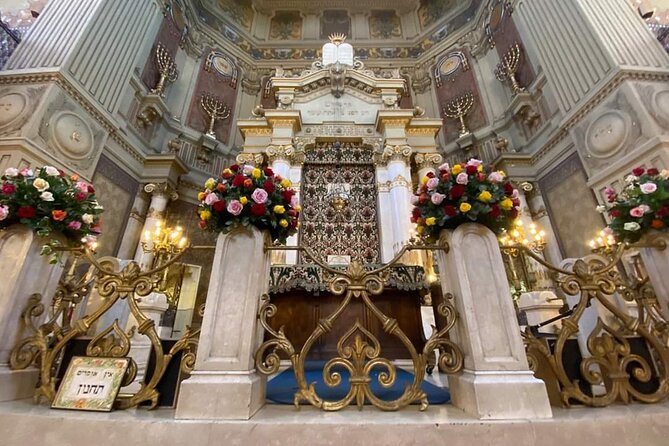
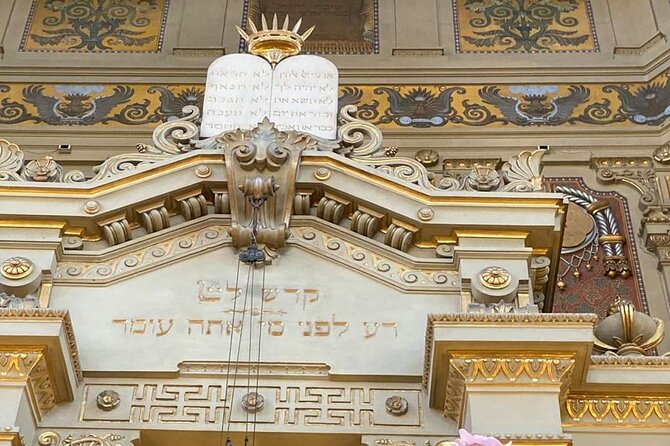
The Tempio Maggiore di Roma, or Great Synagogue of Rome, is the visual center of the Jewish community. Its large square dome makes it easy to recognize among Rome’s more familiar domes and church towers.
The listed visit inside lasts about 15 minutes. That is not a long architectural visit, but the synagogue is an important part of the tour because it gives physical form to the community you have been learning about. The guide explains the interior rather than leaving you to make sense of it on your own.
The building’s presence also helps correct a common mistake. Rome’s Jewish story is not confined to ancient history or the wartime period. The Great Synagogue represents an active community and a place of worship, not just a monument.
The synagogue and museum can close to the public on Jewish holidays. The listed 2025 closures include Shavuot, Tishà Be Av, Rosh Hashanà, Yom Kippur, Sukkot, O’Shannah Rabbah, Shemini Atzeret, and Simhat Torah, along with Yom Ha’azmaut. On those dates, the tour takes place only in the afternoon and the guide explains the sites from outside.
That is a major planning point. If entering the synagogue and museum is the main reason you want this tour, check your date carefully before paying. A holiday visit may still offer useful neighborhood context, but it is a different experience.
More walking tours in Rome:
- Rome: Trastevere & Campo de Fiori Street Food Walking Tour
★ 4.9 · 2,768 reviews - Rome: Paranormal Night Walking Tour & Secret Backstreets
★ 4.9 · 1,921 reviews - Rome by Night Walking Tour – Legends & Criminal Stories
★ 4.5 · 1,003 reviews - Rome: Guided City Center Evening Sightseeing Walking Tour
★ 4.4 · 953 reviews
Walking the Antico Quartiere Ebraico
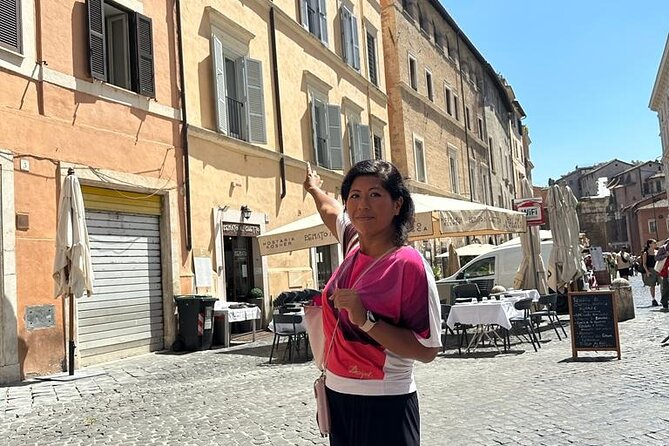
The final major section is a roughly one-hour walk through the Antico Quartiere Ebraico, the old Jewish Quarter. Here, the pace becomes less formal. You move through narrow streets and quiet squares, passing old buildings from Roman and medieval periods.
The setting is especially useful after the museum and synagogue. You can place the community’s story in an actual neighborhood rather than treating it as something locked behind museum glass. Hidden fountains, old facades, bakeries, and restaurants give the walk a daily-life feel.
I would pay close attention to the food stops, even if you are not hungry. Traditional Jewish restaurants and bakeries are part of the area’s continuing identity. Several people have found it worthwhile to stay for lunch afterward, including at a kosher restaurant. The tour does not include lunch, but the timing makes it easy to continue your visit with a meal nearby.
Do not expect a long list of major monuments during this section. The appeal is the close look at a compact district and the stories attached to ordinary streets. If you want Rome’s biggest ruins, book an ancient Rome tour instead. If you want to understand how a community shaped part of the city, this walk fills a different need.
Sara Terracina’s personal approach
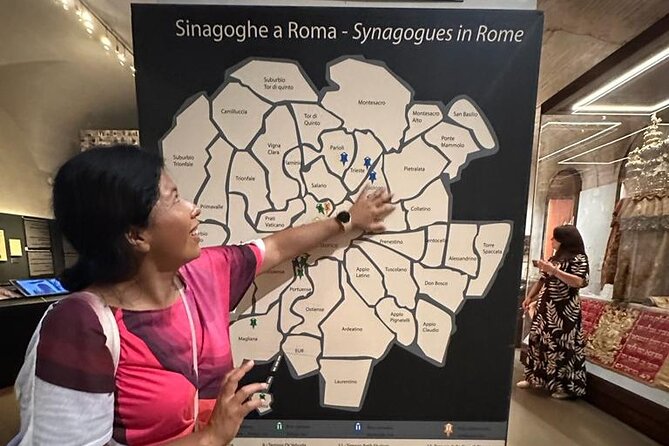
The guide can make or break a history walk. Here, Sara Terracina receives especially strong praise for warmth, clarity, humor, and personal knowledge of the Roman Jewish community. Her family story reaches back into the area, and she has shared personal accounts connected with the community and wartime history.
That personal element matters, but it should not replace evidence or broader context. The strongest version of this tour appears to combine both. You get the long arc of Jewish life in Rome, along with an individual connection that helps you understand the subject as lived experience.
Sara is also praised for welcoming questions. That is useful for families with teenagers, who may ask direct questions about persecution, politics, religion, and current community life. The tour is not presented as a dry lecture. You can engage with the guide and shape some of the discussion.
Another guide named Sylvia appears in the supplied feedback, and the activity is offered in multiple languages. Since Sara Terracina is the named provider, ask who will lead your departure if having a particular guide is important to you.
How the small group changes the experience
A maximum of 12 people is a real advantage in a neighborhood tour. Rome’s Jewish Quarter has tight streets and small spaces, and a large group can block sidewalks or make it hard to hear. A smaller group lets you stay closer to the guide and ask about details that catch your eye.
The group size can also affect the feel of the tour. If the minimum is met but the group is not full, you may have a more personal conversation. In at least one case, cancellations left a private tour for the remaining couple. That should not be expected, but the small format creates the possibility of a more tailored experience.
The stated duration is two to three hours. Plan on walking for most of that time, with the museum taking about an hour, the synagogue about 15 minutes, and the neighborhood walk about an hour. Wear comfortable shoes and avoid placing this directly before a timed attraction across town.
The tour is suitable for most people, and service animals are allowed. The supplied information does not give a detailed route or step-free guarantee, so you should ask the provider directly if you have specific mobility needs.
Is $169.31 a fair price?
At $169.31 per person, this is not a budget walking tour. The value depends on what you want from the visit.
You are paying for a small group, a multilingual guide, access to the museum and synagogue, and a focused subject that is easy to miss in a first visit to Rome. A guide with direct community ties can also offer a kind of perspective that a general city tour may not provide.
The price is harder to justify if you only want to see the synagogue exterior or stroll through the quarter. You can walk around the neighborhood independently, and the advertised duration is fairly short for the cost. The unclear ticket wording also means you should confirm exactly what your payment covers.
For me, the price makes more sense for visitors who value interpretation and personal stories. It is also a better fit if you would otherwise spend time trying to piece together the museum, synagogue, and quarter on your own. The tour gathers them into one coherent visit.
Group discounts are available, though the amount is not stated. If you are booking for several people, check the final price rather than assuming the discount applies automatically.
Who should book this Rome Jewish Ghetto tour?
I would choose this experience if you want to understand Rome beyond its ancient monuments and famous churches. It suits people with Jewish heritage, but you do not need a Jewish background to appreciate it. The tour addresses Roman history, religious life, migration, discrimination, war, survival, and the modern community.
Families can benefit from the small group and the guide’s willingness to answer questions. Teenagers may find the personal stories and wartime material more engaging than a standard museum visit. The subject is serious, so parents should decide how much historical detail is suitable for younger children.
This is also a good choice for repeat visitors to Rome. You may have already seen the Colosseum and Vatican Museums, but the Jewish Quarter gives you a different way to read the city.
I would be more cautious if your schedule is tight, your budget is limited, or your visit falls on one of the listed Jewish holidays. The outdoor walk still has value, but the synagogue and museum interiors are central to the advertised experience.
Booking and cancellation details to keep in mind
The experience is often reserved well ahead, with an average booking lead time of about 67 days. That suggests you should plan ahead, especially if you need a particular language or date.
English, Spanish, and Italian are offered. If you book Spanish or Italian, contact the guide immediately. Otherwise, the tour may still be conducted in English.
You can cancel for a full refund up to 24 hours before the local start time. Cancellations or changes made inside that 24-hour window are not refunded or accepted. If the minimum group size is not reached and the activity is canceled, you are offered another date or experience, or a full refund.
Should you book it?
Yes, if you want a focused, thoughtful look at Rome’s Jewish community and value a guide who can connect public history with personal experience. The Great Synagogue, Jewish Museum, and old quarter work well together, and the group size is small enough for real conversation.
I would book it after confirming two things: the exact admission policy for the museum and synagogue, and whether Sara Terracina herself will lead your tour. Choose another activity if you need a low-cost stroll or if you mainly want major Roman sights.
For the right visitor, this is more than a neighborhood walk. It is a careful introduction to a community that has shaped Rome for centuries and continues to shape it today.
FAQ
How long does the Rome Jewish Ghetto tour last?
The experience lasts approximately two to three hours. The Jewish Museum takes about one hour, the Great Synagogue visit is listed at 15 minutes, and the Jewish Quarter walk takes about one hour.
Where does the tour begin and end?
The tour begins at Largo 16 ottobre 1943 Deportazione degli Ebrei Di Roma, 00186 Rome. It ends back at the same meeting point.
Is the tour offered in English?
Yes. The tour is offered in English, Spanish, or Italian. If you book a language other than English, contact the guide immediately, or the tour may be conducted in English.
What is the maximum group size?
The tour has a maximum of 12 participants. It requires at least four people to confirm the group.
Are the Jewish Museum and Great Synagogue entrance tickets included?
The supplied details conflict. One section says tickets can be purchased on the spot by credit card or cash, while another says entrance to the Jewish Museum and Great Synagogue is included. Confirm the current ticket policy before your visit.
Can I visit the synagogue and museum on Jewish holidays?
No. On the listed 2025 Jewish holidays, the Great Synagogue and Jewish Museum are closed to the public. The tour takes place only in the afternoon, with the guide explaining the sites from outside.
What is the cancellation policy?
You can cancel up to 24 hours before the local start time for a full refund. Cancellations or changes made less than 24 hours before the start are not accepted or refunded.
Newest reviews from Rome
- ROME:Colosseum & Ancient Rome – private/small group TOUR★ 5.0 · 24 reviews
- Off the Beaten Track in Rome: Rione VI Parione Private Tour★ 5.0 · 24 reviews
- Cinematic Photoshoot in Rome★ 5.0 · 24 reviews
- Rome: Best of Colosseum and Roman Forum Small Group Guided Tour★ 4.5 · 24 reviews
- The Labyrinth of Rome between catacombs and ancient quarries★ 4.5 · 24 reviews
- Vatican and Trionfale Market Tour with Wine and Food Tasting★ 5.0 · 24 reviews
- private tour: Vatican Museums, Sistine Chapel, St. Peter’s Basilica★ 4.5 · 24 reviews
- 3 Hours Mosaic Workshop in Trastevere★ 5.0 · 24 reviews
Jewish Ghetto Tours, compared.
Trastevere or Jewish Quarter Street Food Tour
Read our review →
Eat Like a Roman Ghetto & Campo de’ Fiori Food Tour
Read our review →
Jewish Ghetto & Piazza Navona: Food, Wine & Sightseeing Rome Tour
Read our review →
Food & Wine Tour of Campo de Fiori, Ghetto, Trastevere
Read our review →
Jewish Ghetto and Campo Dè Fiori By Night Food, Wine and Sightseeing Tour
Read our review →
Trastevere and Rome’s Jewish Ghetto Half-Day Walking Tour
Read our review →
Jewish Ghetto & Campo de Fiori by Night Food Wine Tour
Read our review →Browse the lists this tour appears in