
Reviewed · DOMUS AUREA TOURS
Domus Aurea Tour-Golden House of an Emperor With VR Experience
Nero’s Domus Aurea, or Golden House, is one of Rome’s strangest ancient sights: a vast palace now buried beneath the Oppian Hill, with rooms that once glittered with marble, mosaics, ivory, fountains, and precious stones. The VR reconstruction helps you picture the extravagant palace that the dark ruins alone cannot fully reveal.
I like the chance to see a major Roman monument that many people skip, and I like the small group size, capped at 10. The preserved frescoes, the Octagonal Room, and the special Raphael exhibition give the visit real substance beyond a short walk through old walls.
The main caution is the VR schedule. It is arranged by the Domus authority on weekends and every day in summer, but it may not be offered on weekdays. You should also confirm the tour language and wait for the direct entry voucher, since the initial booking voucher is not the admission ticket.
In This Review
- Key points to know before you book
- Why Nero’s Golden House is worth your time
- Meeting at Viale della Domus Aurea
- Inside the archaeological remains
- The Raphael exhibition in the Octagonal Room
- What the VR experience adds
- The cold, dark setting is part of the experience
- Is $69.96 a fair price?
- Who will enjoy this visit most?
- Booking details that can prevent trouble
- Should you book the Domus Aurea VR tour?
- FAQ
- How long does the Domus Aurea tour last?
- Is VR included on every tour?
- What is included in the price?
- Where does the tour meet?
- Is the initial booking voucher the entry ticket?
- How cold is the Domus Aurea?
- Can I bring luggage or leave a suitcase at the site?
Key points to know before you book
- The palace is underground: You enter a cool archaeological site beneath the Oppian Hill, not a restored imperial villa.
- VR makes the ruins easier to understand: The headset shows how Nero’s rooms, decoration, and architecture may have looked at their height.
- The visit includes Raphael: The Octagonal Room hosts a special exhibition connected with Raphael and the influence of ancient Roman decoration.
- The authorized Domus guide leads the tour: The booking company arranges admission, but the Domus authority controls the official guided visit.
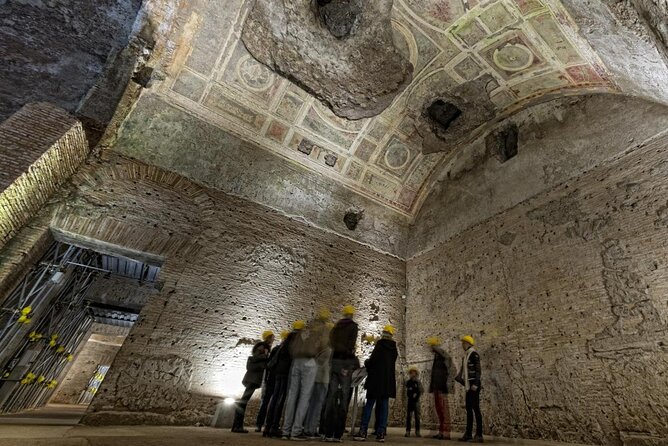
- Expect a cold interior: Temperatures inside are around 10 degrees Celsius, so take a sweater or light jacket even on a warm Roman day.
- The weekday VR question matters: Read the exact date conditions carefully, and contact the operator if the headset is the main reason you are booking.
Why Nero’s Golden House is worth your time
The Domus Aurea gives you a different view of ancient Rome. The Colosseum shows the public face of imperial power. This palace shows Nero’s private world of excess, spectacle, and self-indulgence.
After the great fire of Rome in AD 64, Emperor Nero claimed a huge area in the center of the city for his palace complex. The Domus Aurea was not a single house in the ordinary sense. It was an enormous pleasure palace with rooms, courtyards, gardens, pools, fountains, and an artificial lake.
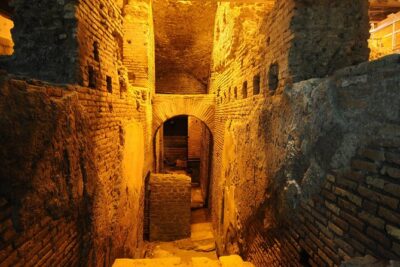
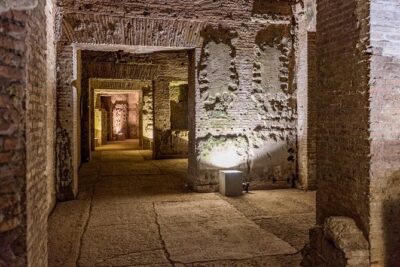
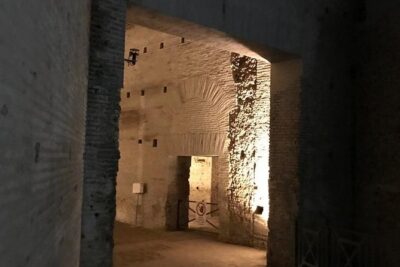
Much of the palace is now lost, buried, or replaced by later buildings. What remains lies below ground, and that setting is part of the appeal. You walk through spaces that were once brightly finished but are now marked by time, water damage, faded pigment, and exposed brick.
I find the contrast powerful. Nero intended to overwhelm visitors with wealth and theatrical design. Today, the surviving rooms are quiet and dim. You have to use imagination to bridge the gap between the archaeological remains and the palace’s original splendor.
The decoration was unusually ambitious. Ancient descriptions refer to ceilings covered with semi-precious stones and ivory, colorful mosaics, pools, fountains, and walls filled with frescoes. The rooms used white marble and changing forms to play with light, while water sounds were designed to carry through the corridors.
The frescoes are especially important. Their decorative figures and patterns were later rediscovered and helped inspire Renaissance artists, including Raphael and Michelangelo. The site therefore connects imperial Rome with one of the most important chapters in European art.
More Domus Aurea entries:
- Rome: Domus Aurea Guided Group Tour
★ 4.6 · 697 reviews - Rome: Domus Aurea, Nero’s Golden House guide tour
★ 4.6 · 449 reviews - Rome: Trevi Fountain District and Underground Domus Guided Tour
★ 4.5 · 298 reviews
Meeting at Viale della Domus Aurea
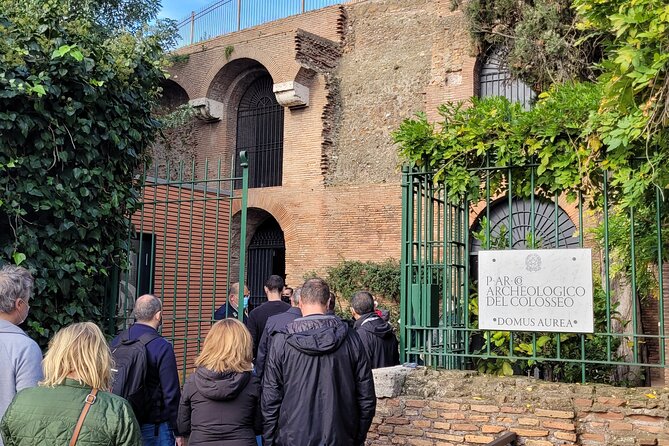
The tour begins at Viale della Domus Aurea, in the 00184 area of Rome. The location is near public transportation, but you should allow enough time to find the entrance without rushing.
One practical detail matters more than it first appears. The Viator booking voucher is not your entry ticket. The operator sends a separate direct e-voucher, generally through email or WhatsApp, and the information says to expect communication up to 48 hours before the visit.
Do not simply walk to the entrance with the first voucher and assume it will get you inside. Wait for the direct entry instructions. If you have not received them, contact the operator before setting out.
The meeting process can feel less tidy than a standard museum ticket, because the booking company reserves the official Domus admission and passes the entry document to you. That arrangement is worth understanding before you pay, especially if you prefer to deal directly with the archaeological site.
The tour normally ends back at the meeting point. No private transport is included, so you reach the site on your own by public transportation or on foot.
Inside the archaeological remains
The visit to the Domus itself lasts about 1 hour and 15 minutes, with the entire activity listed at approximately 1 hour and 35 minutes. The pace is controlled by the official site, and the guided format is compulsory.
You should expect an archaeological visit rather than a fully reconstructed palace. The walls and ceiling surfaces are fragile, and the site’s preservation needs limit how long people can remain in certain areas. One private-tour account describes about 45 minutes inside the Domus itself, followed by additional explanation outside, so the exact movement through the complex can vary.
That is useful to know if you are expecting a long, leisurely museum visit. The value lies in the quality of the spaces you see, not in the number of hours spent underground.
The remaining rooms can feel puzzling at first. A doorway, curved wall, or faded painted panel may not immediately tell you what the space once did. This is where a strong guide matters. The best experience gives you context about the construction, the purpose of the rooms, and the way the decoration worked together.
Guide quality has not been consistent. Daniele receives especially warm praise for his passion and clear knowledge of Roman culture, and a number of visitors have described his tours as personal and well organized. Still, the official Domus authority assigns the guide, so you should not assume that a particular guide will lead every departure.
The guide may also discuss Nero’s interest in Egypt, which is relevant to the emperor’s taste and political image. However, some people found that subject took too much time away from the building itself. If your main goal is architecture, frescoes, and room function, pay attention to the tour description and ask for clarification at the start.
The Raphael exhibition in the Octagonal Room
A special part of the visit is the exhibition dedicated to Raphael, held in the Octagonal Room. The exhibition was connected with the 500th anniversary of Raphael’s death and focuses on the relationship between the ancient Roman decoration found here and the later Renaissance response to it.
The Octagonal Room is one of the site’s most memorable spaces because its shape reveals how inventive Nero’s architects were. The room is not simply a square chamber with a flat ceiling. Its geometry, openings, and changing surfaces were designed to create an unusual visual effect.
The exhibition adds a useful art connection. Without it, you might see the frescoes as attractive but damaged wall paintings. With the Renaissance link, you can understand how the ancient designs influenced artists who rediscovered Roman decorative schemes centuries later.
The extent of the visit can depend on the day. From Monday through Thursday, access may be limited to the Octagonal Room and nearby rooms, including the immersive exhibition, with compulsory accompaniment. This limitation is important. The advertised experience may sound like a full tour of the entire palace, but weekday access can be narrower.
A completely different way to spend the day in Rome:
- Vatican: Museums & Sistine Chapel Entrance Ticket
★ 4.5 · 144,003 reviews - Vatican Museums & Sistine Chapel Tour with Optional Basilica
★ 4.3 · 67,413 reviews - Vatican Museums, Sistine Chapel & St Peter’s Basilica Guided Tour
★ 4.5 · 39,149 reviews - Rome: Colosseum, Palatine Hill and Roman Forum Guided Tour
★ 4.8 · 32,814 reviews
What the VR experience adds
The VR segment is the tour’s big selling point, and when it is available, it solves the main problem of visiting the Domus Aurea: you are looking at ruins that were never meant to be plain.
The headset presents a digital reconstruction of the palace at the height of its glory. Rooms that now show faded paint and bare masonry can be understood as spaces filled with color, marble, mosaics, light, and water. It gives you a visual answer to the question every visitor asks: what did this place actually look like under Nero?
I like VR here more than I do in many historic sites because the gap between the remains and the original building is so large. A few fragments of fresco cannot show the full effect of a room covered in decoration. A reconstruction can.
The experience is not a substitute for the archaeology. It works best after you have seen the real walls and paintings. First you study what survived, then the digital model helps you imagine what has disappeared.
But you must check the schedule. The supplied conditions state that VR glasses are arranged by the Domus authority during weekends and every day in summer. They are not reliably included on weekdays. Several bookings were made specifically for VR and then found that no headset was available, particularly outside the stated schedule.
This is the clearest weakness in the product description. The title and main presentation can make VR sound automatic, while the detailed conditions make it seasonal and schedule-dependent. If the digital reconstruction is essential to you, book a weekend or a summer date when possible, then confirm before you go.
If the headset is unavailable, the archaeological visit and exhibition still remain, but the value changes. At nearly $70 per person, that difference matters.
The cold, dark setting is part of the experience
The temperature inside the Domus Aurea is around 10 degrees Celsius. Rome can be sunny and warm above ground, so the cold may come as a surprise.
Bring a sweater, light jacket, or scarf. You will be more comfortable and better able to listen if you are not spending the visit wishing for a warmer coat. Comfortable shoes also make sense, since this is an archaeological site rather than a polished gallery.
There is no cloakroom, and you cannot leave a trolley case or other luggage at the site. Do not arrive with a large suitcase. The practical rule is simple: carry only what you can keep with you.
Photography and video are restricted in specific areas. In particular, shooting is forbidden inside the multimedia reproduction of the Stufetta del Bibbiena in Room II. Follow the guide’s instructions, since the preservation rules are part of visiting a fragile monument.
Is $69.96 a fair price?
The listed price is $69.96 per person. That is not a bargain admission ticket, especially because the Domus authority runs the official guided visit and because VR may not be available on every date.
You are paying for more than entry. The price includes one admission, the compulsory authorized guided tour, the Raphael exhibition, and the possibility of the VR segment when the authority provides it. The group limit of 10 is another positive. A small group should make it easier to hear the guide and stay close to the explanation in narrow rooms.
The value is strongest for someone who wants interpretation and visual help, rather than a simple walk through ruins. If you already know the Domus Aurea and can arrange a direct official visit at a lower price, this package may feel expensive.
I would judge the price by the date and the guide. A weekend visit with VR, a small group, and a good guide can make the cost reasonable for a major archaeological experience. A weekday visit without VR, especially with a guide who spends too little time on the building, is harder to defend.
The tour is often booked about 23 days ahead, so popular dates may fill before your Rome trip takes shape. That does not mean you should book blindly. Check the schedule first, then compare the package with the official Domus options available for your dates.
Who will enjoy this visit most?
I would recommend the tour to you if you already plan to see Rome’s major ancient monuments and want something less familiar than the Colosseum or Roman Forum. The Domus Aurea offers a close look at imperial private life, experimental architecture, and ancient wall painting.
It is a particularly good match for:
- People interested in Roman architecture and archaeology
- Art lovers curious about the connection between Roman frescoes and Raphael
- Visitors who find it hard to picture ruined buildings without visual reconstruction
- Families and small groups who prefer a short, structured visit
- Anyone willing to wear a jacket and follow site restrictions
I would be more cautious if you need a guaranteed English tour, require a fully accessible luggage-free schedule, or are booking mainly for VR on a weekday. The supplied information does not guarantee one language for every departure, and one booking was unexpectedly conducted in Italian.
The tour is also not ideal if you want to wander independently. The guided format is compulsory, access is controlled, and the time inside is limited.
Booking details that can prevent trouble
The experience is non-refundable if you cancel or request a change. If the operator cancels because of poor weather or because the minimum number is not reached, you are offered another date, another experience, or a full refund.
Late arrival and non-arrival do not qualify for a refund. Build in extra time for Rome traffic, finding the meeting point, and receiving the direct e-voucher.
The tour accepts a maximum of 10 people, which is a useful size for an underground archaeological site. Most people can participate, and the location is near public transportation.
Check the language before completing the booking. The tour material does not provide a firm language guarantee, and one person expected English but found the visit was in Italian. If you need English, ask the operator to confirm it in writing.
Should you book the Domus Aurea VR tour?
I would book this experience if you want to understand what Nero’s palace looked like, not merely see its remains. The combination of surviving frescoes, bold room shapes, the Raphael exhibition, and a VR reconstruction can make the Domus far easier to grasp than a self-guided visit.
I would choose a weekend or summer date and confirm that VR is included. I would also wait for the direct entry e-voucher, bring warm clothing, leave luggage at your accommodation, and verify the tour language.
The tour is not flawless. The guide can make or break it, weekday access may be limited, and the headset is not guaranteed outside the stated schedule. But when the logistics line up, this is a memorable way to see the extravagant side of imperial Rome and one of the city’s less obvious ancient sites.
FAQ
How long does the Domus Aurea tour last?
The full activity lasts approximately 1 hour and 35 minutes. The main Domus Aurea visit is listed at about 1 hour and 15 minutes, with an additional period for meeting and entry.
Is VR included on every tour?
No. VR glasses are arranged by the Domus authority during weekends and every day in summer. The headset may not be available on weekdays, so confirm the schedule before booking if VR is important to you.
What is included in the price?
The price includes one admission to the Domus Aurea, the compulsory guided visit authorized by the Domus, and the VR experience when it is provided by the authority. Admission to other Rome sites and private transportation are not included.
Where does the tour meet?
The meeting point is on Viale della Domus Aurea, 00184 Rome. The activity ends back at the meeting point.
Is the initial booking voucher the entry ticket?
No. The booking voucher is not the direct admission ticket. You should wait for the operator to send the separate e-voucher and entry instructions by email or WhatsApp.
How cold is the Domus Aurea?
The temperature inside is around 10 degrees Celsius. Wear appropriate warm clothing and comfortable shoes.
Can I bring luggage or leave a suitcase at the site?
No. The Domus Aurea has no cloakroom, and visitors cannot leave a trolley case or other luggage there.
Newest reviews from Rome
- ROME:Colosseum & Ancient Rome – private/small group TOUR★ 5.0 · 24 reviews
- Off the Beaten Track in Rome: Rione VI Parione Private Tour★ 5.0 · 24 reviews
- Cinematic Photoshoot in Rome★ 5.0 · 24 reviews
- Rome: Best of Colosseum and Roman Forum Small Group Guided Tour★ 4.5 · 24 reviews
- The Labyrinth of Rome between catacombs and ancient quarries★ 4.5 · 24 reviews
- Vatican and Trionfale Market Tour with Wine and Food Tasting★ 5.0 · 24 reviews
- private tour: Vatican Museums, Sistine Chapel, St. Peter’s Basilica★ 4.5 · 24 reviews
- Colosseum guided tour with Virtual Reality★ 5.0 · 24 reviews
Domus Aurea Tours, compared.
Trevi Fountain District and Underground Domus Guided Tour
Read our review →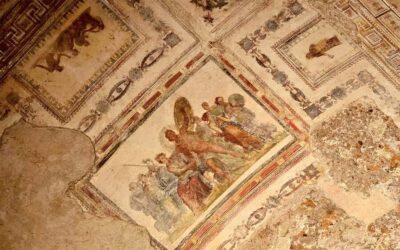
Domus Aurea Guided Tour: The Golden House of Nero
Read our review →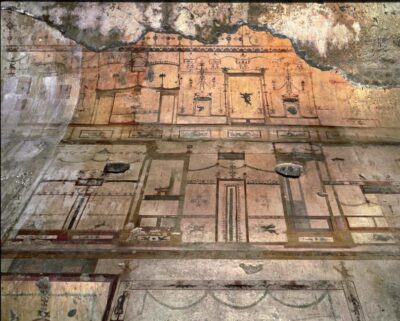
Domus Aurea Guided Tour and Virtual Reality Experience
Read our review →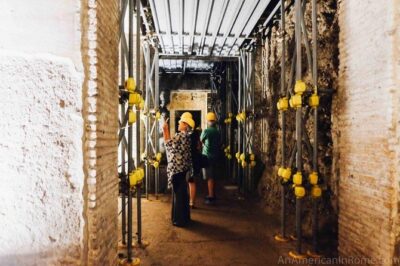
Browse the lists this tour appears in