
Reviewed · DOMUS AUREA TOURS
Domus Aurea Tour with WEST WING & Virtual Reality Experience
Rome’s Domus Aurea is one of Rome’s strangest sights: an imperial pleasure palace hidden underground beneath the city’s later monuments. This two-hour tour combines the palace ruins with a virtual reality reconstruction, helping you picture the gold, color, and scale that are hard to grasp from walls and fragments alone.
I like the direct-entry ticket, useful for a site with limited access, and the short outdoor introduction that sets Nero’s palace within the fall of his reign. I also like the cool underground setting, a welcome break from a hot Roman afternoon. The main catch is that the outside guide may hand you over to the Domus Aurea’s official internal guide, so the experience can feel like two connected tours rather than one continuous guided visit.
In This Review
- Key points to know before booking
- Why the Domus Aurea feels unlike other Roman ruins
- The meeting point and the first history lesson
- Entering the East and West Wings
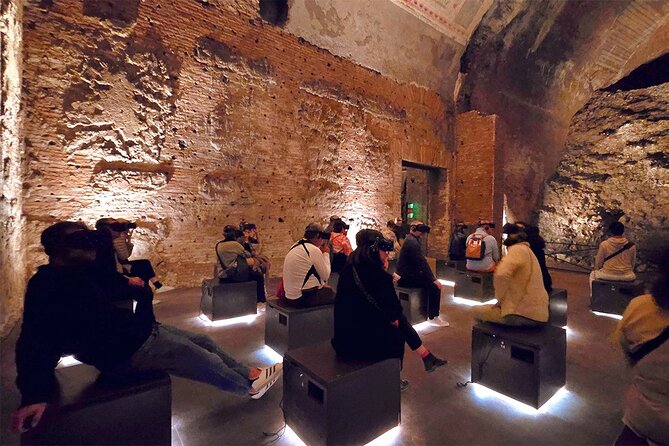
- What the virtual reality segment adds
- One tour, two guiding styles
- A cool, unusual break from Rome’s heat
- Is $84.19 a fair price?
- Who should book this Domus Aurea visit?
- My take: book it for the palace, not just the headset
- FAQ
- How long does the Domus Aurea tour last?
- What does the tour price include?
- Does the tour include the West Wing?
- Is the virtual reality experience included?
- Where does the tour meet?
- How many people can join the group?
- Are food and drinks included?
- Can I cancel for a full refund?
Key points to know before booking
- Nero’s buried palace: Walk through the remains of the Domus Aurea, built after the great fire of Rome.
- Recently reopened West Wing: The tour includes both the East and West Wing areas when open for the scheduled visit.
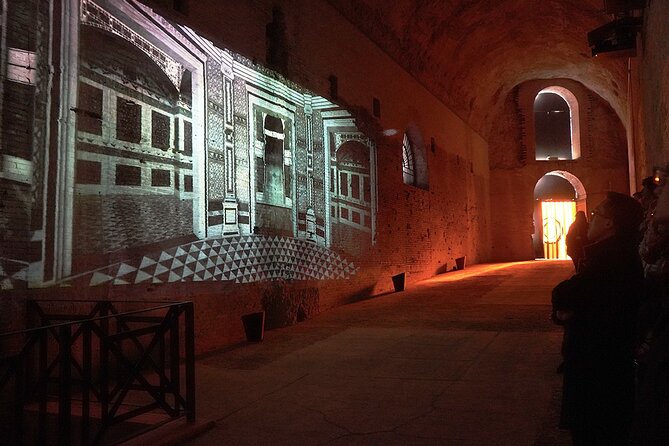
- Virtual reality reconstruction: See a short digital presentation of how the palace may have looked in Nero’s time.
- Two-part guiding format: An outside guide may provide the historical introduction, followed by the official guide inside the archaeological site.
- Small-group entry: The group can include up to 22 people, more intimate than a large coach tour but not a private visit.
- Bring a light layer: The underground rooms can feel cold even when Rome is hot outside.
Why the Domus Aurea feels unlike other Roman ruins
I love Rome’s famous monuments, but the Domus Aurea gives you a different kind of ancient experience. The Colosseum rises into the sky. The Pantheon still has a clear purpose and shape. Nero’s palace is mostly a sequence of dark rooms, ruined vaults, faded frescoes, and unfinished clues.
That uncertainty is part of the appeal. You are not simply looking at a restored palace. You are trying to read an enormous complex from what survived after later emperors buried it, built over it, and reused the area.
The palace was constructed after the great fire that destroyed about two-thirds of Rome and caused thousands of deaths. Nero used the cleared ground to expand his imperial residence. That decision helped turn public anger against him, and after his death in 68 AD, the next emperor, Vespasian, began the Colosseum over the site of Nero’s former lake.
That political story matters when you visit. The Domus Aurea was not just a lavish home. It was a public statement of imperial power, built by a ruler whose popularity collapsed as the palace grew. The Colosseum was partly a way for Vespasian to win back Roman support and distance himself from Nero.
More Domus Aurea entries:
- Rome: Domus Aurea Guided Group Tour
★ 4.6 · 697 reviews - Rome: Domus Aurea, Nero’s Golden House guide tour
★ 4.6 · 449 reviews - Rome: Trevi Fountain District and Underground Domus Guided Tour
★ 4.5 · 298 reviews
The meeting point and the first history lesson
The meeting point is on Viale della Domus Aurea, at the street address provided for the activity. It is not necessarily the same thing as the entrance to the archaeological site, so check the confirmation carefully and arrive with time to spare.
This detail matters because the meeting-point instructions have caused confusion. The practical rule is simple: go to the listed street location first, not directly to the underground entrance.
The tour usually begins with an outdoor introduction before you enter. This portion can last around 20 to 30 minutes, depending on the exact running of the visit. The guide explains Nero, the fire, the palace, and the political events that followed.
I see real value in this opening. Without it, the Domus Aurea can feel like a maze of rooms disconnected from the rest of Roman history. A clear explanation of Nero’s rise, his extravagant building program, and his downfall gives you a useful map before the ruins begin.
The drawback is comfort. On a hot summer day, standing outside while listening to a long historical introduction can be tiring. One person found that some of this material would have worked better inside, and that is a fair point. If the weather is severe, bring water, a hat, and patience.
Entering the East and West Wings
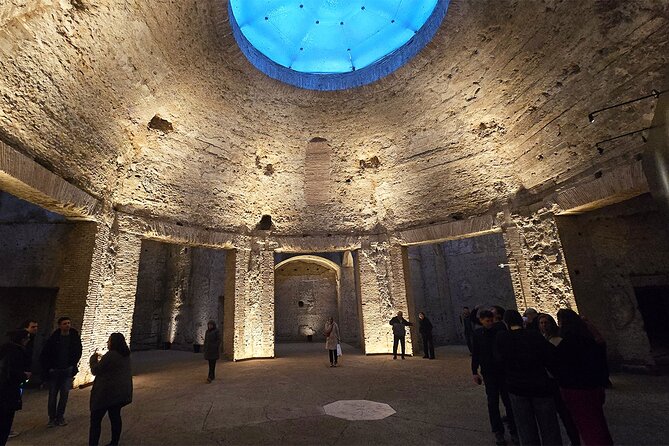
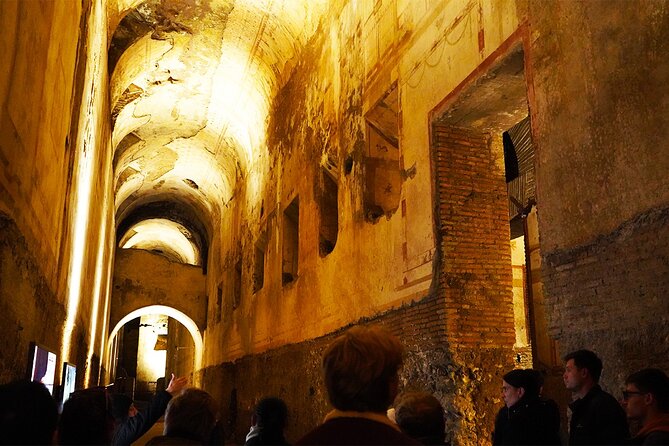
The palace visit takes place below ground, where the remains sit under later Roman construction. The tour includes the East Wing and the recently reopened West Wing, subject to the access arrangements in place for your date.
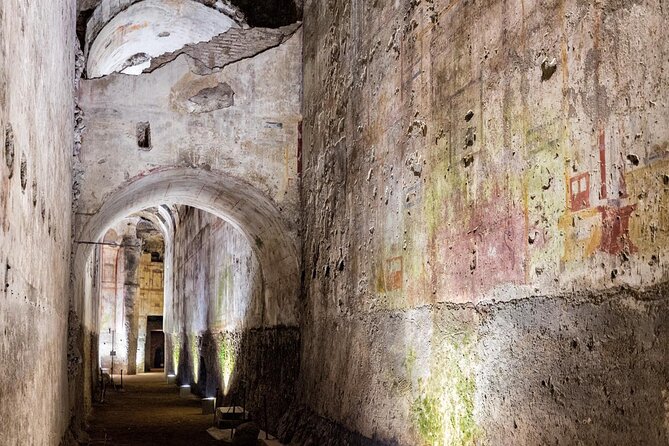
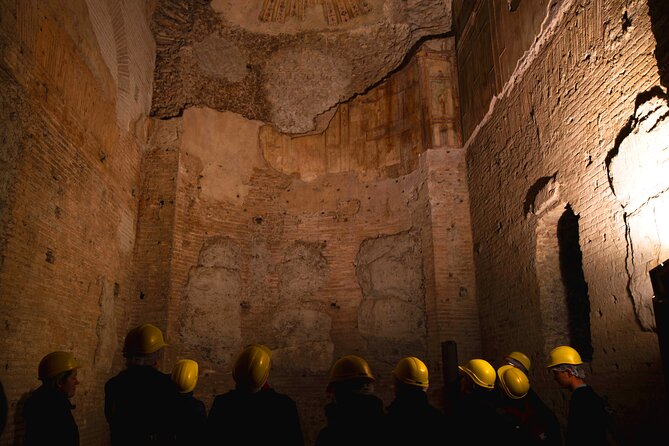
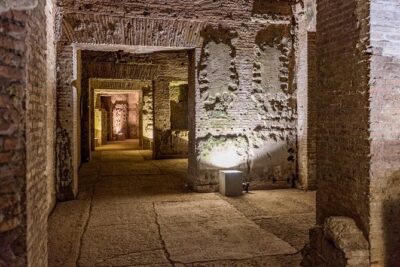
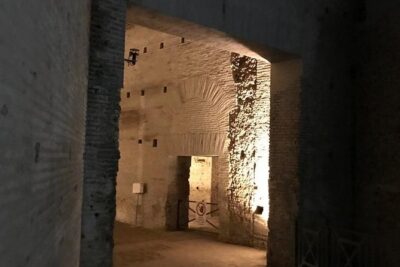
Inside, the scale is difficult to read at first. You see broad rooms, heavy walls, curved ceilings, and fragments of decoration. The palace once had a far grander finish, with marble, gold, painted surfaces, and ornate details. Much of that was stripped, covered, or lost, leaving archaeology rather than a complete imperial residence.
That is why the guide’s explanation is important. An archaeologist or history specialist can point out how the rooms relate to one another and explain what you are seeing in the excavation. The internal guide may follow a more formal script, but the best moments come when the explanation connects the visible ruins with the larger palace complex.
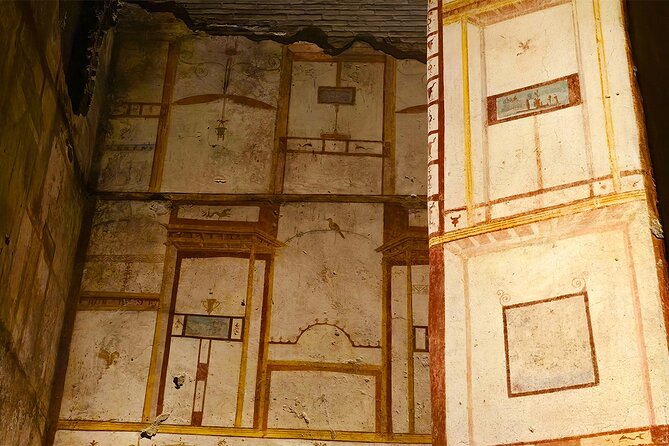
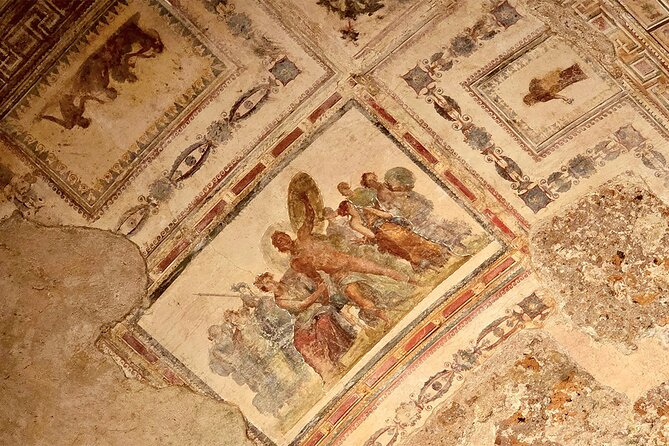
The frescoes are among the most memorable details. They are not displayed as a fully restored sequence, and lighting can be low, but surviving painted decoration gives you a direct link to the palace’s original finish. Look closely rather than expecting one giant showpiece room.
The West Wing adds interest because newly reopened areas can change what you see at the site. Archaeological places are not fixed museum displays. Access can shift as conservation work continues, so the West Wing is a useful reason to check the current tour details when booking.
What the virtual reality segment adds
The virtual reality portion is the tour’s strongest tool for making sense of the Domus Aurea. Ruins show you the bones of the palace. The digital reconstruction supplies the missing surfaces and volume.
You may see the rooms as they might have appeared in Nero’s era, then view changes across later periods as the palace was buried and built over. The contrast helps explain why the site looks so different from its original form.
I would not book this tour for the VR alone. The headset presentation is brief, and one person wished it lasted longer. Another had a fuzzy image, possibly because of eyeglasses. Still, the technology earns its place because it answers the question every visitor eventually asks: what am I looking at?
The order can affect how much you get from it. If you see the ruins first and the reconstruction afterward, the VR may clarify details you have just encountered. If you prefer a visual preview, you might wish the reconstruction came earlier. Either way, it is more useful than a flashy add-on because the palace is so incomplete.
The experience also works well for families. It was not designed specifically as a children’s tour, but the visual element can hold younger attention better than a long talk about imperial politics. Children who enjoy ancient buildings, hidden rooms, or technology may find the palace especially memorable.
A completely different way to spend the day in Rome:
- Vatican: Museums & Sistine Chapel Entrance Ticket
★ 4.5 · 144,003 reviews - Vatican Museums & Sistine Chapel Tour with Optional Basilica
★ 4.3 · 67,413 reviews - Vatican Museums, Sistine Chapel & St Peter’s Basilica Guided Tour
★ 4.5 · 39,149 reviews - Rome: Colosseum, Palatine Hill and Roman Forum Guided Tour
★ 4.8 · 32,814 reviews
One tour, two guiding styles
You should understand the guiding format before paying $84.19 per person. The outside guide provides the lead-in and helps with entry. Once inside, an official Domus Aurea guide may take over because outside guides are not permitted to conduct the entire internal visit.
This arrangement has advantages. The first guide can give you the political background and help you reach the entrance. The official internal guide knows the site’s rules, excavation areas, and conservation concerns. Several people found the opening talk especially clear and engaging.
It also creates a possible mismatch. Your outside guide may be lively and conversational, while the internal guide may sound more scripted. Accents and speaking style can affect how easy it is to follow technical explanations. If you miss a detail, focus on the broad story first: Nero’s building program, the palace’s later burial, and the connection between the ruins and the VR reconstruction.
The group limit is 22 people. That is not private, but it is small enough for a more personal feel than a large public tour. The experience can still feel crowded in narrow rooms or during popular time slots, and you may not stand directly beside the guide at every moment.
A cool, unusual break from Rome’s heat
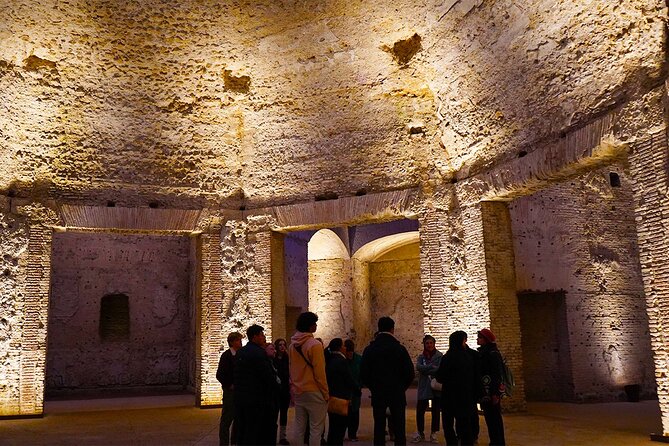
The underground temperature is one of the tour’s practical pleasures. On a very hot day, the Domus Aurea can feel close to 65 degrees Fahrenheit while the streets are around 90 degrees. That makes the visit physically refreshing as well as historically interesting.
Do not assume you will want summer clothing throughout. Several people found the rooms cold compared with outside, so bring a light sweater, scarf, or thin jacket. You will also be walking through a large archaeological complex, making comfortable shoes a smart choice.
The supplied information does not describe special food stops, so plan to eat and drink before or after the activity. Snacks and drinks are not included. The tour ends back at the meeting point, and the starting location is near public transportation.
The total duration is about two hours. That is long enough for an introduction, the site visit, and the VR presentation without taking over your entire day. If you are building a full ancient-Rome itinerary, you can still leave room for another major sight afterward, though you should allow extra time if your group enters slowly.
Is $84.19 a fair price?
At $84.19, this is not a cheap way to see Roman ruins. You are paying for direct-entry access, a licensed English-speaking guide, a small-group format, and the VR presentation. The strongest value comes when official Domus Aurea tickets are difficult to obtain and you want someone else to handle the entry process.
The price is harder to justify if you expect two uninterrupted hours with one private guide. That is not the format. The outdoor introduction may be relatively short, and the internal tour may be led by a separate official guide. The VR segment is also brief.
I think the price makes sense for three types of visitors. First, you want guaranteed access to a site with limited capacity. Second, you care about Roman history and would rather have context than wander through ruins alone. Third, you find visual reconstruction helpful when ancient buildings survive only in fragments.
If you mainly want a long guided lecture, the cost may disappoint. If you already know Nero’s story and are comfortable reading archaeological remains on your own, a less expensive entry option might offer better value when available. The advantage here is convenience and interpretation, not simply admission.
Who should book this Domus Aurea visit?
I would recommend it to anyone fascinated by Nero, imperial Rome, archaeology, or the way later buildings can hide earlier ones. The palace feels unusual even by Roman standards, and the combination of ruins and VR gives you two ways to understand it.
Families can enjoy it, especially if children respond to visual technology. Couples and solo visitors who want a focused historical stop should also find the two-hour length manageable.
You should think twice if you dislike underground spaces, cool rooms, or guided visits with a set pace. The site is not a broad open-air stroll, and the explanations may be difficult to follow if the internal guide’s accent or delivery does not suit you. The meeting point also deserves extra attention because it is on the street rather than simply at the site entrance.
The tour is available as a mobile ticket, and confirmation arrives at booking. Free cancellation is available until 24 hours before the start time. Cancellations or changes inside that window are not accepted for a refund.
My take: book it for the palace, not just the headset
I would book this tour if the Domus Aurea is high on your Rome list and regular entry is hard to secure. The palace itself is the reason to go: its buried rooms, surviving frescoes, political backstory, and connection to the Colosseum offer a side of ancient Rome that you will not get from the city’s better-known monuments.
The VR is a useful bonus, not the whole event. Go prepared for a short outdoor introduction, a possible handoff to an official internal guide, a cool underground temperature, and plenty of walking. With those expectations, the experience offers a practical way to see one of Rome’s most unusual archaeological sites.
FAQ
How long does the Domus Aurea tour last?
The experience lasts approximately two hours, including the historical introduction, the palace visit, and the virtual reality presentation.
What does the tour price include?
The $84.19 price includes Domus Aurea direct-entry skip-the-line tickets, a licensed English-speaking guide with history or archaeology expertise, and the small-group experience.
Does the tour include the West Wing?
Yes. The experience is described as including both the East Wing and the recently reopened West Wing, subject to the site’s access arrangements.
Is the virtual reality experience included?
Yes. Virtual reality is part of the tour and shows a reconstruction of how the Domus Aurea may have looked during Nero’s era and across later periods.
Where does the tour meet?
The meeting point is on Viale della Domus Aurea, 00184 Rome. The street meeting point is not necessarily the archaeological site entrance, so follow the location in your booking confirmation.
How many people can join the group?
The activity has a maximum group size of 22 people.
Are food and drinks included?
No. Snacks, food, and drinks are not included in the tour price.
Can I cancel for a full refund?
Yes. You can cancel at least 24 hours before the experience start time for a full refund. Cancellations or changes made less than 24 hours before the start time are not accepted for a refund.
Newest reviews from Rome
- ROME:Colosseum & Ancient Rome – private/small group TOUR★ 5.0 · 24 reviews
- Off the Beaten Track in Rome: Rione VI Parione Private Tour★ 5.0 · 24 reviews
- Cinematic Photoshoot in Rome★ 5.0 · 24 reviews
- Rome: Best of Colosseum and Roman Forum Small Group Guided Tour★ 4.5 · 24 reviews
- The Labyrinth of Rome between catacombs and ancient quarries★ 4.5 · 24 reviews
- Vatican and Trionfale Market Tour with Wine and Food Tasting★ 5.0 · 24 reviews
- private tour: Vatican Museums, Sistine Chapel, St. Peter’s Basilica★ 4.5 · 24 reviews
- 3 Hours Mosaic Workshop in Trastevere★ 5.0 · 24 reviews
Domus Aurea Tours, compared.
Trevi Fountain District and Underground Domus Guided Tour
Read our review →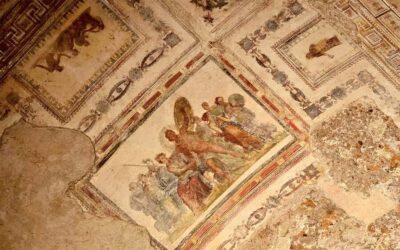
Domus Aurea Guided Tour: The Golden House of Nero
Read our review →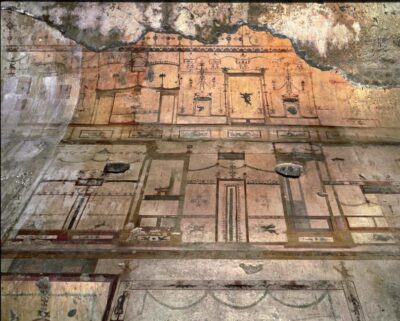
Domus Aurea Guided Tour and Virtual Reality Experience
Read our review →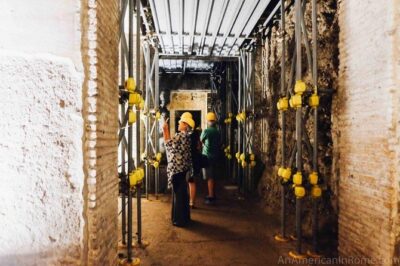
Browse the lists this tour appears in